The final presentation and silhouette of any tailored garment depend critically on the precision of its bottom and sleeve hems. A crooked, puckered, or wavy hemline on a dress, tailored trouser leg, or jacket sleeve instantly undermines even the finest fabric. Achieving a crisp, flat, and wave-free hem requires selecting the correct technical method suited to fabric weight and garment geometry. At vykroyka.com.ua, we examine professional hemming methods for dresses, skirts, pants, and sleeves.
1. Double-Fold Turned Hem: Classic Solution for Lightweight Fabrics
This technique is the industry benchmark for blouses, casual dresses, and lightweight cotton, linen, silk, and viscose garments. It encases raw cut edges completely within the fold, safeguarding against fraying during washing and active wear.
Step-by-Step Procedure:
- First Press: Turn the raw hem edge toward the wrong side by 7–10 mm and press firmly with an iron;
- Second Fold: Fold the hem once more toward the wrong side by the desired finished depth (typically 1.2–1.5 cm), concealing the raw edge completely;
- Pinning: Secure the fold with tailor pins positioned perpendicularly or baste with contrast thread.
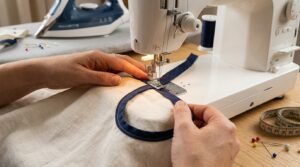
Precision Stitches: Edgestitch along the inner fold line exactly 1–1.5 mm from the edge. To prevent drag or twisting on lightweight textiles, reduce presser foot pressure or employ a rolled-hem presser foot.
2. Blind Hemming: Invisible Finishes for Tailored Suiting and Coats
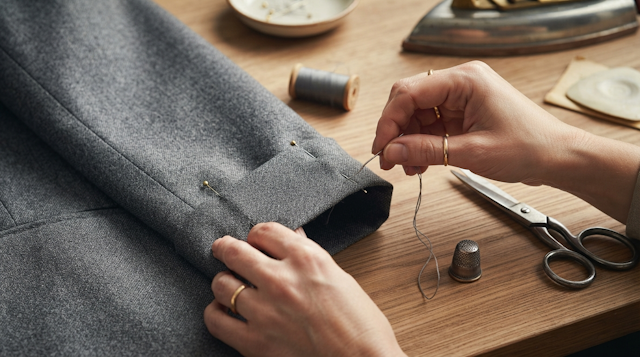
When an invisible exterior hemline is mandated—such as on tailored trousers, pencil skirts, blazers, and wool overcoats—tailors utilize blind stitch mechanics, executed by machine or by hand.
A. Machine Blind Hemming
Modern sewing machines offer a dedicated blind hem stitch pattern (a sequence of straight stitches punctuated by a periodic lateral zig-zag). The overlocked or bound hem allowance is folded back against the right side of the garment, allowing the needle to catch a single warp thread on its lateral strike. When pressed open, the exterior exhibits barely perceptible stitch anchors.
B. Hand Catch Stitching («Herringbone» Stitch)
The gold standard for bespoke tailoring and Haute Couture. The hem allowance is secured with loose cross-stitches that preserve fabric elasticity, allowing the garment hem to drape naturally without puckering.
3. Curved and Bias Hems: Mastering Circle and Flared Skirts
Attempting a standard wide hem on flared garments, circular skirts, or bias dresses results in unsightly bunching, because the cut edge circumference is significantly greater than the inner turn line.
Narrow Rolled Hem (Baby Hem / Parisian Stitch):
- Press the raw edge inward by only 3–4 mm;
- Stitch along the edge 1 mm from the fold;
- Trim the excess seam allowance flush to the stitching using sharp embroidery shears;
- Fold the hem once more by 2–3 mm and topstitch directly over the initial seam line for an ultra-fine, fluid finish.
When working with wool suiting and coat fabrics, steam-press the hem allowance into curved shape (shrink easing) prior to blind stitching. Moisture and heat compress the excess width along the upper edge of the allowance, preventing ripples from telegraphing through to the garment face.
Mastering precision hemming guarantees impeccably finished silhouettes and elevates every handcrafted piece to boutique standards. Discover comprehensive pattern drafting courses, technical masterclasses, and PDF patterns at vykroyka.com.ua.
Sew Tailored Garments with Professional Finishes!
Browse the Vykroyka digital pattern library featuring precision allowances for skirts, coats, trousers, and dresses.
EXPLORE PATTERNS →