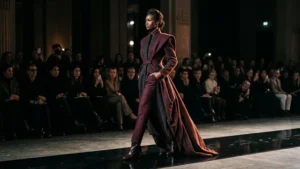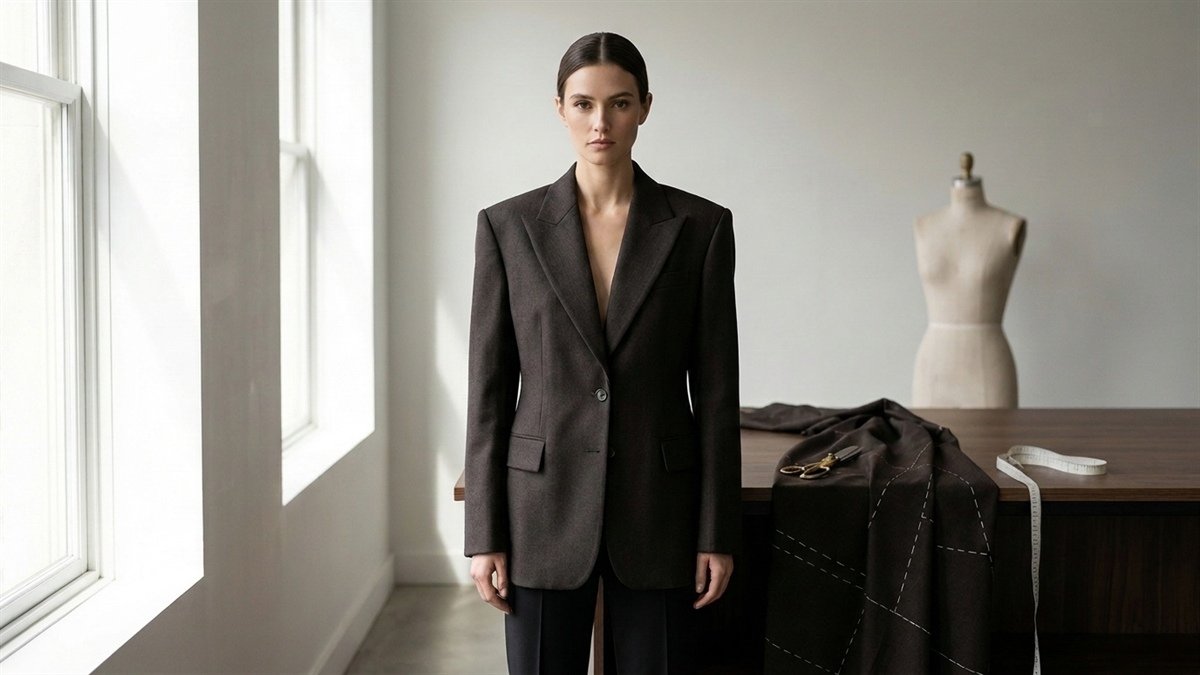
The Power Tailoring aesthetic of the 2026/2027 season has decisively evolved beyond casual oversized garments into rigorous sartorial engineering: adapting a masculine straight-cut blazer for the female form demands exquisite shoulder balance, shifting the shoulder seam forward by 1.5 cm, and integrating an authentic multi-layered canvas chest piece. In our pattern-making atelier, we conducted extensive fitting trials on standard sizes 42 to 52 using Cool Wool worsted wool weighing 290 to 340 gsm. In this comprehensive technical guide, we reveal the exact ease allowances (+16 cm on chest, +24 cm on waist), two-piece sleeve construction with an armhole deepened by 3.0 cm, iron-molding techniques to shape the bust contour without exterior darts, and crisp seam setting with a tailor's oak clapper.
- 1. The 2027 Power Tailoring Evolution: From Bulk to Precise Ergonomics
- 2. Architectural Shoulder Anatomy: Seam Offset, Extended Span, and Composite Padding
- 3. The Chest Canvas Interfacing Package: Traditional Horsehair vs. Fusing
- 4. Two-Piece Sleeve and Vent Engineering: Crown Height and Dynamic Balance
- 5. Material Selection and Cutting Layout: Cool Wool, Crepe, and Yardage Calculations
- 6. Pressing Protocol (VTO) and Oak Tailor's Clapper Stabilization
- 7. Styling Rules 2027: Harmonic Proportions and Silhouette Formulas
When a pattern maker adapts masculine tailoring for women, the primary pitfall is amorphous sagging and a compromised center of gravity. Merely putting a men's size 52 jacket onto a woman of size 44 causes the front hem edges to splay apart, the upper back to buckle horizontally below the shoulder blades, and the sleeve to torque backward with diagonal stress folds. True architectural Power Tailoring 2027 requires an engineered female foundation block featuring broadened shoulder geometry, an adapted bust dart rotated into the side seam or armhole, and the crisp planar discipline of traditional bespoke tailoring. Below is our design bureau's definitive blueprint for patterning, cutting, and assembling the ultimate oversized power blazer.
1. The 2027 Power Tailoring Evolution: From Bulk to Precise Ergonomics
In the 2026/2027 collections, power tailoring moves away from shapeless exaggeration toward disciplined linear architecture. Haute couture runways in Milan and Paris celebrate clean, articulate silhouettes: sharp horizontal shoulders, pristine straight front edges without waist indentation, and strict plumb-line alignment along the front opening.
When engineering our studio master patterns, we apply the following baseline ease allowances to half-girth measurements (for sizes 42 to 52):
- Chest Ease Allowance: +14.0 to +18.0 cm (total full-girth ease of 28 to 36 cm), providing comfortable layering over fine cashmere knits or silk shirts without tightness;
- Waist Ease Allowance: +22.0 to +26.0 cm (total ease of 44 to 52 cm), eliminating body contours and establishing a fluid architectural column silhouette;
- Hip Ease Allowance: +12.0 to +16.0 cm, preserving vertical side seams that resist twisting during movement;
- Armhole Drop: lowered by 2.5 to 3.5 cm from the standard basic block, paired with a 1.5 to 2.0 cm widening of the armhole base to ensure uninhibited arm mobility.
2. Architectural Shoulder Anatomy: Seam Offset, Extended Span, and Composite Padding
The shoulder girdle is the structural framework of any power tailored jacket. To ensure broadened shoulders appear authoritative rather than oversized by mistake, we implement three key bespoke techniques:
Forward Shoulder Seam Offset of 1.2 to 1.5 cm: Originating in classic Savile Row tailoring, this offset aligns the join with the natural forward slant of the clavicle. This prevents the heavy back canvas from pulling the collar backward away from the neck.
Extended Shoulder Span: Both front and back shoulder lines are lengthened by 3.0 to 4.5 cm past the natural acromion joint. A 0.8 to 1.2 cm ease allowance is built into the back shoulder seam and shrunk out with an iron before seaming to mold smoothly over the deltoid muscle.
Three-Tiered Composite Shoulder Pad: Low-density foam is strictly avoided. We construct bespoke 18 to 22 mm shoulder pads from three layers: structural polyester batting, stiff horsehair canvas, and soft needle-punched cotton wadding. A 4.0 cm wide bias-cut sleeve head roll is inserted along the cap line to prevent dimpling.
3. The Chest Canvas Interfacing Package: Traditional Horsehair vs. Fusing
True longevity and sculptural presence depend on the invisible interior chest canvas. Mass production commonly floods panels with heavy fusible glue, creating a rigid board that bubbles after damp weather. Our studio advocates a refined Half-Canvas methodology:
- Lightweight Base Interfacing: The entire wool front is stabilized with a bi-elastic knitted interfacing (45 to 55 gsm) cut on the true bias to preserve drape and tactile softness.
- Horsehair Chest Piece (Plastron): A tailored chest piece cut from natural linen canvas reinforced with unbleached horsehair (180 to 220 gsm) covers the upper chest and armhole. Strategic cuts and spliced darts mold a three-dimensional bust volume without cutting the external fashion fabric.
- Pad-Stitched Lapel Roll: The lapel is pad-stitched to the chest canvas with subtle hand tension, establishing a permanent spring roll that never presses flat.
4. Two-Piece Sleeve and Vent Engineering: Crown Height and Dynamic Balance
Setting sleeves into an oversized silhouette tests a tailor's highest precision. When deepening the armscye by 3.0 cm, simply raising sleeve cap height causes the sleeve to bind and pull the entire garment upward when reaching forward.
We construct a classic two-piece sleeve featuring a moderate cap height of 14.0 to 15.5 cm and expanded bicep girth (+5.0 to 7.0 cm ease). Sleeve cap ease is calculated at 0.08 to 0.10 cm per centimeter of armhole perimeter (3.5 to 4.5 cm total ease). Ease distribution is deliberate: 60 percent is shrunk into the upper crown curve on a tailor's ham, 30 percent across the front bias curve, and 10 percent along the elbow seam.
The sleeve cuff is completed with an authentic 14 cm working vent featuring four overlapping horn buttons and hand-worked buttonholes.
5. Material Selection and Cutting Layout: Cool Wool, Crepe, and Yardage Calculations
Oversized tailoring demands textiles with natural resilience capable of hanging in plumb planes without limp creasing. Premier recommendations include:
- Cool Wool Worsted Wool (Super 120s to 140s): 280 to 340 gsm, exceptional yarn twist, moisture recovery, and durability;
- Wool Gabardine or Steep Twill: for graphic seam definition, sharp lapel edges, and clean pocket welts;
- Bemberg Cupro Lining: 85 to 100 gsm breathable cupro for frictionless glide over interior knitwear layers.
Exact Yardage Requirements: For sizes 42 to 46 with 145 to 150 cm fabric width, purchase 2.20 to 2.35 meters. For sizes 48 to 52, increased hem and chest circumferences require 2.45 to 2.65 meters. Lining requirement is 1.80 to 2.10 meters; chest canvas requirement is 0.90 meters.
6. Pressing Protocol (VTO) and Oak Tailor's Clapper Stabilization
Without disciplined pressing, a bespoke-cut jacket remains an unrefined shell. Every joining seam requires synchronized thermal and moisture shaping:
Armhole Edge Shrinking: Before joining, front armholes and back necklines are shrunk over a tailored press pad using pressurized steam at 160 to 180 degrees Celsius. A 10 mm reinforced stay-tape is applied under slight tension along the front armhole curve to shorten the seam by 1.0 to 1.5 cm and permanently eliminate gaping.
Seam Busting and Clapper Setting: Longitudinal seams are pressed open on a seam stick. Immediately after releasing the iron, press the seam firmly with a polished dense oak or beech tailor's clapper for 8 to 12 seconds. The wood absorbs moisture and heat instantly, locking wool fibers flat without surface shine.
When assembling the shoulder line, never stitch the seam without first shrinking the back shoulder ease. Run two parallel basting threads along the back shoulder edge (2 mm and 7 mm from the raw edge) with a 4 mm stitch length. Draw the threads to ease in 1.0 cm of excess length, then press through a damp pressing cloth until all fullness disappears and the seam lies flat against an oak block. Only then join front to back to guarantee an impeccable anatomical seat.
7. Styling Rules 2027: Harmonic Proportions and Silhouette Formulas
Mastering power tailoring styling hinges on controlling vertical lines. To maintain an elongated frame, our design studio highlights two essential pairings:
Formula 1: Proportional Tension (Oversized Blazer + Column Maxi Skirt). An extended straight blazer hitting mid-thigh (76 to 82 cm back length) harmonizes with a minimalist column maxi skirt. Broadened shoulders balance the slender vertical lower half to create an elegant architectural poise.
Formula 2: Monochromatic Grandeur (Double-Breasted Blazer + Pleated Palazzo Trousers). Deep-pleated wide trousers in matching wool extend the vertical silhouette from lapel to floor. Complete the ensemble with structured square-toe leather boots or pointed loafers.
Craft Your Iconic Power Tailoring Blazer with Studio-Grade Patterns
Explore Andrey Ardatiev's digital PDF patterns for masculine oversized blazers in sizes 40 through 54. Every file includes calibrated ease allowances, tailored canvas interfacing diagrams, and step-by-step master construction guides.
Explore Blazer Patterns
Apparel Industry Hub in Telegram
Community of garment manufacturers, tailors and designers. Daily fresh workshop vacancies, verified factories database and direct contacts.