When a pattern maker develops an impeccably fitted foundation block for a children's dress, hoodie, or trouser at a baseline height (such as 92 cm), a critical manufacturing imperative arises: how can this master pattern be expanded across a complete commercial size range up to 140 cm without redrafting every size from scratch? Simply enlarging the paper draft via a photocopier or uniform CAD vector scaling causes severe fitting failures: children grow non-linearly (limbs lengthen rapidly while torso girth and cervical proportions evolve along distinct trajectories). At vykroyka.com.ua, we examine the structural rules of childrenswear pattern grading by height and girth increments.
1. Anthropometric Laws of Children's Growth Increments
Unlike adult pattern grading where girth increments are linear and stable, childrenswear grading is structured along stature intervals and developmental sizing cohorts:
- Standardized Height Intervals: The universal sizing increment in childrenswear is 6 cm (standard progression: 80–86–92–98–104–110–116–122–128–134–140 cm). Older school-age grading may utilize 6–8 cm intervals;
- Disproportionate Limb Growth: Children's arms and legs lengthen far faster than their spinal column. For a 6 cm height jump, inseam and sleeve lengths advance by 3.0–3.5 cm, whereas center back bodice length increases by only 1.0–1.2 cm;
- Girth Evolution: A 6 cm height jump produces only a 1.5–2.0 cm increase in chest circumference, demanding controlled horizontal expansion.
2. The Slice-and-Spread Method for Manual Grading
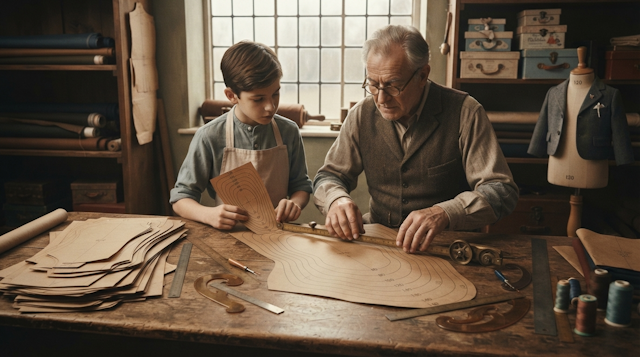
Pattern makers utilize the engineering slice-and-spread protocol to scale manual cardstock patterns with mathematical precision:
A. Vertical Stature Grading
Slice the front and back bodice patterns horizontally across three primary load lines: armscye level, waistline, and hip line. Spread the severed segments apart vertically by predetermined intervals (e.g., +0.5 cm to upper shoulder slope, +1.0 cm to torso length, and +2.5–3.0 cm to skirt or trouser drop).
B. Horizontal Girth Grading
Make vertical incisions parallel to the center line from mid-shoulder through the bust point downward. Shift the pattern sections horizontally by 1/4 of the total size chest or hip increment (approximately 4–5 mm per quarter-pattern piece).
3. Grading Dynamics for Sleeves and Trousers
Curvilinear sleeve caps and crotch curves require precise coordinate shifts:
- Sleeve Grading: Expand the sleeve cap vertically by 3–5 mm to match the bodice armhole drop, while extending sleeve length by 3 cm per size. Widen the bicep width laterally by 4–6 mm;
- Trouser and Jogger Grading: Shift the crotch point downward by 1 cm and lengthen the inseam by 3 cm per height size. Waist circumference is adjusted via elastic casing, while hip volume expands per standardized anthropometric growth tables.
Following slice-and-spread expansion, always verify contour blending! Align adjacent side and shoulder seams to inspect armscye curvature and cap continuity. Re-blend stepped cut joints with a curved styling ruler to ensure continuous, organic curves.
Mastering pattern grading enables designers to generate commercial size sets rapidly while preserving immaculate balance. Explore digital PDF patterns and grading masterclasses at vykroyka.com.ua.
Sew Childrenswear with Multi-Size Graded Patterns!
Browse the Vykroyka digital pattern library featuring fully nested multi-size childrenswear patterns from height 80 to 140.
SCHNITTMUSTER ANSEHEN →
Nähportal Vykroyka auf Telegram
Community von Bekleidungsherstellern, Schneidern und Designern. Tägliche Werkstatt-Jobs, verifizierte Fabriken und direkte Kontakte ohne Zwischenhändler.