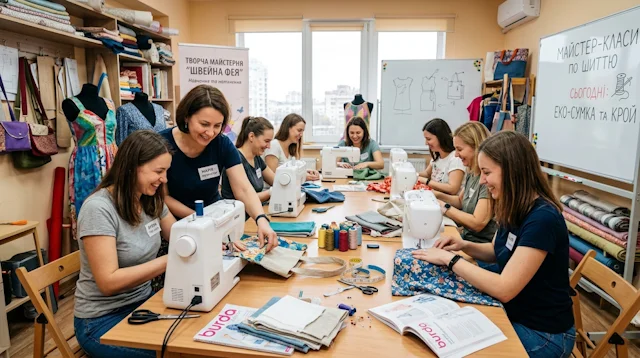
Launching your own sewing workshop or clothing brand is a promising and highly profitable business that requires a clear understanding of production processes, calculating the economics of a product unit and organizing the technological flow. In this comprehensive guide, Vykroyka.com.ua experts analyze a step-by-step plan for opening a sewing enterprise: from choosing premises and basic equipment to working with proven patterns and quality control.
Contents of the article
- Step 1. Analysis of the niche, target audience and assortment matrix
- Step 2. Selection of premises and organization of work areas (cutting, sewing, WTO)
- Step 3. Basic park of industrial sewing equipment
- Step 4. Patterns, gradation of sizes and development of a reference sample
- Step 5. Calculation of costs, production standards and defect control
- Advice from a business consultant: how to minimize risks at the start
- Frequently asked questions (FAQ)
Step 1. Analysis of the niche, target audience and assortment matrix
A successful start begins with a narrow specialization. Do not try to sew evening dresses, outerwear and knitwear at the same time. Focus on 1-2 clear product groups (for example, quality basic knitwear or oversized jackets).
Step 2. Selection of premises and organization of work areas
The sewing workshop premises must have good natural and artificial lighting (from 500 lux), supply and exhaust ventilation and electrical power of 15–20 kW with 380V wiring.
Step 3. Basic fleet of industrial sewing equipment
- Straight-stitch lockstitch machines with direct servo drive and automatic thread trimming (2–4 pcs.).
- 4-thread industrial overlockers for knitwear (1–2 pcs.).
- Flat-stitch machine (coverer) for hemming the bottom (1 pc.).
- Professional console ironing table with vacuum suction and steam generator (1–2 pcs.).
- Cutting table (3–5 meters long) and disk/band cutting knife.
Step 4. Patterns, gradation of sizes and development of a reference sample
The foundation of the sewing business is impeccable patterns. Errors in sizing or incorrect fit will result in batches being returned. Always make and test a pilot sample before launching it into production.
Step 5. Calculation of cost, production standards and defect control
The cost of the product consists of the cost of raw materials (fabric, accessories, threads), piecework wages for the seamstress, depreciation of equipment, rental and logistics. The production rate should be calculated based on the timing of operations.
Advice for an entrepreneur
Save time and resources at the development stage: use professionally tested ready-made patterns from the Vykroyka.com.ua database, which are already adapted to the requirements of industrial tailoring.
Frequently asked questions (FAQ)
What is the minimum budget needed to open a mini-workshop with 3 jobs?
To purchase a basic set of used or new industrial equipment, tables and the first supply of consumables, you need from $4,000–$6,000.
What is more profitable: sewing under your own brand or taking orders on a toll-to-buy basis (B2B)?
At the start, B2B toll orders allow you to quickly load capacity and recoup the rental, while simultaneously developing your brand line.
Expertly designed patterns are the key to a perfect fit of any product. To be the first to learn about the intricacies of design, modeling and trends in the sewing world, subscribe to our video channel Pattern - Ready-made patterns.

Apparel Industry Hub in Telegram
Community of garment manufacturers, tailors and designers. Daily fresh workshop vacancies, verified factories database and direct contacts.