Every experienced tailor and pattern maker follows an unbending golden rule: never cut into fabric immediately after purchasing it. Before tracing patterns, the fabric must undergo thorough decatizing (pre-shrinking).
What exactly is decatizing, why does neglecting this step risk ruining your tailored garments, and how do you properly prepare different types of fabrics? Let''s explore the essential science of fabric pre-treatment.
What is Fabric Decatizing and Why Is It Mandatory?
Decatizing (pre-shrinking) is the preliminary heat-and-moisture treatment (pressing, steaming, or laundering) applied to a fabric length prior to cutting. Its purpose is to force maximum fabric shrinkage and release internal fiber tension built up during mechanical weaving and bolt rolling.
Virtually all natural fibers (cotton, linen, wool, silk), semi-synthetics (viscose, rayon, modal, Tencel), and blends experience 3% to 15% shrinkage upon their initial contact with water or high-temperature steam.
The risk of skipping decatizing: After the first domestic wash, a tailored dress, shirt, or pair of trousers will permanently shrink by one or two sizes, seams will pucker severely, and linings will bag out or distort the silhouette.
How to Decatize Different Fabric Categories
1. Cotton, Linen, and Plant-Based Blends
- Soaking: Immerse the yardage in warm water (95–104°F / 35–40°C, matching the intended garment washing temperature) for 20–30 minutes without detergent.
- Drying: Gently squeeze out excess water without aggressive twisting to prevent permanent creases. Line-dry smoothly along the straight-of-grain.
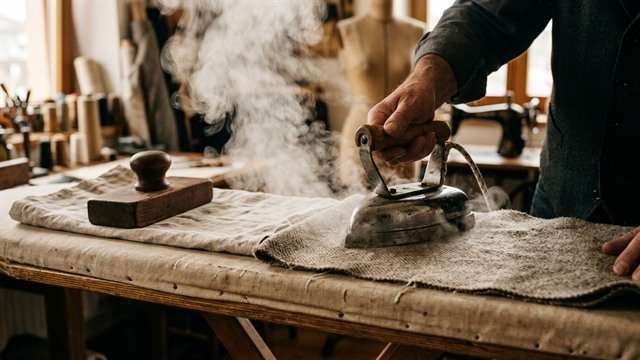
- Pressing: While the fabric is still slightly damp, thoroughly steam press on the wrong side parallel to the selvage.
2. Pure Wool, Tweed, and Tailoring Woolens
- Never submerge wool in water: Soaking can felt fibers and distort delicate surface weaves.
- Heavy steam hovering: Lay the fabric wrong side up on the ironing board. Set your iron to the wool setting with maximum steam burst. Hover the soleplate 1–2 mm above the fabric (or lightly press over a cotton pressing cloth), allowing penetrating steam to shrink the wool fibers without creating shine marks.
- Damp sheet method: For heavy coating wools, wrap the yardage inside a damp bedsheet for 4–6 hours, then press flat over a dry cloth.
3. Viscose, Rayon, and Modal
- Viscose exhibits significant shrinkage (up to 12%) and weakens when wet.
- Dip in lukewarm water for 15 minutes, gently roll inside a terry towel to absorb moisture without wringing.
- Dry flat and press while damp on the Silk/Rayon iron setting from the wrong side.
4. Synthetics (Polyester, Nylon, Spandex)
Synthetic polymers do not absorb water and experience virtually zero shrinkage from laundering. However, they benefit from light low-heat steam pressing over a cloth to remove stubborn roll creases and packaging folds.
3 Rules for Impeccable Fabric Preparation
- Pre-shrink everything: Decatize linings, fusible interfacings, zipper tapes, and decorative trims before cutting.
- Press along the grainline: Always move the iron parallel to the selvage (warp grain) to avoid stretching the fabric on the bias or weft.
- Let the fabric cool: Allow the pressed fabric to rest completely on the cutting table for 20–30 minutes to set its stabilized fiber memory.