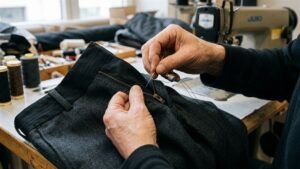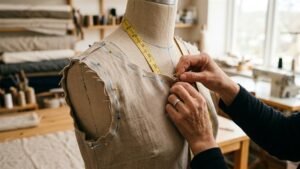
Master tailors abide by an enduring golden maxim: "Sewing is 30% needlework and 70% ironwork." One can draft a mathematically pristine pattern, execute razor-straight seams, and employ exquisite luxury threads; yet, if the garment bypasses disciplined pressing and iron shaping (VTO), it will inevitably exude a homemade appearance. The pressing iron sculpts garment architecture, compresses seams, establishes poise, and embeds anatomical contours where flat cloth cannot. At vykroyka.com.ua, we examine the atelier pressing protocols that elevate sewing projects to couture standards.
- 1. The Crucial Difference: Domestic Ironing vs. Tailor's Pressing (VTO)
- 2. The Three Pillars of Seam Engineering: Pressing Flat, Open, and Shrinking
- 3. Essential Atelier Pressing Equipment: Hams, Clappers, and Press Cloths
- 4. Temperature Control and Demanding Textiles
- Tailor's Advice: Preventing Seam Impressions with Paper Strips
1. The Crucial Difference: Domestic Ironing vs. Tailor's Pressing (VTO)
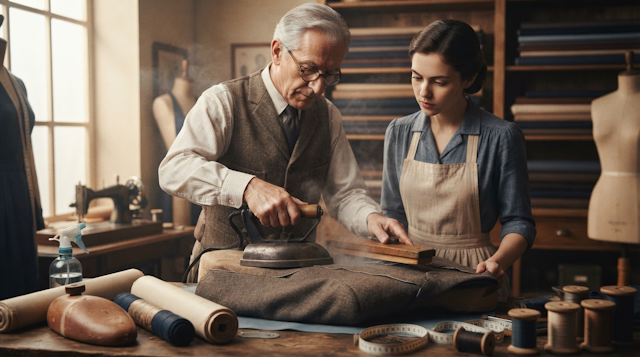
Novice sewists typically reach for the iron only upon completion—merely smoothing out creases before wearing. Professionals execute pressing sequentially after each single seam assembly.
The Atelier Law: Once a construction unit is stitched (such as a bust dart, shoulder seam, or yoke), press it immediately while the seam area remains fully accessible. Crossing an unpressed seam with subsequent construction is strictly forbidden; embedded seam ridges and bulk cannot be corrected later.
2. The Three Pillars of Seam Engineering: Pressing Flat, Open, and Shrinking
Depending on seam curvature and fiber characteristics, specific manipulation techniques are deployed:
Pressing Flat (Setting the Stitch)
Before splitting seam allowances, press the newly sewn seam flat exactly as it emerged from the feed dogs. This settles the thread into the weave matrix, neutralizes tension distortion, and prepares the fibers for directional pressing.
Pressing Open or Toward Direction
Seam allowances are butterflied open and set with steam (for tailored jacket sides, coat shoulders, and trouser outseams) or pressed to one side (for shirts and delicate blouses), ensuring knife-flat seamlines that do not telegraph through to the face.
Easing and Shrinking (3D Sculpting)
Modifying fabric dimensions through steam and iron manipulation. For instance, shrinking out ease fullness around a sleeve cap or shrinking convex dart points, while stretching trouser inseams to contour seamlessly against dynamic body anatomy.
3. Essential Atelier Pressing Equipment: Hams, Clappers, and Press Cloths
A standard flat ironing board is inadequate for molding three-dimensional garments. Essential atelier equipment includes:
- Tailor's Ham and Seam Roll: Curved molds designed to press darts, sleeve crowns, and bust cups without flattening the three-dimensional curve of the human body;
- Hardwood Tailor's Clapper: The definitive secret to razor-sharp, bulk-free tailored seams. Immediately after applying pressurized steam, clamp the seam with a dense hardwood clapper for 3–5 seconds. The wood absorbs moisture and heat instantly, freezing the seam flat without scorching or inducing fabric shine;
- Press Cloth: A piece of fine untreated cotton muslin or organza placed between the iron soleplate and the fashion fabric, shielding delicate fibers from unsightly iron shine and friction marks.
4. Temperature Control and Demanding Textiles
Never rely blindly on standard dial markings. Always test heat and steam tolerance on a spare fabric scrap first:
- Natural Wool and Linen: Thrive under robust steam, high heat, and immediate cooling with a tailor's clapper;
- Synthetics (Polyester, Nylon, Faux Leather): Melt instantaneously under excessive heat—handle with low-temperature dry heat using a protective press cloth;
- Napped Textiles (Velvet, Corduroy): Never press with direct soleplate weight on the face. Steam exclusively from the reverse side or press face-down on a needle board (velvet board) to preserve the pile.
To prevent seam allowances from creating unsightly embossed ridges on the face of delicate fabrics (such as satin, silk, or fine wool), slide strips of smooth card stock or heavy paper beneath the seam allowances prior to pressing. The iron glides along the seam while the paper cushions the garment face from seam impressions!
Disciplined pressing transforms ordinary assembly into bespoke sartorial art. Explore comprehensive sewing masterclasses, patternmaking tutorials, and precision patterns on the homepage of vykroyka.com.ua.
Sew Like a Master with Precision Patterns!
The Vykroyka pattern collection features professional digital patterns with step-by-step pressing instructions for every garment.
VIEW PATTERNS →