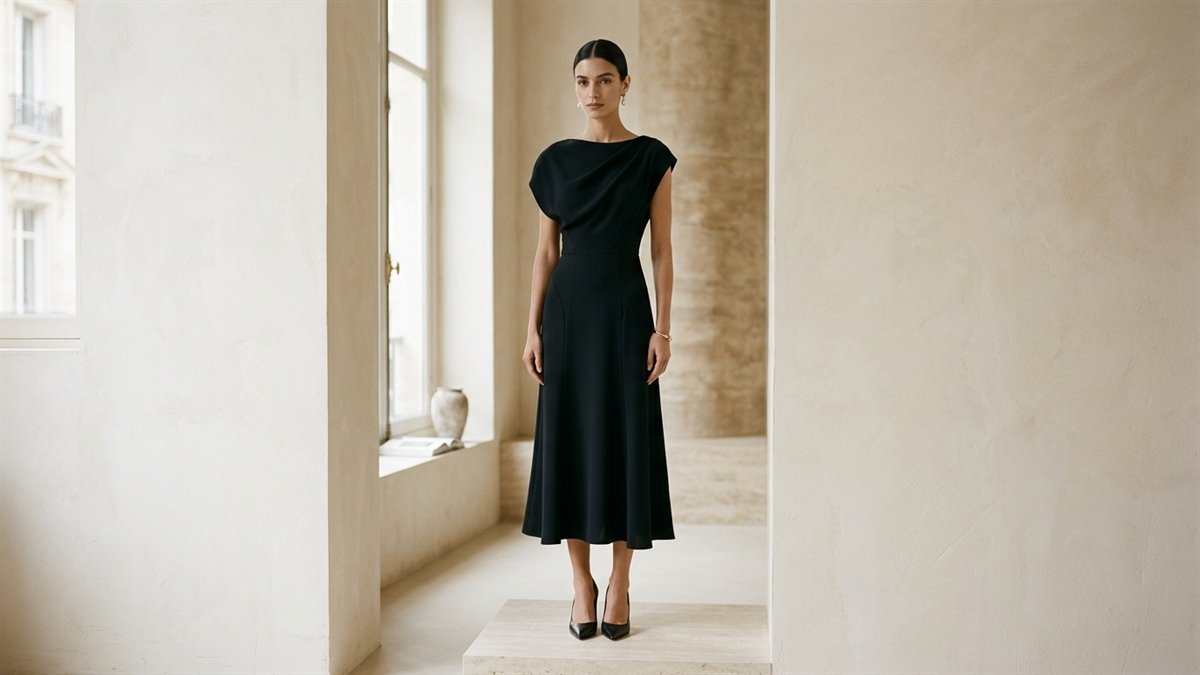
Across the history of global fashion, only a handful of garments have fundamentally altered civilization's aesthetic codes, and standing unchallenged at the summit of this pantheon is the Little Black Dress (La Petite Robe Noire). Exactly one century ago, in October 1926, when American Vogue published a minimalist sketch of a straight crêpe de Chine dress, conservative Paris recoiled in astonishment. Prior to that historic moment, black was strictly consigned to widows in deep mourning, orphans, and domestic service. Gabrielle Chanel executed an unprecedented aesthetic coup: she severed black from bereavement, transforming it into an absolute manifesto of female independence, erotic restraint, and democratic luxury. A century has passed, dozens of styling eras have risen and vanished, yet the Little Black Dress remains the supreme anchor of the female wardrobe. In this centennial cultural essay, Andrey Ardatiev Studio traces the hundred-year journey of this masterpiece—from Parisian salons of the 1920s to modern runways of 2027—and delivers an authoritative guide to curating the timeless dress.
- 1. 1926: The Genesis of an Icon on the Pages of American Vogue
- 2. Mourning vs. Seduction: Why High Society Was Shaken by Chanel's Audacity
- 3. The Grand Evolution: From Audrey Hepburn in Givenchy to Diana's Revenge Dress
- 4. The 2027 Little Black Dress: Architectural Cuts, Sculptural Necklines, and Fluid Silk
- 5. 5 Cardinal Rules for Choosing the Ultimate LBD for Your Figure
- 6. The 60-Second Transformation: From Professional Executive to Evening Black-Tie
- 7. The Alchemy of Black Textiles: Wool Crepe, Silk Satin, and Velvet
- 8. Jewelry and Accessories: Preventing Black from Reading Funereal
- 9. Why the Little Black Dress Will Never Fade
When celebrated couturier Paul Poiret, master of lavish oriental turbans and hobble corsets, encountered Chanel on the street in her black frock, he sneered: «For whom are you in mourning, Mademoiselle?». To which Coco instantly retorted: «For you, Monsieur». She accurately foresaw the demise of suffocating, bourgeois theatricality. American Vogue prophetically christened Chanel's design «The Ford of fashion»—a direct reference to Henry Ford's Model T, universal, reliable, and produced strictly in black. Chanel's dress democratized elegance: an heiress and a stenographer could now look equally magnificent. Below is the chronicle of this transformation and the modern rules of engagement.
1. 1926: The Genesis of an Icon on the Pages of American Vogue
Chanel's original 1926 creation stood in stark contrast to contemporary ultra-short variations. It was an exercise in monastic geometry: a straight, semi-fitted shift crafted from heavy silk crêpe de Chine, with a hemline falling below the knee (Coco notoriously considered knees the least graceful anatomical feature), long fitted sleeves, and a modest boat neckline.
It bore zero buttons, no embroidery, and no decorative flounces. Its brilliance resided entirely in sculptural dart architecture and supple drape that moved organically with the body without requiring rigid corsetry. For the first time, women could breathe freely, dance the Charleston, and operate an automobile with effortless dignity.
2. Mourning vs. Seduction: Why High Society Was Shaken by Chanel's Audacity
French high society initially condemned the creation as an affront to propriety. In the 1920s, France was still mourning millions fallen during the Great War, and black remained an emblem of sorrow.
Chanel inverted this cultural optic: she proved that black does not conceal a woman, but acts as a velvet jewel box. By stripping away chromatic clutter and decorative distraction, Chanel highlighted the woman herself—the luminescence of her skin, the line of her throat, the clarity of her gaze, and the poise of her posture.
3. The Grand Evolution: From Audrey Hepburn in Givenchy to Diana's Revenge Dress
Over the past century, the Little Black Dress journeyed through milestone cultural and cinematic moments:
- 1961 — Audrey Hepburn in Breakfast at Tiffany's: Hubert de Givenchy's cutout masterpiece with open scapulae and opera gloves canonized the LBD as the ultimate uniform of Manhattan bohemia;
- 1994 — Princess Diana's Revenge Dress: Christina Stambolian's daring off-the-shoulder silk chiffon dress, worn on the night Prince Charles confessed infidelity on national television, proved black could wield triumphant retributive power;
- 1994 — Elizabeth Hurley in Versace's Safety Pin Dress: Radical side slits linked by golden pins transformed an unknown actress into a global phenomenon in a single evening.
4. The 2027 Little Black Dress: Architectural Cuts, Sculptural Necklines, and Fluid Silk
For the 2026/2027 season, the Little Black Dress experiences an architectural renaissance echoing 1990s purism. Runways at Prada, Saint Laurent, and Khaite abandoned superficial embellishment in favor of razor-sharp proportions.
Three definitive silhouettes dominate the contemporary landscape: the sculpted midi sheath dress featuring armscye princess darts; the minimalist slip dress cut from heavy matte sand-washed silk on micro-straps; and the graphic column dress with a high collar and open low back.
5. 5 Cardinal Rules for Choosing the Ultimate LBD for Your Figure
To ensure your black dress endures for decades rather than seasons, apply optical discipline when selecting your cut:
- Textile Density Dictates Form: The fabric must hold architectural integrity. Opt for dense wool crepe, heavy silk cady, or high-twist double-weave viscose—flimsy jersey exposes undergarments and degrades the silhouette;
- Hemline Proportions: The most universally flattering length falls two fingers below the kneecap or hits mid-calf;
- Shoulder Framing: Tailored set-in shoulders or elegant saddle raglans align posture far more effectively than shapewear;
- Focal Point Balance: Reveal the neckline, the legs, or the back—never all three simultaneously;
- Submerged Hardware: Avoid exposed metal zippers or plastic buttons; closures must be concealed and fluid.
6. The 60-Second Transformation: From Professional Executive to Evening Black-Tie
The singular genius of the black dress is its chameleonic versatility. A single tailored sheath effortlessly transitions across environments in under a minute:
Daytime Executive Presence: Layer the dress beneath an oversized grey wool menswear blazer with calfskin penny loafers and a structured tote. The impression is commanding, intellectual, and composed.
Evening Gala: Remove the blazer, step into pointed kitten-heel slingbacks, clasp a baroque pearl choker or sculptural gold cuffs, and apply classic crimson lipstick. The transformation is instantaneous.
7. The Alchemy of Black Textiles: Wool Crepe, Silk Satin, and Velvet
In monochrome black, textile texture takes primary focus, as the eye is unencumbered by surface print:
- Wool Crepe and Silk Cady: ideal for structured tailoring. Their pebble-grain matte surface absorbs light, visually slimming the silhouette by an entire size;
- Silk Charmeuse and Crepe Satin: fluid sheen drapes sensually over curves for slip dresses;
- Silk-Cotton Velvet: creates nocturnal depth with rich chiaroscuro shadows, turning a minimalist dress into an heirloom work of couture art.
8. Jewelry and Accessories: Preventing Black from Reading Funereal
Black demands intentional light reflection in the portrait zone:
The warm luster of polished yellow gold or luminous natural pearls instantly illuminates the complexion, counteracting the gravity of black. If styling with silver or platinum, ensure a fresh, radiant skin finish with bold lip color so the dark textile does not drain the face.
A master patternmaker secret for black dresses: black fabric optically obscures interior seams, yet ruthlessly exposes any contour defect—such as lower-back bagging, armhole gaping, or an uneven hem. When cutting a wool crepe dress, stay-tape the entire neckline and armscye edges with bias woven stay-tape eased by 2 mm, and secure the back walking vent with a hand-stitched silk lining corner. This guarantees the hemline stays level during movement and the neckline remains glued to the clavicles.
9. Why the Little Black Dress Will Never Fade
The immortality of the LBD lies in its democratic philosophy. It is a blank canvas upon which every woman articulates her singular identity. In a little black dress, one is never overdressed or underdressed: it is equally at home at a state banquet, an art gallery opening, or an intimate dinner.
As Coco Chanel observed: «Look for the woman in the dress. If there is no woman, there is no dress». The Little Black Dress dissolves class barriers and elevates human presence—ensuring it will greet its second bicentennial as radiant and indispensable as ever.
Tailor the Legendary Little Black Dress with Andrey Ardatiev Patterns
Create your own timeless masterpiece: download professional PDF patterns for sculpted sheath dresses, fluid slip dresses, and column gowns designed by Andrey Ardatiev Studio for sizes 40 through 54. Flawless fit and couture poise.
Explore Black Dress Patterns
Apparel Industry Hub in Telegram
Community of garment manufacturers, tailors and designers. Daily fresh workshop vacancies, verified factories database and direct contacts.