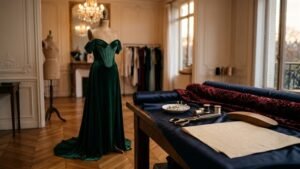
The major design shift in the winter 2026/2027 wardrobe marks a decisive return to monumental, sharply tailored trouser silhouettes: replacing shapeless casual wear are architectural wide-leg palazzo trousers characterized by deep waist pleats, crisp pressed creases, and a cascading fluid drape of heavy wool flannel. In our design laboratory, we adapted these runway forms for demanding urban conditions through systematic prototype testing, examining the interaction of weighty suiting fabrics with chunky lug-sole boots and structured outerwear. In this technical manual, we break down crotch curve geometry, ease allowance formulas for European sizes 36 to 46, iron shaping methods, and hem clearance rules for an elongated silhouette.
- 1. The 2026/2027 Direction: From Relaxed Slouch to Architectural Presence
- 2. Fit Balance: Waistline Rise, Inseam Stride, and Crotch Curve Geometry
- 3. Material Science: Wool Flannel, Worsted Suiting, Gabardine, and Corduroy
- 4. Cutting Layout and Ease Allowances (EU Sizes 36 to 46)
- 5. Couture Iron Shaping: Inseam Stretching and Under-Buttock Shrinking
- 6. Proportions and Styling: Hem Clearance with Boots and Outerwear
Analyzing recent runway presentations for the upcoming 2026/2027 winter season makes one principle indisputable: tailored trousers have reclaimed their role as the primary architectural anchor of modern tailoring. Contemporary palazzo pants share none of the looseness of loungewear; they represent rigorous sartorial craftsmanship requiring a stable reinforced waistband, calculated seat depth, and masterly ironwork. Below is our comprehensive engineering guide covering every technical node of contemporary trouser construction.
1. The 2026/2027 Direction: From Relaxed Slouch to Architectural Presence
The 2026/2027 cold season establishes a decisive departure from oversized bottoms lacking a clear structural center. Wide-leg palazzo trousers with a high-rise tailored waistband dominate the collections. The focal point rests across the upper waistband: deep front pleats (one to two on each front panel) introduce fluid fabric movement while keeping the abdominal plane and upper hip curve clean and flat.
When engineering these pleats, we calculate an inner depth between 3.0 and 4.5 cm. Depending on fabric drape, pleats may face toward the center fly for a heritage British aesthetic or outward toward the side seam following Italian tailoring tradition. The front crease is pressed precisely along the grain line from the center of the primary pleat down to the hem, creating a clean unbroken vertical axis.
2. Fit Balance: Waistline Rise, Inseam Stride, and Crotch Curve Geometry
The central technical challenge in cutting wide trousers lies in establishing the correct crotch seam curve (the saddle). An overly shallow rise causes binding during sitting, while excessive drop produces horizontal smile wrinkles beneath the buttocks. In our patterns, rise depth is drafted strictly from seat height measurements with a built-in functional ease of 1.5 to 2.0 cm for natural movement.
To maintain a smooth front profile, the fly front utilizes an 18 to 20 cm metal zipper with an internal waistband extension tab secured by a flat hook-and-bar closure. The interior waistband is supported by stiff Petersham ribbon or fusible canvas, preventing collapse or rolling beneath heavy knitwear.
3. Material Science: Wool Flannel, Worsted Suiting, Gabardine, and Corduroy
Winter palazzo pants require specific weight and drape qualities. The cloth must possess sufficient heft to fall cleanly without fluttering in cold winds, yet retain enough flexibility to avoid looking stiff. The optimal selections are 2-ply worsted wool and woolen flannel with subtle melange texture, weighing between 340 and 460 gsm.
Thorough fabric preshrinking (sponging) prior to cutting is mandatory: steam pressing through a damp press cloth typically reveals 3.5% to 6% lengthwise shrinkage. For pocket bags and waistband linings, tightly woven cotton twill or cupro lining is advised. Front panels are lined to below the knee with lightweight slippery cupro to protect wool fibers from knee bagging.
4. Cutting Layout and Ease Allowances (EU Sizes 36 to 46)
When cutting wide palazzo patterns, ease allowances must be clearly differentiated between waist and hips:
- Waist ease (Ew): 1.0 to 1.5 cm for breathing comfort without gapping;
- Hip ease (Eh): 6.0 to 8.0 cm for moderate wide cuts and 9.0 to 12.0 cm for voluminous pleated runway models;
- Hem width: 32 to 38 cm flat (total hem circumference of 64 to 76 cm depending on height and size).
Fabric consumption on 140 to 150 cm wide yardage equals two trouser lengths plus 25 cm for the waistband, seam allowances, and a generous hem. Sizes 36 to 42 require 2.35 to 2.45 m; sizes 44 to 46 require 2.55 to 2.70 m.
5. Couture Iron Shaping: Inseam Stretching and Under-Buttock Shrinking
Without iron shaping (dressur), flat pattern pieces cannot contour smoothly around three-dimensional anatomy. Shaping transforms two-dimensional wool panels using steam, heat, and pressure:
- Inseam stretching: the upper third of the back inseam is stretched with the iron by 1.5 to 2.0 cm to provide stride comfort;
- Seat hollow shrinking: the area directly beneath the gluteal fold is shrunk inward with curved iron passes, redistributing fullness over the seat curve;
- Clapper cooling: each pressed area is immediately compressed with a solid hardwood tailor clapper for 10 to 15 seconds to set the wool structure.
When finishing wide wool trousers, avoid topstitching the hem by machine. Use a blind catch stitch with silk thread and relaxed tension, catching merely one yarn of the outer cloth. Maintain a generous 4.5 to 5.0 cm hem allowance: this added weight creates a clean vertical drop that resists billowing in winter winds.
6. Proportions and Styling: Hem Clearance with Boots and Outerwear
The defining styling metric for winter 2026/2027 is hem clearance. Palazzo cuffs should cover the boot shaft almost entirely, floating precisely 1.0 to 1.5 cm above floor level. The trouser leg must form a single deliberate soft break over the vamp rather than pooling messy folds.
To shield the interior hem from street grit and boot friction, tailor hem tape with a raised edge is sewn along the lower back hem allowance. In combination with winter coats, wide trousers pair best with either floor-sweeping straight wool coats or cropped shearling jackets that accent the elevated waistline and elongate leg lines.
 Free
Women's dress pattern
View Pattern → Free
Women's dress pattern
View Pattern → Free
Women's jumper pattern
View Pattern →Draft Your Perfect Palazzo Trousers with Professional Patterns
Download precision-engineered digital sewing patterns with tested anatomical balance across European sizes 34 to 48 with illustrated tutorials.
Explore Trouser Patterns
Apparel Industry Hub in Telegram
Community of garment manufacturers, tailors and designers. Daily fresh workshop vacancies, verified factories database and direct contacts.