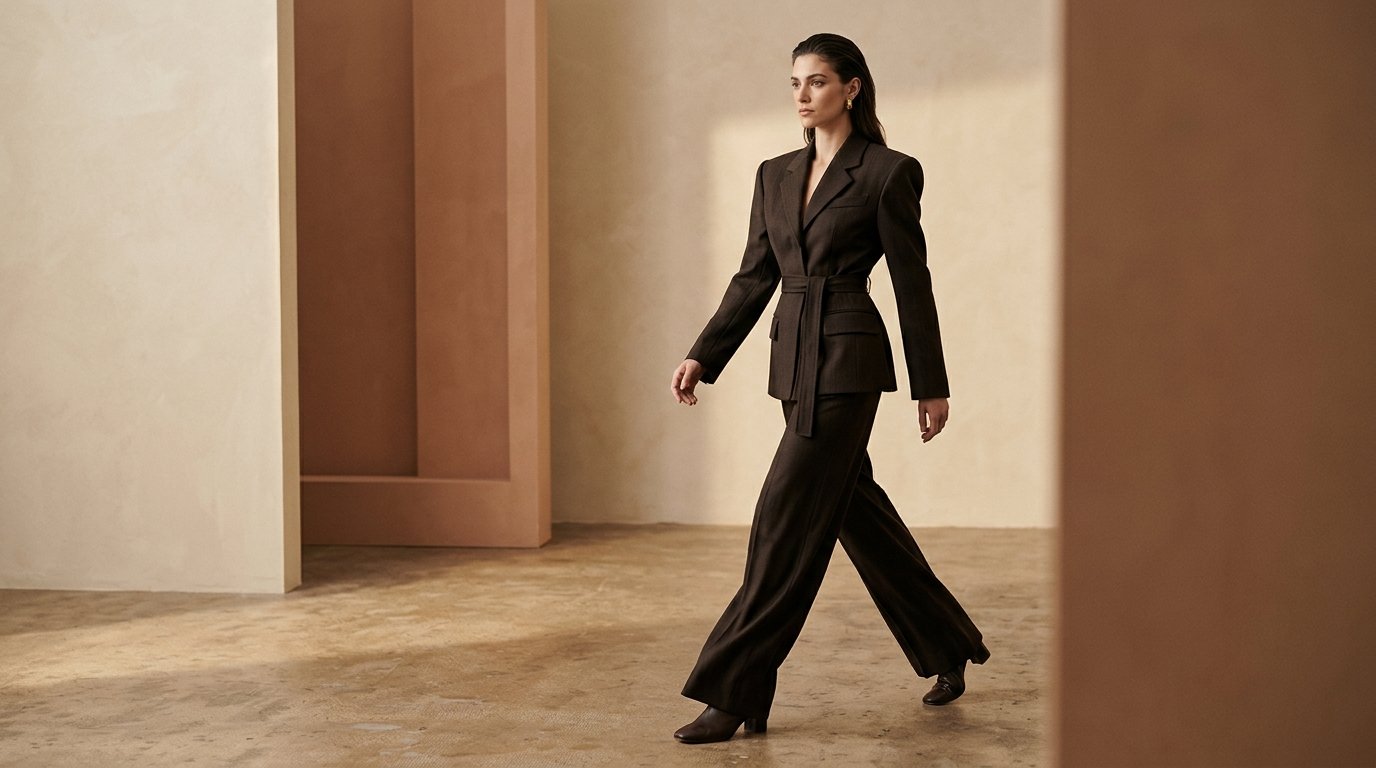
The 2026/2027 runway cycle definitively transforms the tailored women's jacket from standard corporate attire into the paramount architectural anchor of the total look: shapeless knitwear yields to defined hourglass waists, monumental masculine shoulders, and masterfully molded chest canvassing. In our pattern-making atelier, we translated these dramatic runway geometries into functional urban garments, preserving razor-sharp lines across compact worsted wools, tactile tweeds, and tailored velvet. This technical guide examines shoulder extension formulas, traditional floating canvas construction, and precise ease calculations across European sizes 36 to 46.
- 1. Silhouette Architecture 2026/2027: The Duel Between Hourglass Waistlines and Masculine Oversize
- 2. Shoulder Girdle Anatomy: Constructing Extended Structure Without Armhole Collapsing
- 3. Design Ease Allowances and Pattern Proportions for European Sizes 36 to 46
- 4. Internal Haute Couture Canvas: Traditional Hair Canvas vs. Modern Fusibles
- 5. Two-Piece Set-In Sleeves with High Cap Height: The Physics of Sleeve Head Ease
- 6. Styling and Proportion Rules: Layering the Modern Architectural Blazer
When our pattern engineering atelier evaluated the defining runway showcases for autumn/winter 2026/2027, an unequivocal truth surfaced: tailoring has entered an architectural golden age. Designers have abandoned flimsy, unlined silhouettes in favor of rigid internal framing capable of reshaping body proportions independently of underlying anatomy. Yet direct translations of runway armor into everyday wardrobes frequently disappoint: exaggerated shoulder pads collapse beneath outerwear, while severely restricted waistlines generate unsightly horizontal stress pulls with every forward stride.
The pattern maker's core objective is transmuting dramatic high-fashion proportion into wearable, long-lived patterns that afford genuine arm mobility and endure repetitive dry cleaning. Below is our exhaustive technical breakdown of modern jacket anatomy: from cutting traditional horsehair canvas chest pieces to the rigorous mathematics of sleeve head ease distribution.
1. Silhouette Architecture 2026/2027: The Duel Between Hourglass Waistlines and Masculine Oversize
Two dominant tailoring philosophies govern the 2026/2027 collections, each grounded in exacting geometric discipline:
Sculpted Hourglass Tailoring: Characterized by an ultra-nipped waist, sharp vertical dart suppression, and flared architectural hip basques. To eliminate restrictive binding across the torso, we transfer classic waist darts into curved princess lines and allocate a minimum waist ease allowance of 4.0 to 6.0 cm, preserving internal diaphragm comfort while seated.
Masculine Extended-Shoulder Blazers: Double-breasted boxy jackets featuring extended vertical center-back drops (74 to 82 cm for a height of 170 cm). The shoulder seam extends 2.5 to 4.0 cm past the acromion process, establishing a broad horizontal line that balances lower hip volume.
2. Shoulder Girdle Anatomy: Constructing Extended Structure Without Armhole Collapsing
The secret of an immaculate architectural shoulder lies not merely in oversize foam padding, but in scientific armhole re-engineering. Lengthening shoulder lines on standard patterns produces hollow diagonal draglines across the upper chest and underarm.
Our studio pattern modifications:
1. Shoulder point elevation: For every 1.5 cm of horizontal extension, the shoulder point must be elevated by 0.4 to 0.6 cm to support horizontal pad trajectory.
2. Armhole drop and widening: Drop the scye depth by 1.5 to 2.5 cm to accommodate modern 12 to 22 mm shoulder pads while restoring functional arm rotation.
3. Composite sleeve head rolls: Pair structured pads with bias-cut hair canvas and pressed fleece sleeve heads to suspend the sleeve cap smoothly without vertical hollows.
3. Design Ease Allowances and Pattern Proportions for European Sizes 36 to 46
Constructing a rigid tailored jacket requires calibrated ease allowances that anticipate internal canvassing thickness:
- Bust Ease: 7.0 to 9.0 cm for fitted hourglass jackets; 11.0 to 15.0 cm for straight masculine blazers.
- Waist Ease: 4.0 to 6.0 cm for fitted silhouettes; 12.0 to 16.0 cm for boyfriend blazers.
- Hip Ease: 6.0 to 8.0 cm distributed evenly across front, back, and side-body panels.
Fabric yardage requirements (145-150 cm fabric width):
— Sizes 36 to 40 (US 4 to 8): 1.75 to 1.95 m shell fabric, 1.40 m breathable viscose lining, and 1.20 m woven fusible interfacing.
— Sizes 42 to 46 (US 10 to 14): 2.15 to 2.45 m shell fabric, 1.70 m lining, and 1.50 m interfacing.
— Add 0.40 to 0.50 m for large-scale check matching across front closures and welt pockets.
4. Internal Haute Couture Canvas: Traditional Hair Canvas vs. Modern Fusibles
A tailored jacket achieves permanence through internal structure. Abandon lightweight non-woven adhesives: 2026/2027 tailoring demands multi-tiered support:
Full Front Fusing: The entire wool front is fused with high-recovery woven tricot interfacing (65 to 85 gsm) cut strictly on-grain parallel to center front.
Floating Horsehair Canvas Chest Piece: An unglued pad-stitched chest shield combining genuine horsehair canvas and wool domette is suspended across the shoulder and upper chest. Pad-stitched by hand or chevron machine stitching with pre-steamed chest cup molding, it produces a sculpted three-dimensional roll that never collapses.
5. Two-Piece Set-In Sleeves with High Cap Height: The Physics of Sleeve Head Ease
Runway blazers for 2026/2027 showcase a proud, roped sleeve head that crowns the shoulder seam without puckers or dimpling.
Sleeve insertion rules from our atelier:
- Ease coefficients: For worsted wools, incorporate 0.08 to 0.11 cm ease per 1 cm of armhole circumference (2.2 to 3.5 cm total cap ease).
- Steam shrinking: Gather cap ease over two rows of basting threads and shrink away fullness over a curved tailor pressing ham using targeted steam until puckers disappear completely.
- Support headers: Stitch a 4.0 to 5.0 cm wide layered bias wadding header directly into the armhole seam allowance to support the roped silhouette.
When tailoring structural blazers in worsted wool (280 to 420 gsm), install Universal size 80 or 90 needles and 40 or 50 weight core-spun polyester thread with a 2.4 to 2.8 mm stitch length. Press seams open at 150 to 170 °C with burst steam through a clean cotton press cloth, clapping immediately with a solid beechwood tailor clapper for 8 to 10 seconds until the wool cools completely flat without shine. Cut the viscose lining with a 1.5 to 2.0 cm vertical pleat allowance at the hem and a central back expansion pleat to preserve full arm reach.
6. Styling and Proportion Rules: Layering the Modern Architectural Blazer
Contemporary tailoring thrives on volume contrast. Balance cinched hourglass blazers with fluid wide-leg puddle trousers or sleek midi column skirts. Pair oversized masculine blazers with straight-leg leather pants or bias-cut silk slip dresses, creating an effortless tension between masculine structure and fluid femininity.
Tailor Precision Architectural Blazers with Andrey Ardatiev Digital Patterns
Explore our digital pattern collection featuring tailored hourglass blazers and masculine boyfriend jackets with engineered shoulder lines, complete canvassing layouts, and separate lining patterns.
Explore Blazer Sewing Patterns
Apparel Industry Hub in Telegram
Community of garment manufacturers, tailors and designers. Daily fresh workshop vacancies, verified factories database and direct contacts.