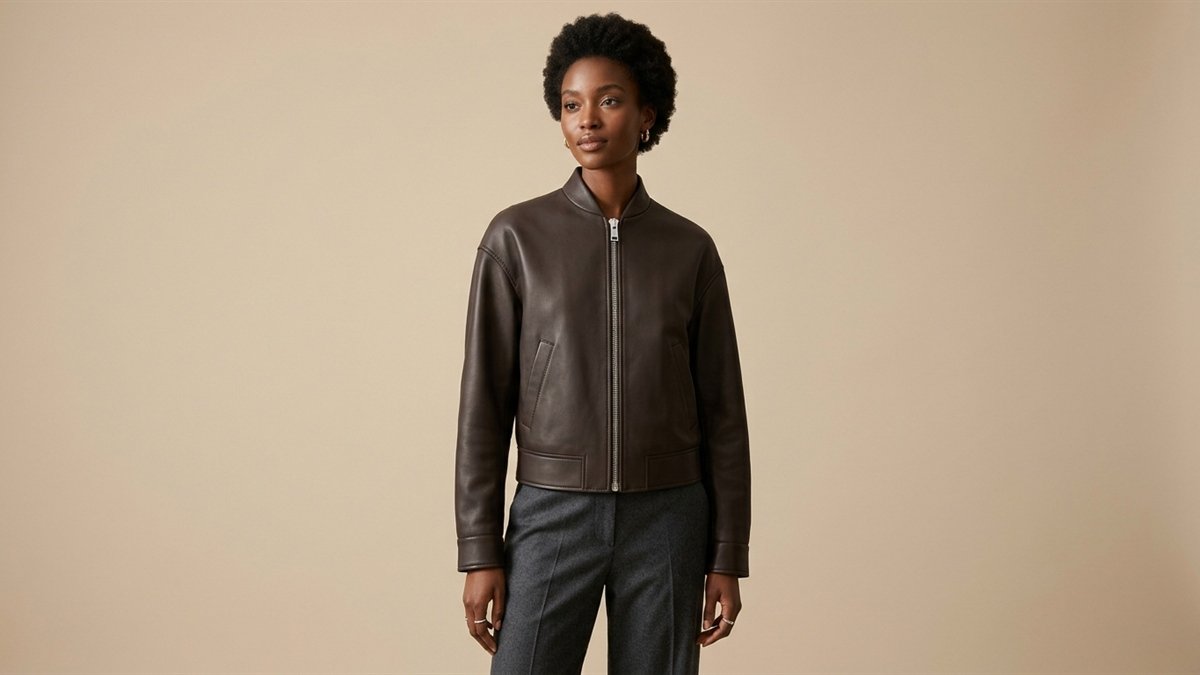
The Spring 2027 season reimagines leather outerwear through the lens of radical minimalism: brash biker silhouettes encrusted with zippers and studs have yielded to monolithic leather bomber jackets characterized by sculptural architectural serenity. Design focus shifts entirely to pristine cutting geometry: drop-shoulder balance, a two-piece curved sleeve with fluid volume, and a seamless leather waistband cut from monolithic hides. Yet natural nappa leather and luxury microfiber faux-leather are merciless textiles that forgive zero cutting mistakes: needle penetrations are permanent, and conventional iron molding along the sleeve cap is mechanically impossible. In our atelier testing lab, we tailored ten prototype bomber jackets from Italian calf nappa (0.8 to 0.9 mm) and microfiber polyurethane leather (420 gsm). In this technical manual, we break down ease allowances, seamless edge skiving, low-temperature interfacing packages, and precision assembly from sizes 42 through 52.
- 1. Leather Bomber Architecture 2027: Proportions, Ease Allowances, and Silhouette
- 2. Two-Piece Sleeve Geometry on Drop Shoulders: Sleeve Cap Pitch Mechanics
- 3. Edge Skiving Technology and Zero-Pinning Assembly Methods
- 4. Low-Temperature Interfacing: Stabilizing Fronts, Zippers, and Welts
- 5. Heavy-Duty Metal Zipper Insertion: The Pristine Leather Welt Border
- 6. Material Science: Lambskin Nappa, Cowhide, and Microfiber Faux-Leather
- 7. Machine Configuration for Leather: Needles, Teflon Feet, and Thread Tensions
- 8. Wardrobe Proportions 2027: Styling the Minimalist Leather Bomber
- 9. Pattern Grading for Leather Jackets (Sizes 40 to 54)
When constructing a minimalist leather jacket, design flaws cannot be concealed behind decorative flaps, epaulets, or patch pockets. If armscye balance deviates by merely 4 mm, the leather buckles into harsh diagonal draglines across the chest, and the sleeve drags uncomfortably forward with the slightest gesture. To attain bespoke luxury standards, our pattern-making bureau developed an anatomical sloper featuring calibrated sleeve cap pitch, seamless welt pockets, and polyamide low-melt interfacing activated at 110 to 120 degrees Celsius. Below is our definitive laboratory manual for cutting, skiving, and assembling the benchmark leather jacket of 2027.
1. Leather Bomber Architecture 2027: Proportions, Ease Allowances, and Silhouette
The contemporary leather bomber strikes a nuanced equilibrium between cocoon volume and graphic restraint. The jacket is cropped precisely at the hip line (56.0 to 62.0 cm finished length), the shoulder plane is extended, and back volume gently cascades into a tailored waistband without ballooning.
When drafting master slopers for sizes 42 through 52 in our atelier, we establish the following baseline ease allowances (applied to half-girth measurements):
- Chest Ease Allowance: +12.0 to +16.0 cm (providing a total circumference ease of 24.0 to 32.0 cm) to accommodate chunky cashmere knitwear underneath;
- Waist Ease Allowance: +16.0 to +20.0 cm, dropping straight toward the lower waistband without hourglass tapering;
- Bicep Girth Ease: +7.0 to +9.0 cm, guaranteeing uninhibited arm elevation without lifting the jacket hemline;
- Shoulder Extension: 5.0 to 7.0 cm outward from the natural acromion point with a 1.0 cm forward anatomical pitch.
2. Two-Piece Sleeve Geometry on Drop Shoulders: Sleeve Cap Pitch Mechanics
The primary engineering challenge of a dropped armscye in leather is that sleeve cap fullness cannot be shrunk away with steam as in wool tailoring. Ease must be calibrated to absolute minimal tolerances:
Sleeve Cap Height Calculation: With shoulder extension of 6.0 cm, sleeve cap height decreases according to the formula Cap Height = Armscye Length / 3 - (2.5...3.5 cm). This yields a calibrated cap height of 11.0 to 13.0 cm, providing arm articulation up to 60 degrees without body drag.
Cap Ease Allowance: Total sleeve cap ease for nappa and microfiber leather is restricted strictly to 0.5 to 0.8 cm across the entire circumference (compared to 3.5 to 4.5 cm in tailored wool coats). Excessive ease in leather inevitably creates unsightly puckers.
3. Edge Skiving Technology and Zero-Pinning Assembly Methods
At seam intersections (such as yoke-to-armscye junctions or zipper insertion points), stacked leather plies reach 4 to 5 mm, causing needle deflection and bulky humps:
- Edge Skiving (Bevelling): Seam allowances (1.0 to 1.2 cm wide) are bevelled on an industrial skiving machine or shaved by hand with a Japanese leather knife along the flesh side at a 30-degree angle, reducing thickness by 50 percent (from 0.9 mm down to 0.4 mm at the edge);
- Zero-Pin Temporary Basting: Traditional sewing pins permanently ruin leather. Panels are held before stitching using spring-loaded craft clips or 4 to 6 mm latex transfer tape that leaves zero gum residue on needle shafts;
- Hammered Seam Flattening: Seams are pressed open over craft paper without steam, glued flat with polychloroprene contact cement, and beaten with a polished cobbler hammer over a granite slab.
4. Low-Temperature Interfacing: Stabilizing Fronts, Zippers, and Welts
Conventional apparel fusibles demand 140 to 160 degrees Celsius and steam, which permanently denatures collagen fibers in leather and melts polyurethane films. Leather outerwear requires a specialized low-melt fusible package:
Low-Melt Polyamide Non-Woven: 50 to 65 gsm with fine dot coating, activated at 110 to 120 degrees Celsius with dry heat under 2.5 kg/sq cm pressure for 8 to 10 seconds through dry muslin.
Mandatory Interfacing Zones: Front zipper facings, welt pocket apertures, lower waistband facings, and collar stands. Armscye curves and necklines are reinforced with a 10 mm bias-cut fusible stay-tape to prevent stretching during wear.
5. Heavy-Duty Metal Zipper Insertion: The Pristine Leather Welt Border
In a minimalist bomber, a heavy-gauge Raccagni or Lampo metal zip (gauge 5 or 8) is installed with architectural precision:
Front Edge Preparation: The front opening edge is reinforced with a 3.0 cm wide fusible strip, turned back 1.0 cm, and secured with double-sided leather basting tape.
Zipper Stitching: The zipper tape is positioned so metal teeth project exactly 1.5 mm beyond the leather fold. Topstitching is executed using a Teflon or roller foot with Gutermann Mara 30 thread at a 4.0 to 4.5 mm stitch length, positioned 2 mm from the fold. The raw underside is encased in a continuous leather wind flap.
6. Material Science: Lambskin Nappa, Cowhide, and Microfiber Faux-Leather
Bomber jacket drape depends directly on skin temper and backing elasticity:
- Italian Lambskin Nappa (0.7 to 0.9 mm): Chrome or mixed vegetable tanning, offering butter-soft hand, fluid drape, and natural satin luster;
- Premium Microfiber Polyurethane Leather (400 to 450 gsm): Microporous cellular structure identical to natural dermis. Remains supple in sub-zero temperatures and resists fatigue cracking at fold points;
- Sateen or Twill Lining: 110 to 130 gsm cupro or acetate-cotton blend with an anti-static finish for effortless layering over wool knitwear.
Material Yield: Natural leather requires 45 to 55 square feet (4.2 to 5.1 sq meters) of prime defect-free hides for sizes 42 to 48. Roll goods in faux-leather (140 cm width) require 1.80 to 2.10 meters, cut strictly in one nap direction.
7. Machine Configuration for Leather: Needles, Teflon Feet, and Thread Tensions
Sewing leather on industrial or heavy-duty domestic machines requires specific setup parameters:
Leather Needles (Schmetz LL / Microtex): For natural nappa, left-twist wedge point needles (LL point) in sizes 90 to 100 pierce leather fibers at a 45-degree angle, generating a handsome angled topstitch. For knitted-back microfiber leather, sharp Microtex needles prevent puncture blowout;
Presser Foot Friction Control: Standard steel feet stick immediately to leather. A non-stick PTFE Teflon foot or articulated roller foot is mandatory to guarantee even feed without drag marks.
8. Wardrobe Proportions 2027: Styling the Minimalist Leather Bomber
The sleek geometry of the minimalist leather bomber creates commanding textural interplay within modern capsules:
Fluid Contrast Rule: The substantial tactile weight of smooth leather pairs magnificently with flowing maxi column skirts or pleated wide-leg palazzo trousers.
Architectural Shirting Layer: Wearing an oversized deconstructed shirt underneath allows 14 cm statement cuffs and layered double collars to extend beyond jacket borders, creating sophisticated editorial depth.
A bespoke atelier secret when sewing leather bomber waistbands: to make the leather waistband hug the hips smoothly without flaring open like a rigid bell, cut the inner facing waistband piece 3 mm shorter in height and 1.5 cm shorter in length than the outer leather shell. Prior to assembly, fuse the inner waistband with light stretch tricot interfacing cut on the true bias at 45 degrees. When stitching the outer and inner waistbands together, slightly stretch the outer leather over the inner facing. This intentional differential tension naturally pulls the hem inward, creating a plump, luxurious rolled contour with zero wrinkles.
9. Pattern Grading for Leather Jackets (Sizes 40 to 54)
When grading relaxed leather outerwear, shoulder and armscye proportions must be preserved with rigor:
- Chest Girth Step: +1.5 cm per half-pattern (+6.0 cm total circumference per size jump);
- Armscye Depth Progression: strictly +0.35 cm per size, preventing excess underarm sag in larger sizes;
- Waistband and Cuff Depths: Waistband height (6.0 cm) and cuff depth (6.5 cm) remain constant, scaling only along the circumference axis.
Sew the Ultimate Minimalist Leather Bomber with Andrey Ardatiev Patterns
Download professional PDF patterns for minimalist leather bomber jackets featuring calibrated drop-shoulder sleeves, zero-bulk edge skiving templates, and detailed technical instructions for sizes 40 through 54. Craft an investment piece of bespoke luxury.
Explore Jacket Patterns
Apparel Industry Hub in Telegram
Community of garment manufacturers, tailors and designers. Daily fresh workshop vacancies, verified factories database and direct contacts.