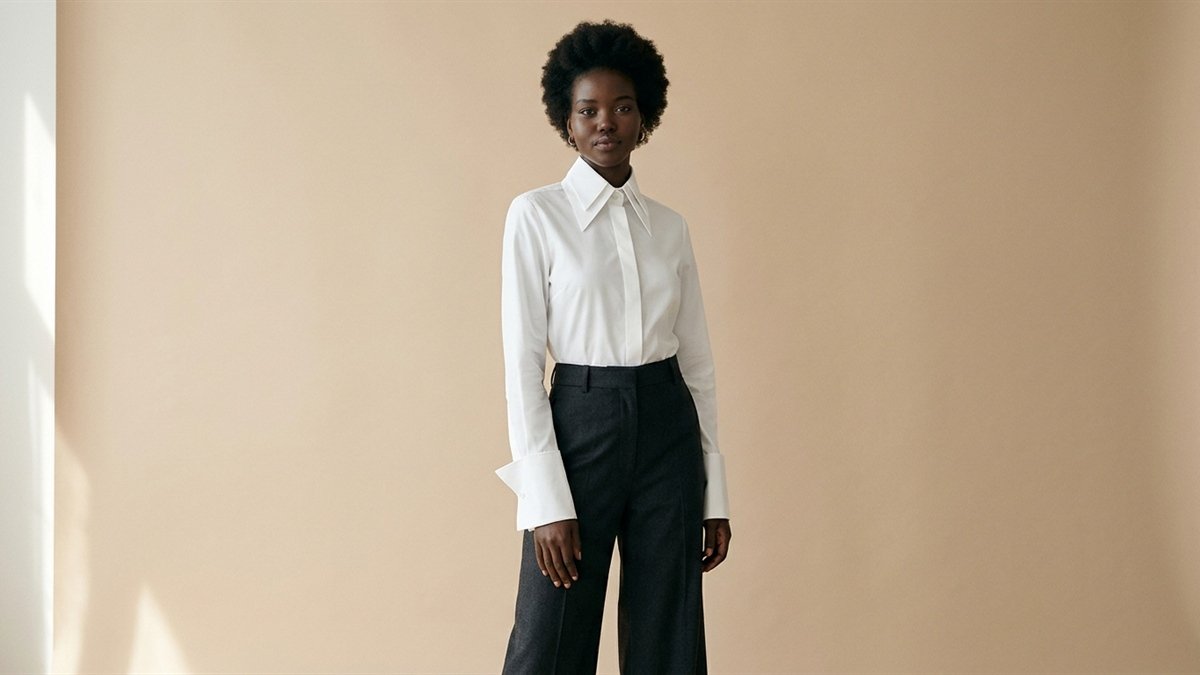
The 2026/2027 season witnesses a profound architectural overhaul of the classic cotton button-up: an everyday wardrobe staple has transformed into a masterclass in sartorial deconstructivism. Traditional office blouses have surrendered to monumental shirting characterized by layered double collars, concealed fly-front plackets, and dramatic French cuffs measuring up to 14 cm in depth. Yet within bespoke couture, avant-garde geometry tolerates zero technical margin for error: a fractional warp misalignment in collar stand interfacing or uneven collar point symmetry instantly turns structural elegance into clumsy amateurism. In our atelier testing lab, we engineered and fitted over twenty-five shirting variations using two-ply Swiss cotton poplin (125 gsm) and dense Oxford weave. In this technical manual, we break down double collar curvature, seamless hidden fly placket drafting, sculptural cuff geometry, and precision assembly across sizes 42 through 52.
- 1. Anatomy of 2027 Deconstructivism: Shoulder Pitch, Ease Volumes, and Silhouette
- 2. Double Collar Geometry: Tier Dimensions and Anatomical Stand Curvature
- 3. Clean Collar Stand Tailoring: Stepped Trimming and Fold Interfacing Release
- 4. Hidden Fly Front Placket: Drafting the Four-Fold Seamless Button Pocket
- 5. Sculptural Statement Cuffs: Extended Depth, Angled Tips, and Multi-Button Arrays
- 6. Material Science: Swiss Cotton Poplin 120/2, Compact Twill, and Lyocell
- 7. Iron-Molding (VTO): Collar Clamping and Cuff Blocking
- 8. Layering and Proportions 2027: Avant-Garde Shirt in Capsule Styling
- 9. Pattern Grading for Deconstructed Shirts (Sizes 40 to 54)
The core paradox of avant-garde shirting lies in the contrast between external boldness and internal rigor: the more intricate the exterior silhouette, the more conservative and exacting the interior tailoring methods must be. When introducing a second collar tier, the neck seam volume doubles, which standard construction methods invariably translate into throat constriction and awkward collar stand flare. To eradicate deformation, our design bureau engineered a graded collar sloper system featuring stepped seam allowance trimming and calibrated shirting interfacings ranging from 90 to 120 gsm. Below is our definitive laboratory manual for cutting, drafting, and assembling the benchmark shirt of the 2027 season.
1. Anatomy of 2027 Deconstructivism: Shoulder Pitch, Ease Volumes, and Silhouette
Modern luxury shirting pairs the ease of traditional menswear tailoring with razor-sharp neckband precision. In contrast to formless historical oversized shapes, the 2027 deconstructed shirt relies on calibrated posture balance: the shoulder seam pitches forward by 1.5 to 2.0 cm, the armscye is dropped, and back panel fullness gathers into an inverted box pleat beneath a deep split yoke.
When drafting master slopers for sizes 42 through 52 in our atelier, we establish the following baseline ease allowances (applied to half-girth measurements):
- Chest Ease Allowance: +8.0 to +12.0 cm (providing a total circumference ease of 16.0 to 24.0 cm) to circulate sculptural negative space around the torso;
- Waist Ease Allowance: +12.0 to +16.0 cm, bypassing waist suppression darts to establish a crisp architectural drop;
- Neckband Girth Ease: strictly +2.0 to +2.5 cm, guaranteeing unconstrained breathing comfort when the top button is fastened;
- Shoulder Drop: 4.0 to 6.0 cm outward from the natural acromion point while maintaining an immaculate horizontal shoulder plane.
2. Double Collar Geometry: Tier Dimensions and Anatomical Stand Curvature
A layered double collar comprises two distinct collar leaves (a foundational base collar and an accented top collar) mounted into a unified or split collar stand:
Dimensional Offset Formulas: The top collar leaf is drafted 4 to 6 mm shorter at the front points and 3 mm narrower in width (lower collar measures 7.5 cm wide; upper collar measures 7.0 cm). If drafted identical, the upper leaf overwhelms the lower layer, creating bulky distortion at the collar points.
Anatomical Stand Curvature: The collar stand sloper features a 2.5 to 3.5 cm rise at the center front ends above the horizontal baseline. This curve contours cleanly against the cervical spine while tilting forward at the neck hollow, supporting the double leaf weight without kicking backward.
3. Clean Collar Stand Tailoring: Stepped Trimming and Fold Interfacing Release
Integrating two collar tiers into a compact collar stand requires meticulous bulk management across six layers of woven cotton and multiple fusible plies:
- Graduated Seam Trimming: After seaming, the undercollar seam allowance is trimmed to 3 mm, the upper collar to 5 mm, and the stand seam allowance to 7 mm. This staggered distribution prevents harsh pressure ridges under the iron;
- Mitered Corner Clipping: At the collar tips, excess seam allowance is clipped diagonally 1.5 mm from the stitch corner, followed by tapering the side margins;
- Interfacing Fold Release: Collar stand fusible interfacing is cut strictly without top seam allowances, preserving a soft, unabrasive fold that protects the wearer neck.
4. Hidden Fly Front Placket: Drafting the Four-Fold Seamless Button Pocket
The sculptural facade of a deconstructed shirt demands a concealed closure. A 3.5 cm fly front placket is cut grown-on directly from the left front pattern piece:
Fold Geometry: A 14.0 cm extension (four times the 3.5 cm placket module) is drafted along the center front edge. The first fold establishes the clean exterior facing; the second creates the interior buttonhole pocket; the third forms the protective underlap shield.
Buttonhole Pocket Interfacing: The interior strip housing the buttonholes is reinforced with ultra-light shirting interfacing (35 to 40 gsm). Buttonholes are worked vertically along the center axis, with horizontal keyhole eyelets reserved for top and bottom anchor buttons.
5. Sculptural Statement Cuffs: Extended Depth, Angled Tips, and Multi-Button Arrays
In 2027 tailoring, shirting cuffs serve as focal design centerpieces, expanding from a standard 7 cm depth to an architectural 12 to 14 cm:
Cuff Profile: Featuring 45-degree mitered top corners (2.5 cm diagonal pitch), the cuff fastens with three or four closely spaced mother-of-pearl buttons or folds back into an architectural French cuff configuration.
Sleeve Tower Placket Assembly: The 16 cm sleeve slash is finished with a traditional 2.5 cm wide pointed gauntlet placket, crowned with a crossed box stitch and double silk topstitching.
6. Material Science: Swiss Cotton Poplin 120/2, Compact Twill, and Lyocell
Crisp multi-tiered collars and sculptural cuffs require textiles with dense yarn counts and superior tensile recovery:
- Two-Ply Swiss Cotton Poplin (120/2): 115 to 130 gsm, compact combed yarn. Offers a crisp paper-like hand, luminous matte finish, and razor-sharp crease retention;
- Compact Cotton Twill: 135 to 150 gsm, featuring a subtle diagonal weave that supports elongated cuff geometry;
- Cotton-Lyocell Blend (60 percent cotton, 40 percent lyocell): 120 to 135 gsm, offering silky drape and cool breathable comfort against the skin.
Yardage Requirements: Due to extended collar leaves, multi-fold plackets, and dramatic cuffs, fabric consumption at 145 to 150 cm width is 1.85 to 2.05 meters for sizes 42 to 46, and 2.15 to 2.35 meters for sizes 48 to 52. Precise grainline alignment parallel to center front is mandatory on all collar and placket pieces.
7. Iron-Molding (VTO): Collar Clamping and Cuff Blocking
Sartorial collar crispness is forged under steam and locked beneath dense hardwood tailor clappers:
Collar Edge Pressing: After turning, collar edges are basted with a 1 mm turn-of-cloth favor toward the underside. Seams are pressed with pressurized steam through dry batiste at 150 to 160 degrees Celsius. Instantly upon lifting the iron, an oak tailor clapper is clamped over the edge for 15 seconds. Rapid cooling crystallizes the cellulose fibers into a razor-sharp fold.
Stand Pre-Shaping: The assembled collar stand is iron-shaped over a curved wooden seam board to induce an anatomical cylindrical curve before insertion into the shirt neckline.
8. Layering and Proportions 2027: Avant-Garde Shirt in Capsule Styling
The sculptural geometry of the deconstructed shirt dictates intentional relationships with outerwear layers:
Cuff Exposure: Oversized Power Tailoring blazer sleeves are pushed upward or tailored short to allow 6 to 8 cm of the architectural shirting cuff to extend beyond the jacket hem, showcasing the button array.
Neckline Sculpting: The double collar is worn unbuttoned at the top two stand buttons to carve a deep geometric V-neckline, or buttoned fully beneath a minimalist sterling silver torque necklace.
A bespoke shirting secret from Savile Row workrooms: to eliminate diagonal puckering when stitching the collar stand into the shirt neckline, cut the inner collar stand lower edge 1.5 mm longer than the outer stand, slightly easing it in during pinning. After machining the first seam, press seam allowances up into the stand, wrap the inner stand over, and edge-stitch from the garment right side directly into the ditch of the first seam. This captures the inner stand cleanly while leaving the outer collar stand surface completely devoid of visible stitching.
9. Pattern Grading for Deconstructed Shirts (Sizes 40 to 54)
Grading complex multi-collar garments requires strict conservation of focal design proportions:
- Neckline Increment: +0.5 cm per half-pattern (+1.0 cm total neck circumference per size jump);
- Collar Height Invariance: Collar stand height (3.2 cm) and base collar leaf depth (7.5 cm) remain fixed across all sizes 40 through 54 to prevent neck crowding;
- Cuff Length: Standardized at 13.0 cm depth, while cuff circumference expands by +0.5 cm per size step.
Sew the Architectural Double-Collar Shirt with Andrey Ardatiev Patterns
Download professional PDF patterns for deconstructed tailored shirts featuring double collars, hidden fly-front plackets, and sculptural statement cuffs for sizes 40 through 54. Complete with step-by-step masterclass tutorials and millimeter-matched collar stands.
Explore Shirt Patterns
Apparel Industry Hub in Telegram
Community of garment manufacturers, tailors and designers. Daily fresh workshop vacancies, verified factories database and direct contacts.