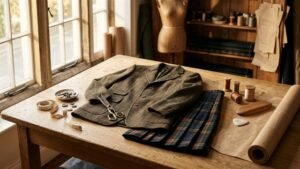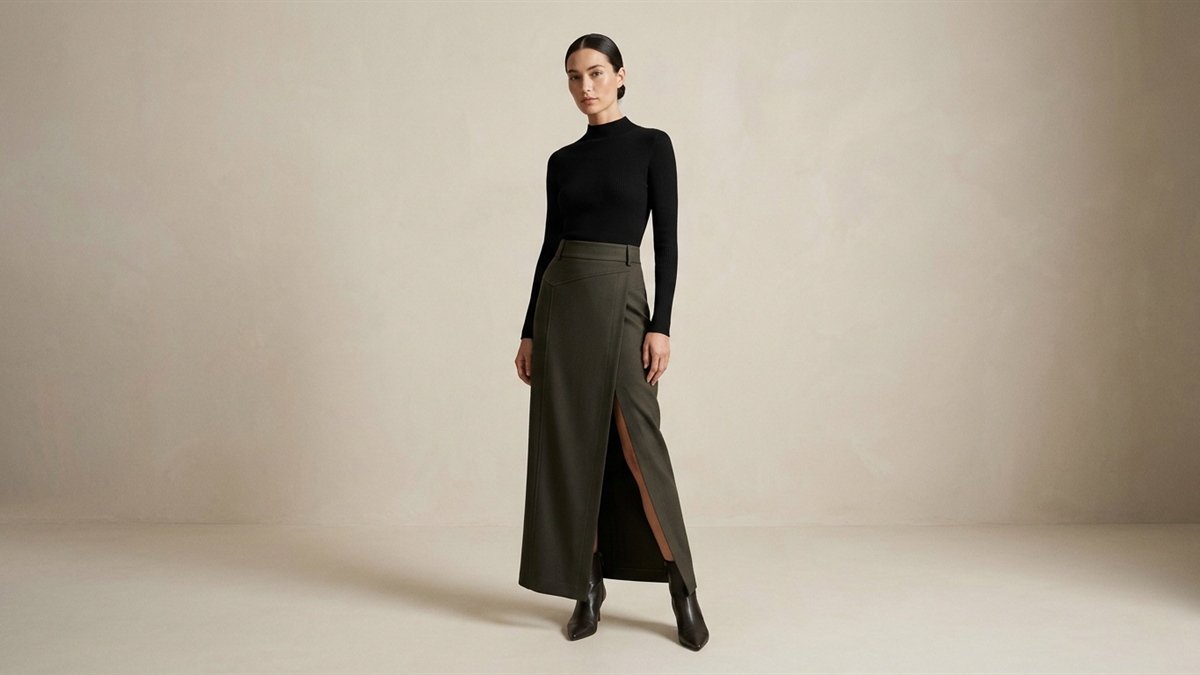
The 2026/2027 season heralds the definitive triumph of the radical vertical: the austere maxi column skirt has decisively supplanted billowing midis and tiered bohemian silhouettes. Yet in couture pattern making, a floor-sweeping narrow skirt represents an intricate engineering compromise between monumental aesthetic purity and human stride biomechanics. If the side seam pitch deviates by a mere 5 mm from true plumb or if the dynamic hemline lift during movement is neglected, the garment invariably torques around the knees, wrinkles across the lower abdomen, and flaps open ungracefully with every step. In our atelier testing lab, we drafted and refined over thirty experimental variations featuring asymmetric wrap closures and concealed high vents using Italian wool crepe (290 gsm) and dense silk cady. In this technical manual, we break down ease formulas, walking slit engineering, multi-layer vent interfacing packages, and fitting principles for sizes 42 through 52.
- 1. Architecture of the Column Silhouette: Proportion Shifts and Floor-Length Ergonomics
- 2. Biomechanics of the Stride: Calculating Vent Height and Dynamic Hem Expansion
- 3. Modeling the Asymmetric Wrap and Balancing Waist Darts
- 4. High Vent Tailoring Technology: Multi-Layer Interfacing and Corner Miter Sealing
- 5. Lining Integration with the Vent: Roof Venting and Floating Pleat Construction
- 6. Material Science: Wool Crepe, Heavy Silk Cady, and Suiting Gabardine
- 7. Iron-Molding (VTO): Gluteal Dart Shaping and Hem Pressing
- 8. Wardrobe Proportions 2027: Footwear Alignment and Silhouette Balance
- 9. Column Skirt Pattern Grading (Sizes 40 to 54): Preserving Vertical Lines
The most frequent error when drafting a maxi column skirt is merely extending a standard knee-length pencil skirt pattern down to ankle level without reconfiguring waist dart suppressions and stride dynamics. Across an overall finished length of 95 to 105 cm, a conventional tubular cylinder immobilizes normal leg extension, turning every stride into an awkward shuffle. To construct a dynamic architectural garment, pattern makers must introduce functional structural elements: an angled asymmetric wrap front, offset vertical seams, or an extended reinforced vent backed by an anatomical interfacing package. Below is our design bureau definitive guide to cutting, assembling, and iron-molding the benchmark skirt of the 2027 season.
1. Architecture of the Column Silhouette: Proportion Shifts and Floor-Length Ergonomics
On international runways, nineties monochrome minimalism returns with amplified structural clarity. The 2027 column skirt creates an unbroken monolithic line from the natural waistline (or raised by 1.5 to 2.0 cm) down to 2 or 3 cm above the floor, dramatically elongating bodily proportions.
When drafting master slopers for sizes 42 through 52 in our atelier, we establish the following baseline ease allowances (applied to half-girth measurements):
- Waist Ease Allowance: +0.5 to +1.0 cm (providing a total circumference ease of 1.0 to 2.0 cm) for a secure fit without ribcage compression;
- Hip Ease Allowance: +1.5 to +2.5 cm (total full-girth ease of 3.0 to 5.0 cm), preventing fabric tension over the gluteal curve;
- Hem Tapering along Side Seams: strictly limited to 1.5 to 2.0 cm inward from the hip vertical plumb line. Extreme mermaid pegging in maxi lengths is forbidden, as it corrupts vertical hang;
- Side Seam Finished Length: 98.0 to 108.0 cm, calibrated to figure stature and intended footwear heel elevation.
2. Biomechanics of the Stride: Calculating Vent Height and Dynamic Hem Expansion
An adult woman average natural walking stride spans 55 to 65 cm. In an enclosed tubular hem measuring 100 to 110 cm in total circumference, such movement is mechanically impossible without fabric strain. To resolve this ergonomic limitation, three architectural solutions are applied:
- Deep Center or Offset Vent: The top apex of the vent must sit strictly 8 to 10 cm above the patella (approximately 42 to 48 cm above the floor). Lower vents inevitably tear during vehicular ingress or stair climbing;
- Asymmetric Wrap Front: The left front overlap over the right panel spans 18 to 24 cm at the waistline, expanding gently to 28 to 32 cm at the hem. This generous overlap prevents accidental exposure even in high crosswinds;
- Structural Seam Walking Slit: Placed along a vertical seam with a minimum 4.0 cm seam turn-back, reinforced at the apex with a tailored bartack.
3. Modeling the Asymmetric Wrap and Balancing Waist Darts
Asymmetrical construction requires cutting front skirt panels in single-ply flat spreads. Dart suppressions are strategically distributed across diagonal wrap angles:
Dart Redistribution: The right waist dart on the basic sloper is partially pivoted into the diagonal wrap edge (up to 1.5 cm), with the remaining intake converted into a soft 2.5 cm fold oriented toward the right hip seam. The left waist dart remains in its canonical vertical position.
Asymmetric Hemline Sweep: The exposed outer edge of the overlapping panel rises subtly by 2.0 to 3.5 cm relative to the horizontal hemline. This subtle curve prevents corner drooping under the collective weight of seam allowances.
4. High Vent Tailoring Technology: Multi-Layer Interfacing and Corner Miter Sealing
A walking vent on a narrow maxi skirt endures severe repetitive mechanical loads. Conventional single-layer fusible fleece deteriorates within weeks, causing the vent apex to split and the vertical edges to curl outwards.
At Andrey Ardatiev studio, we mandate a three-tier reinforcement package:
- Face Interfacing: The overlap and underlap vent facing allowances are fused with woven elastic interfacing (45 to 55 gsm) with polyamide adhesive, aligned strictly with the longitudinal warp;
- Bias Seam Tape Barrier: A 12 mm stitch-reinforced fusible stay-tape is applied along the upper fold line, offset 1 mm into the allowance to prevent stretching;
- Dynamic Apex Reinforcer: On the wrong side above the vent apex, a 50 by 50 mm diamond patch of high-density cotton lawn is fused, extending 25 mm above the seam intersection. Topstitching is executed at a 45-degree angle with dual silk thread passes anchored through this internal cushion.
5. Lining Integration with the Vent: Roof Venting and Floating Pleat Construction
The lining of a maxi column skirt is essential: it protects fine wool fibers from gluteal friction and ensures effortless gliding over hosiery.
Lining Ease Allowances: Viscose or silk twill lining pieces are cut 0.5 cm wider along each vertical seam and finished 3.0 to 4.0 cm shorter than the shell fabric.
Vent Opening Connection: The lining above the vent is cut with an inverted U-shaped window with 1.0 cm seam allowances, notched diagonally at the corners. When attaching lining to vent allowances, a 1.5 to 2.0 cm vertical pleat (ease overflow) is formed at the top. This allows the lining to float freely during stride elongation without pulling on the outer vent.
6. Material Science: Wool Crepe, Heavy Silk Cady, and Suiting Gabardine
Column skirt drape depends fundamentally on fabric gravity and yarn twist:
- Merino Wool Crepe: 280 to 320 gsm, high-twist yarn. Holds a sharp vertical drape, conceals undergarment outlines, and resists creasing throughout hours of seated wear;
- Heavy Silk Cady: 300 to 360 gsm, matte pebbled surface texture, fluid structural weight suited for formal daytime and evening capsules;
- Compact Bi-Stretch Suiting Viscose: 310 to 350 gsm with 3 to 5 percent elastane recovery for dynamic urban routines.
Yardage Requirements: At a standard 140 to 150 cm fabric width, a straight column skirt with a conventional vent requires 1.20 to 1.35 meters (one garment length plus 20 to 25 cm for waistband and hem allowances) for sizes 42 through 48. An asymmetric wrap style requires 1.80 to 2.10 meters, as panels must be cut flat without fabric folding.
7. Iron-Molding (VTO): Gluteal Dart Shaping and Hem Pressing
Shaping a narrow skirt requires dedicated ironwork combined with rapid fiber cooling under tailor oak clappers:
Dart Tip Shrinking: Waist darts are pressed toward center back or side seams. The bubble at each dart apex is worked over a tailor ham with generous steam in circular strokes until completely flattened. A polished oak clapper is immediately pressed onto the zone for 12 to 15 seconds to lock the molded wool fibers.
Hem Pressing: The 4.0 to 4.5 cm hem allowance is basted and caught with invisible hand cross-stitches using fine silk thread. Front pressing is performed through dry linen press cloth without heavy down-force to avoid seam impressions on the face.
8. Wardrobe Proportions 2027: Footwear Alignment and Silhouette Balance
The clean geometry of the column skirt calls for precise volumetric counterweights in the upper garment layer:
Volumetric Contrast Rule: The slender lower vertical is best paired with a structured, masculine oversize Power Tailoring blazer hitting mid-thigh, or an ultra-cropped wool bomber jacket ending sharply at the natural waist.
Footwear Interface: The maxi hemline must either completely envelop the shaft of close-fitting kitten-heel sock boots or expose only the sharp pointed toe of sleek leather booties. An awkward gap exposing the ankle breaks the clean architectural silhouette of 2027.
A bespoke tailoring secret for narrow column skirts: to prevent the walking vent from gaping open into an unsightly V-shape when standing still, offset the inner edge of the lower vent allowance inward by 2 mm during cutting, creating a very slight taper. Before final seam assembly, gently steam and stretch the outer vent fold line by 1 to 2 mm, while slightly shrinking the underlap fold line. This micro-tension ensures the vent edges remain perfectly flat and sealed like scissors blades throughout prolonged wear.
9. Column Skirt Pattern Grading (Sizes 40 to 54): Preserving Vertical Lines
When grading narrow maxi skirt patterns across sizes, precise point movements must be observed:
- Hip Circumference Increment: +1.0 cm per quarter pattern (+4.0 cm total circumference per size jump);
- Dart Intake Expansion: Back darts expand by 0.2 cm per size to accommodate increased gluteal depth without side seam tilting;
- Vent Height Proportions: Vent length increases by +0.5 cm per size step to preserve stride comfort for sizes 50 through 54.
Sew the Benchmark Maxi Column Skirt with Andrey Ardatiev Patterns
Download professional PDF sewing patterns for tailored maxi column skirts with ergonomic stride balance, reinforced vent packages, and comprehensive illustrated instructions for sizes 40 through 54. Experience flawless bespoke fit from the very first toile.
Explore Skirt Patterns
Apparel Industry Hub in Telegram
Community of garment manufacturers, tailors and designers. Daily fresh workshop vacancies, verified factories database and direct contacts.