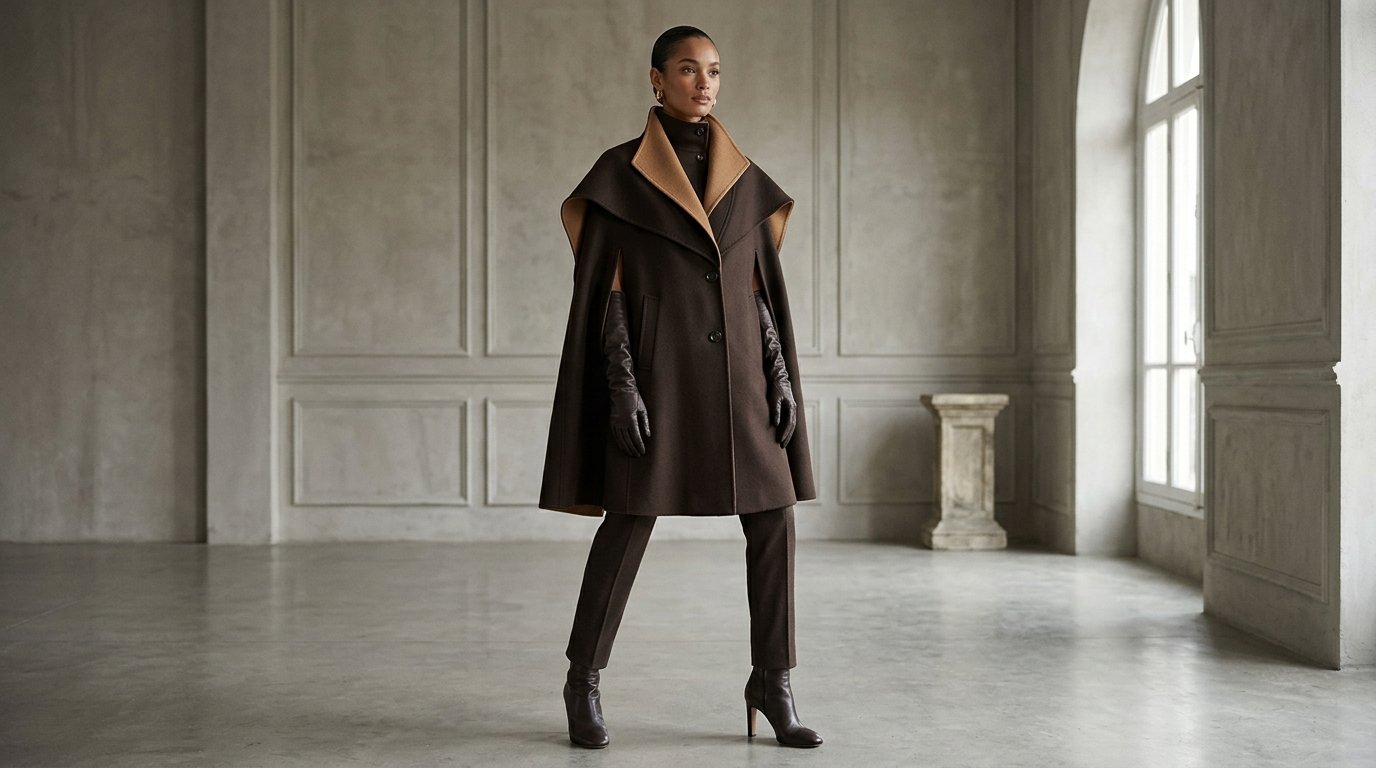
The quintessential sculptural outerwear statement for Winter 2026/2027 centers on architectural wool capes and monumental mantles tailored from double-faced cashmere and dense espresso wool melton: replacing shapeless ponchos is precision tailoring featuring articulated shoulders and tailored vertical arm slits. In our patternmaking laboratory, we engineered a static shoulder balance formula that counterweights heavy draping cloth and prevents the neckline from choking backward during stride. In this technical masterclass, we break down conical flare calculations, reinforced welted arm slit construction, high stand collar geometry, and lining attachment protocols that eliminate hem sagging.
- 1. Silhouette Trajectory 2026/2027: The Conical Trapezoid, Midi Length and Structured Shoulders
- 2. Shoulder Balance Mechanics: Calculating Conical Flare and Shoulder Darts
- 3. Arm Slit Engineering: Welted Openings, Stay Tapes and Stress Distribution
- 4. High Stand Collar Architecture: Tailored Canvas Packages for Heavy Meltons
- 5. Internal Stay Harness and Lining Attachment to Prevent Sagging
- 6. Styling Discipline and Footwear Coordination for Winter 2026/2027
Sewing a tailored winter cape is often mistakenly perceived as simple due to the absence of set-in sleeves; however, it is precisely in sleeve-less outerwear that any balance error becomes immediately fatal. Failing to calculate the center of gravity across 3.2 to 3.6 meters of 550 gsm heavy wool causes the garment to ride backward against the throat or flare awkwardly at the back hem. A true bespoke cape rests securely on the shoulders through engineered shoulder darting and concealed interior waist stays. Below is our comprehensive workshop manual on drafting, cutting, and assembling the benchmark Winter 2026/2027 tailored cape coat.
1. Silhouette Trajectory 2026/2027: The Conical Trapezoid, Midi Length and Structured Shoulders
Outerwear for Winter 2026/2027 establishes the tailored cape as the pinnacle of aristocratic minimalism. The dominant silhouette is a disciplined conical trapezoid cut at midaxi length (115 to 122 cm center back length for statures 168 to 172 cm). The shoulder line is deliberately structured rather than sloping: extended 1.5 to 2.0 cm past natural bone with 8 to 10 mm semi-rigid raglan shoulder pads to provide an unshakeable architectural foundation.
The color story highlights muted monochromes: deep roasted espresso, rich camel melange, smoky charcoal, and midnight black. Defining features include an imposing 6.5 to 7.5 cm high stand collar, concealed fly front closures with 25 mm horn buttons or heavy-duty snaps, and precision vertical arm slits designed to showcase long leather opera gloves extending past the elbows.
2. Shoulder Balance Mechanics: Calculating Conical Flare and Shoulder Darts
A frequent amateur pitfall is cutting capes as flat half-circles radiating from the neckline. This shortcut generates chaotic fabric ripples and causes the garment to drag backward under its own weight. Professional pattern engineering relies on differentiated balance formulas:
- Front-to-Back Balance Delta: The front bodice length to waist includes a +1.5 to +2.0 cm addition over anatomical measurements to clear the bust curve, ensuring the front placket falls strictly plumb without splaying open;
- Pitch and Back Shoulder Darts: The shoulder seam is shifted forward 1.0 cm from the natural crest. The back incorporates two 2.0 to 2.5 cm shoulder darts (9 to 11 cm in length) to mold the fabric smoothly over the shoulder blades;
- Conical Hem Flare: Side seams radiate at a 35 to 42 degree angle relative to the center back grainline. Total hem circumference measures 260 to 290 cm, delivering fluid movement without catching wind sail forces.
3. Arm Slit Engineering: Welted Openings, Stay Tapes and Stress Distribution
Vertical arm slits endure severe cyclic shear stress when arms articulate or hold handbags. To prevent corner tearing and fabric deformation, we employ our reinforced bespoke welt method:
- Slit Placement: Engineered at an exact length of 24 to 28 cm, positioned parallel to center front at a distance of 14 to 16 cm, with the top point situated 3 to 4 cm below the bust line;
- Woven Stay-Tape Interfacing: The wrong side of the bodice panel is reinforced with a 6 cm wide strip of woven fusible canvas extending 3 cm beyond both slit extremities, supplemented by straight-grain fusible stay-tape along the cutting line;
- Double-Interfaced Welts: Cut strictly on the lengthwise grain with a finished width of 2.5 to 3.0 cm, stitched using heavy-duty core-spun thread #30. Slit corners are clipped into precise 8 mm triangles and triple-stitched under tension;
- Lining Baffle Integration: The interior lining incorporates an internal draught-shield flap or is bagged cleanly against the facing with a 1.0 cm pleat allowance to accommodate full arm extension.
4. High Stand Collar Architecture: Tailored Canvas Packages for Heavy Meltons
Capes require exceptional stability through the neck and collar zone. Conventional turn-down collars frequently collapse under the dragging weight of cape panels, making structured stand collars the runway standard:
Drafted at a height of 6.5 to 7.5 cm, the undercollar is cut on a 45-degree bias in two halves and stabilized with 140 gsm collar canvas or horsehair haircloth pad-stitched horizontally. The front neckline is dropped 1.5 cm to prevent throat contact. The cashmere upper collar incorporates a 2.0 mm turn-of-cloth allowance, guaranteeing that the joining seam rolls cleanly to the inside.
5. Internal Stay Harness and Lining Attachment to Prevent Sagging
When unfastened or caught in winter gales, capes tend to slide off-center. To maintain pristine vertical alignment, our studio integrates an internal stay harness:
Two 3.5 to 4.0 cm wide grosgrain webbing straps with buckle closures are anchored into the interior waist side seams, fastening securely around the torso beneath the back drape. This transfers the entire weight of the heavy wool cloth from the cervical spine directly onto the pelvic girdle. The lining is cut with a +2.0 cm jump-pleat hem allowance, preventing the lining from hitching the wool shell upward during damp weather.
When stitching arm slits in heavy coating wool, always bevel-trim seam allowances: trim one welt allowance to 3 mm and leave the companion allowance at 7 mm. Clip the corner triangles to within exactly 1 mm of the stitch line, turn inside out, and press using a damp pressing cloth. Immediately clamp a heavy solid oak or beechwood tailor clapper over the welt corners for 15 seconds. The hardwood draws out heat and moisture instantly, setting the corners razor-flat without surface shine or bulky lumps.
6. Styling Discipline and Footwear Coordination for Winter 2026/2027
The voluminous conical silhouette of a cape demands strict architectural discipline across the lower body to preserve proportion:
Pair a 120 cm cape with cigarette wool trousers, tailored leather leggings, or a pencil skirt with a crisp back vent. The signature accessory is elbow-length or opera-length leather gloves in calfskin or deer nappa protruding through the arm slits. Ground the outfit with tall, minimalist leather boots featuring architectural 6 to 8 cm block heels for an imposing high-fashion aesthetic.
Sew Your Bespoke Haute Couture Cape With Studio Patterns
Download tested digital sewing patterns for architectural winter capes and tailored mantles with pre-calculated shoulder balance and precision arm slits. Sizes 40 to 54 with photo tutorials.
Explore Cape Patterns
Apparel Industry Hub in Telegram
Community of garment manufacturers, tailors and designers. Daily fresh workshop vacancies, verified factories database and direct contacts.