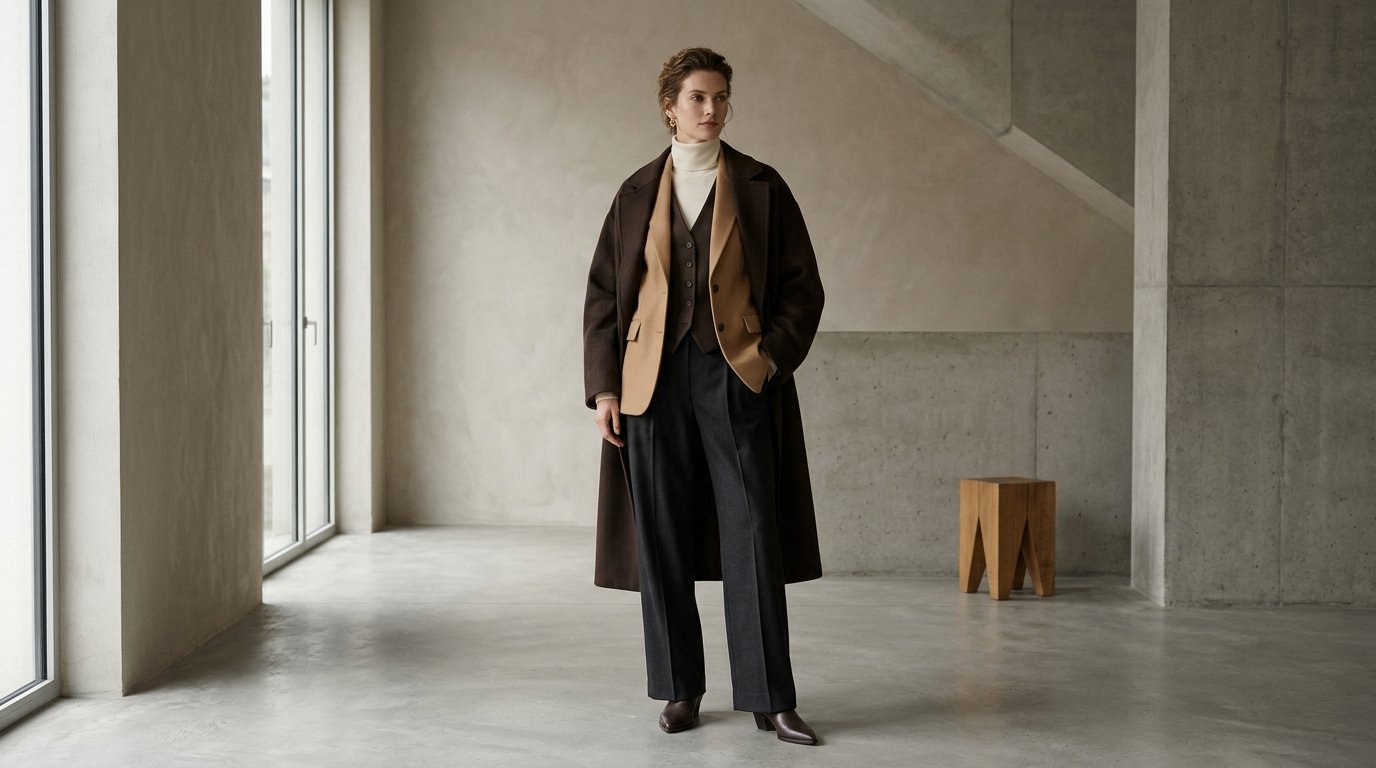
Sophisticated winter layering for 2026/2027 evolves into a rigorous patternmaking discipline: arbitrary bundling is replaced by an architectural four-tier formula comprising shirt, tailored waistcoat, oversized menswear blazer, and open cocoon coat. In our pattern studio, we developed a cascading ease allowance progression (+3 cm → +7 cm → +13 cm → +20 cm) that prevents armhole binding and eliminates diagonal back stress folds across all tiers. In this technical manual, we break down hemline length gradients spaced at 8 to 12 cm, radial neckline expansion for collar stacking without throat compression, waistcoat lining construction with buckle tabs, and the tactile balance of silk, flannel, and double-face cashmere.
- 1. Cascading Ease Architecture: The Four-Tier Volume Progression
- 2. Hemline Length Gradients: The 8 to 12 cm Rhythm and Visual Verticality
- 3. Waistcoat Pattern Drafting: Lining Fit and Front Balance Points
- 4. Collar Stacking Geometry: Harmonizing Three Lapels Without Bulk
- 5. Tactile Weight Contrasts: Silk, Worsted Wool, Flannel and Cashmere
- 6. Styling Formulas and Lower-Body Coordination for Winter 2026/2027
When crafting a coordinated multi-layer winter wardrobe, the central engineering challenge lies in preserving streamlined vertical posture while maintaining uninhibited upper-body mobility. Cutting each individual piece with standard commercial ease causes the interior blazer to bunch uncomfortably beneath the coat while the waistcoat hikes the armscye upward. Only calibrated armscye depth gradations (+1.5 cm for waistcoats, +3.5 cm for blazers, +6.0 cm for overcoats) and lapel roll alignment produce a cohesive, statuesque silhouette. Below is our definitive step-by-step masterclass on engineering the benchmark Winter 2026/2027 layered ensemble.
1. Cascading Ease Architecture: The Four-Tier Volume Progression
Winter 2026/2027 layering operates on a strictly calculated volume pyramid. Each successive layer incorporates a specific ease allowance delta calibrated against the underlying garment:
- Tier 1 (Base Layer): Silk button-down or fine-gauge ivory cashmere turtleneck. Bust ease allowance +2.0 to +4.0 cm with zero armscye drop, sitting flush against the anatomical armpit;
- Tier 2 (Intermediate): Tailored waistcoat vest cut from worsted suiting wool (280 gsm). Bust ease allowance +6.0 to +8.0 cm with armscye lowered 1.5 cm to accommodate shirt sleeves smoothly;
- Tier 3 (Structured Outer): Relaxed menswear blazer in wool flannel (360 to 400 gsm). Bust ease allowance +12.0 to +14.0 cm, armscye lowered 3.5 to 4.0 cm, shoulder extended 1.5 to 2.0 cm with low-profile 8 to 10 mm shoulder pads;
- Tier 4 (Overcoat Shell): Oversized cocoon or raglan coat in double-faced cashmere (520 to 580 gsm). Bust ease allowance +18.0 to +22.0 cm, armscye dropped 6.0 to 7.0 cm, providing frictionless drape over underlying blazer sleeves.
2. Hemline Length Gradients: The 8 to 12 cm Rhythm and Visual Verticality
Arbitrary garment lengths visually fracture the body horizontally. Runway collections for Winter 2026/2027 follow a disciplined hemline hierarchy:
The tailored waistcoat hits the pelvic crest or 3 to 5 cm below the natural waistline (52 to 56 cm length). The shirt hem peeks out beneath the vest points by 5 to 7 cm front and back. The structured blazer drops to mid-thigh (74 to 78 cm back length), fully enveloping both the waistcoat and shirt tails. The midaxi coat (128 to 132 cm length) forms the framing shell, leaving 6 to 8 cm of sleek leather boot shaft exposed. This cascading stepping of hems creates a continuous, elongating vertical rhythm in motion.
3. Waistcoat Pattern Drafting: Lining Fit and Front Balance Points
The waistcoat serves as the architectural anchor of the cold-weather capsule. To prevent the back panel from riding upward beneath the blazer, we implement traditional bespoke tailoring methods:
- Front Suiting Wool Panels: Interfaced with lightweight fusible canvas (45 gsm), shaped with twin vertical waist darts (1.8 to 2.2 cm intake) to contour the torso smoothly;
- Deep V-Neckline Stance: Placed 22 to 24 cm below the suprasternal notch, framing a crisp shirt collar and silk tie or fine knit turtleneck;
- Viscose Lining Back: Cut without batting to reduce bulk across the shoulder blades, featuring twin adjustment tabs fitted with a metal cinch buckle at the waist;
- Sculptural Hem Points: Engineered at a 60-degree angled spread, providing a dynamic visual contrast against the squared hemline of the open blazer.
4. Collar Stacking Geometry: Harmonizing Three Lapels Without Bulk
Layering multiple necklines often leads to throat constriction and lapel flaring. To eliminate this distortion, we apply radial neckline enlargement across tiers:
The waistcoat neckline opens 0.8 cm wider than anatomical base, the blazer neckline expands by 1.5 cm, and the overcoat neckline enlarges by 2.5 cm. The 4.5 cm turtleneck collar hugs the neck softly. The notched blazer collar, engineered with a 75-degree gorge angle, settles cleanly along the perimeter of the vest opening. The sweeping shawl or notched coat collar frames the layered arrangement without crushing the inner lapels.
5. Tactile Weight Contrasts: Silk, Worsted Wool, Flannel and Cashmere
The luxury of high-end layering lies in tactile tension between diverse textile densities:
Silk Habotai or Cotton Poplin (110 gsm): Delivers a frictionless, breathable foundation that allows outer woolens to glide without static cling.
Worsted Wool Super 120s (280 gsm): Holds razor-sharp waistcoat welt lines without adding unwanted midsection volume.
Wool Flannel or Shetland Tweed (380 to 420 gsm): Injects depth and texture into the blazer, lined with slippery cupro to avoid dragging on the waistcoat.
Double-Face Cashmere (550 gsm): Creates a cloud-like outer cocoon that drapes fluidly without cardboard rigidity.
When assembling a multi-layer wardrobe, always align shoulder heights across all garments: the waistcoat requires a natural unpadded shoulder slope, the blazer needs an 8 to 10 mm shoulder pad with sleeve head roll, and the overcoat requires a relaxed dropped shoulder or raglan curve. When conducting fittings, wear all four layers simultaneously: raise your arms overhead and stretch forward; the blazer hem should not shift relative to the waistcoat by more than 1.5 cm. Press waistcoat darts using a tailor ham and lock seam flat with a dense hardwood clapper.
6. Styling Formulas and Lower-Body Coordination for Winter 2026/2027
An intricately layered upper body requires strict minimalism on the lower half to maintain elegance:
Opt for pleated wide-leg wool trousers featuring a crisp pressed crease or a streamlined column skirt with a high back vent. Ground the look with chisel-toe leather boots on architectural block heels. Harmonize tones through nuanced monochrome: an ivory base, roasted espresso vest, camel blazer, and dark chocolate coat forge an opulent, cohesive tonal story.
Sew Your Bespoke Layered Winter Capsule With Studio Patterns
Calibrated digital sewing patterns for tailored waistcoats, menswear blazers, and oversized cocoon coats designed for harmonious layering. Sizes 40 to 54 with comprehensive technical manuals.
Explore Wardrobe Patterns
Apparel Industry Hub in Telegram
Community of garment manufacturers, tailors and designers. Daily fresh workshop vacancies, verified factories database and direct contacts.