The defining technical silhouette for Winter 2026/2027 outer garments pivots from amorphous sportswear puffers toward sculptural cocoon coats characterized by macro-scale horizontal and diamond quilting: replacing glossy paper-thin nylon are matte calendered technical membranes in espresso brown and charcoal with water-repellent silky finishes. In our patternmaking laboratory, we established the mathematical delta of fabric shrinkage induced during quilting, which contracts pattern panels by 4.0 to 5.5% across both length and width. In this technical manual, we dissect two-layer downproof barrier engineering, rough pre-cutting allowances, precision trimming after quilting, wrap cocoon hoods, and magnetic storm flap placket assemblies with ribbed cuffs.
- 1. Silhouette Evolution 2026/2027: The O-Cocoon, Macro-Scale Quilting and Matte Membranes
- 2. Deformation Physics: Quilting Shrinkage Ratios and Rough Pre-Cut Formulations
- 3. Insulation Science: Engineering -25 °C Thermal Shields Without Excess Bulk
- 4. Windproof Enclosure Engineering: Magnetic Storm Flaps and Ribbed Storm Cuffs
- 5. Sculptural Cocoon Hood Architecture: Wind-Sealed Warmth Without Scarves
- 6. Styling Proportions and Coordination for Winter Streetwear 2026/2027
Constructing a tailored luxury puffer coat in a bespoke atelier demands exact engineering across layered materials of differing elasticity. The principal hazard lies in the physical shrinkage produced by quilting lines: cutting pattern pieces to finished dimensions prior to stitching creates a finished coat up to two full sizes smaller than planned, completely ruining vertical balance. Furthermore, incorrect needle points and overly tight stitch lengths perforate waterproof membranes, triggering unsightly fiber migration through needle holes. Below is our comprehensive workshop manual on drafting, calculating shrinkage, and assembling the benchmark Winter 2026/2027 quilted coat.
1. Silhouette Evolution 2026/2027: The O-Cocoon, Macro-Scale Quilting and Matte Membranes
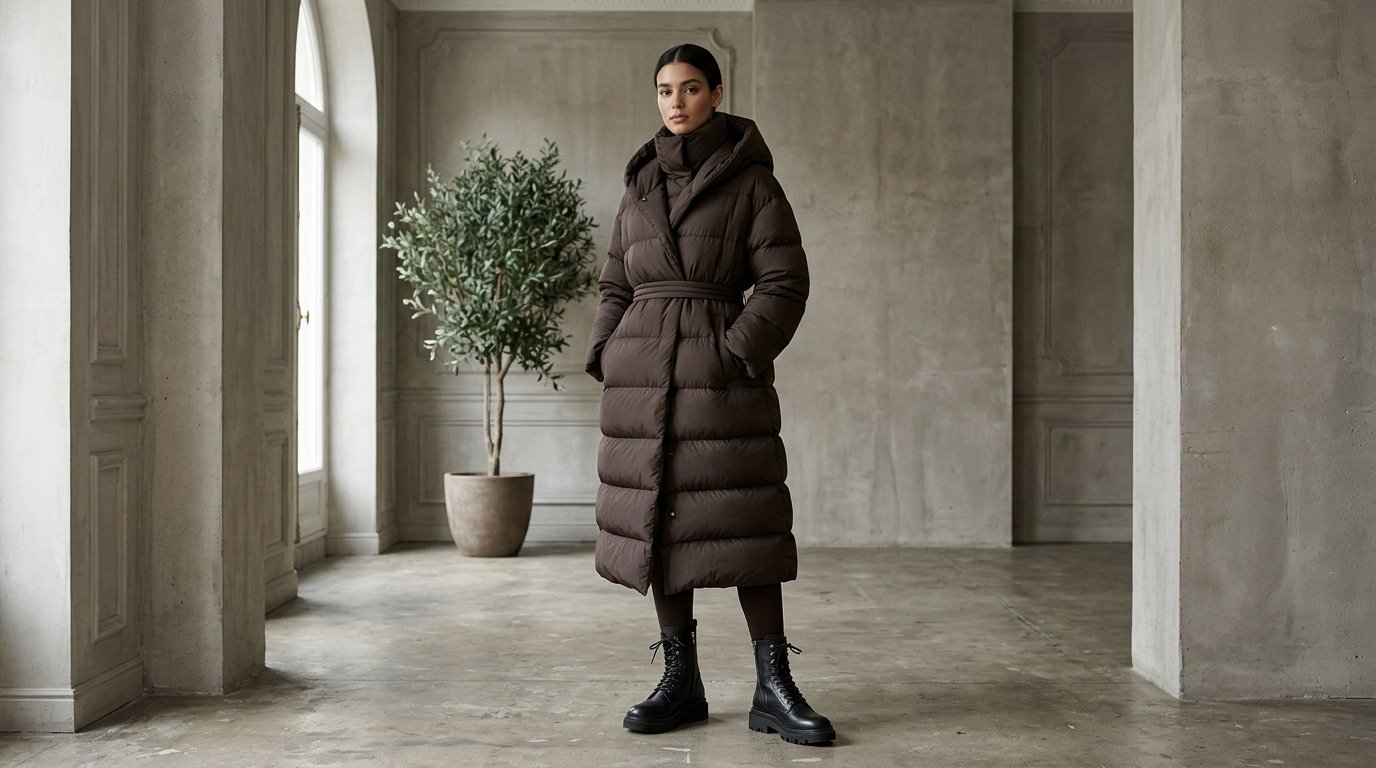
Winter 2026/2027 brings a refined haute-pret-a-porter aesthetic to insulated outerwear. The dominant silhouette is an elongated midaxi cocoon (120 to 125 cm center back length for statures 168 to 172 cm) tapering inward by 5 to 7 cm toward the hemline with an internal elastic drawcord and metal toggle stops. This tapered curvature prevents cold upward drafts while sculpting a streamlined aerodynamic form.
Moving away from micro-channel stitching, runway designers embrace macro-scale quilting: wide horizontal baffles spaced 14 to 18 cm apart or expansive 20 by 20 cm diamond matrices. Shell fabrics rely on matte Japanese and Korean technical textiles coated with breathable polyurethane membranes (110 to 135 gsm), eliminating cold weather rustle and offering a subtle tactile sheen. The color palette favors roasted dark espresso, wet slate grey, ash taupe, and creamy warm cashew.
2. Deformation Physics: Quilting Shrinkage Ratios and Rough Pre-Cut Formulations
Each pass of a quilting stitch compresses high-loft insulation (200 to 250 gsm), pulling adjacent shell fabric into three-dimensional ridges that reduce surface dimensions. Linear contraction correlates directly with baffle density and batting thickness:
- Wide Quilting Baffles (14 to 18 cm spacing): contracts 3.5 to 4.2% vertically and 2.5 to 3.0% horizontally;
- Dense Baffles (8 to 10 cm spacing): contraction escalates up to 5.0 to 6.0% in length;
- Diamond Quilting (Bias Stitching): uniform 4.5% contraction across both fabric axes.
Our studio adheres to a strict manufacturing rule: coat shell panels are never cut to final net slopers initially. Instead, rough panels are blocked out with a +3.5 to 4.5 cm perimeter allowance around each pattern piece. Quilting begins strictly from the panel center outward to prevent fabric bunching. Only after complete stitch stabilization and a 24-hour relaxation period are finished pattern blocks laid over the quilted slabs to execute precision final trimming with standard 1.0 to 1.2 cm seam allowances.
3. Insulation Science: Engineering -25 °C Thermal Shields Without Excess Bulk
To achieve sub-zero warmth without creating a heavy unwieldy garment, modern bespoke outerwear relies on advanced calendered microfibers. While raw goose down presents laundering and clumping challenges in wet urban climates, siliconized synthetic insulation packages provide superior stability:
Alpolux or Thinsulate 200 gsm: Blending hollow microfibers with natural merino wool, this batting traps still air to deliver comfort down to -25 °C while maintaining a sleek 18 to 22 mm compressed profile.
Two-Layer Downproof Core: To block microfiber escape through needle punctures, a 25 to 30 gsm thermal-bonded spunbond non-woven scrim or high-density windproof interlining is sandwiched between the outer shell and the batting. Stitching directly through this scrim seals fiber ends and locks thermal loft permanently in place.
4. Windproof Enclosure Engineering: Magnetic Storm Flaps and Ribbed Storm Cuffs
The primary thermal vulnerabilities on any winter jacket are the front zip closure and sleeve openings. Cold gale-force air penetrates zipper teeth easily unless protected by specialized tailoring barriers:
- Interior Quilted Under-Flap: A continuous 4.5 to 5.0 cm wide placket insulated with 100 gsm batting sits behind the heavy-duty #8 two-way zipper, complete with an upper chin-guard tab to prevent ice-cold slider contact with the skin;
- Concealed Magnetic Outer Storm Placket: Overlaps the zipper by 4.0 cm on the exterior. We embed 15 mm neodymium disc magnets hermetically sealed inside flexible silicone envelopes within the placket seam: the coat snaps closed automatically when walking;
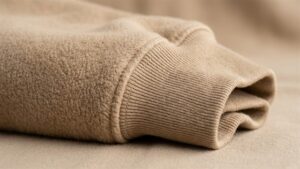
- Recessed Storm Cuffs: Sewn into the sleeve lining seam 6 cm above the sleeve hem, these 10 to 12 cm long cuffs are crafted from 380 gsm dense 95/5 cotton-spandex rib knit (kashkorse), hugging the wrists securely to block drafts from rushing up the arms.
5. Sculptural Cocoon Hood Architecture: Wind-Sealed Warmth Without Scarves
The 2026/2027 puffer hood functions as a natural extension of the high stand collar. We draft a three-piece hood incorporating a 8 to 10 cm center gusset that conforms smoothly to the skull curvature:
The neckline drops 2.5 cm along the front and back bodice to accommodate chunky cashmere turtlenecks comfortably. The front collar stand rises 10 to 12 cm, enabling full closure up to the lower lip. The facial perimeter houses a concealed drawstring tunnel equipped with 3 mm shock-cord and dual cord-locks, permitting instant wind sealing during winter storms.
When stitching calendered technical shell fabrics with high-loft batting, always use Schmetz Microtex or sharp Jeans needles sized 75/11 or 80/12. Their acute acute points slice between microfibers rather than tearing circular punch holes in waterproof membranes. Maintain a stitch length strictly between 3.8 and 4.2 mm; smaller stitches perforate the fabric like a stamp sheet, causing insulation leakage and seam tearing. Always engage a walking foot (even-feed mechanism) or Teflon presser foot to prevent top-layer fabric slippage and diagonal ripple distortions.
6. Styling Proportions and Coordination for Winter Streetwear 2026/2027
An architectural 125 cm quilted cocoon coat demands tailored discipline across the lower silhouette to avoid an unstructured bulky look:
Pair the coat with sharp pressed wool trousers, coordinating fine-gauge cashmere joggers, or dense ribbed knit maxi skirts. Anchor the hemline with structured lug-sole Chelsea boots or minimalist leather combat boots. The tactile juxtaposition of technical matte nylon against plush cashmere and structured leather produces a harmonious luxury streetwear ensemble.
Sew Your Bespoke Quilted Cocoon Coat With Studio Engineered Patterns
Download professional digital patterns for cocoon puffers and quilted coats with pre-calculated ease and batting thickness compensation. Sizes 40 to 54 with comprehensive construction guides.
Explore Puffer Patterns
Apparel Industry Hub in Telegram
Community of garment manufacturers, tailors and designers. Daily fresh workshop vacancies, verified factories database and direct contacts.