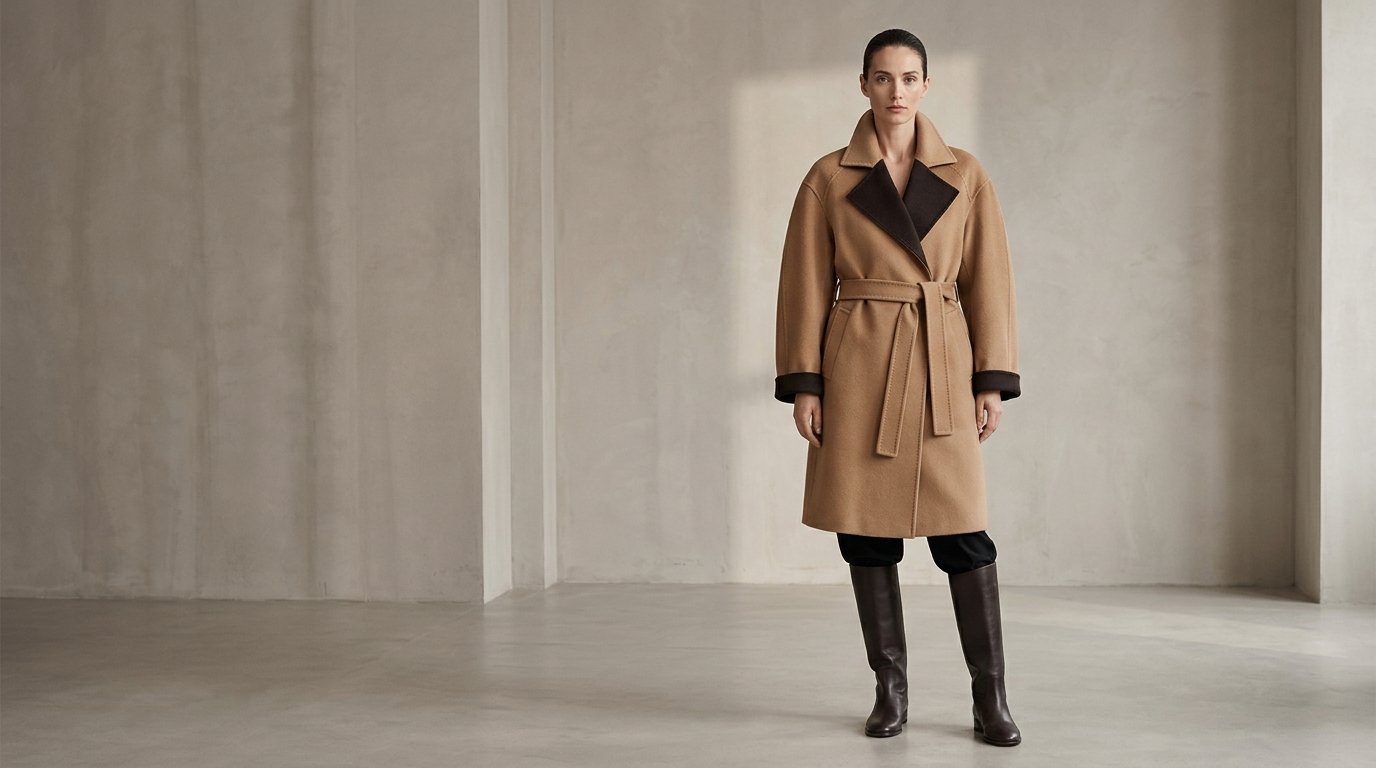
The quintessential outerwear silhouette for Winter 2026/2027 revolves around the architectural cocoon coat and relaxed belted robe silhouettes featuring sculptural raglan sleeves: shifting away from rigid shoulder pads, modern tailoring prioritizes calculated drape across heavyweight double-faced cashmere and rich espresso wool melton. In our patternmaking laboratory, we engineered a precision ease-allowance matrix and underarm gusset geometry that eliminates back stress folds during motion. In this comprehensive technical guide, we break down raglan drafting with shoulder darting, notched collar lapel roll lines, three-tier chest canvas interlinings, and steam pressing protocols utilizing a solid hardwood clapper.
- 1. Silhouette Architecture: The O-Shape Cocoon, Midaxi Length and Raglan Curves
- 2. Ease Allowances and Balance Mechanics: Sizing for Chunky Knitwear
- 3. Sleeve Engineering: Raglan Shoulder Darts and One-Piece Gussets
- 4. Tailored Notched Collar Mechanics: Stand Height, Lapel Break and Roll Allowances
- 5. Interfacing Architecture: Zonal Fusibles and Horsehair Chest Canvas
- 6. Pressing Protocol and Silhouette Coordination with Footwear
When our studio analyzed luxury winter coatings ranging between 480 and 620 gsm, it became apparent that conventional commercial slopers fail to balance runway volume without collapsing into bulky shapelessness. True architectural tailoring requires microscopic armscye depth adjustments and exact collar roll calculation along the back neck. Mastering canvas and fusible interfacing architecture empowers sewists to achieve sculpted lapels that roll softly without stiff cardboard rigidity. Below is our definitive step-by-step masterclass on drafting and constructing the benchmark Winter 2026/2027 coat.
1. Silhouette Architecture: The O-Shape Cocoon, Midaxi Length and Raglan Curves
Outerwear proportions for Winter 2026/2027 balance generous upper volume with deliberate tapering at the hem. The cocoon O-silhouette is crafted using curved side seams that reach peak expansion at hip level before narrowing by 4 to 6 cm per side toward the bottom hemline. Cut at a refined midaxi length of 128 to 135 cm along the center back, the coat hemline overlaps tall leather boot shafts by 6 to 8 cm, preventing disjointed breaks in the visual vertical line.
The shoulder point drops 2.5 to 4.0 cm past the anatomical acromion bone, transitioning seamlessly into a three-piece raglan sleeve. This geometry drapes the torso in a soft sculptural shell that holds majestic balance whether cinched with a soft tie belt or worn loose and open in stride. Core runway colorways feature roasted espresso, warm camel melange, smoky charcoal, and untreated virgin wool ecru.
2. Ease Allowances and Balance Mechanics: Sizing for Chunky Knitwear
Attempting to create an oversized coat by simply cutting two sizes up invariably distorts garment balance: the neck pulls backward, armscyes bind into the armpit, and sleeve pitch pitches off-grain. Professional pattern drafting demands specific engineered allowances across sizes 42 to 52:
- Bust Ease Allowance: +16.0 to +20.0 cm total circumference (distributed equally between front chest, armscye width, and across-back);
- Waist Ease Allowance: +24.0 to +28.0 cm to ensure fluid, uninhibited vertical drop;
- Hip Ease Allowance: +14.0 to +18.0 cm tapering toward the lower edge;
- Armscye Depth Drop: lowered 5.0 to 7.0 cm below anatomical armpit depth;
- Upper Bicep Ease Allowance: +10.0 to +13.0 cm, ensuring effortless layering over tailored blazers or chunky cable-knit sweaters.
3. Sleeve Engineering: Raglan Shoulder Darts and One-Piece Gussets
To guarantee complete freedom of arm articulation without pulling the coat hemline upward, our studio relies on two precision drafting systems:
Three-Piece Raglan Sleeve: The upper sleeve seam incorporates a 2.0 to 2.5 cm shoulder dart that sculpts the shoulder curve naturally without artificial padding. The front raglan diagonal intersects the neckline cleanly, while the underarm armscye curve maintains a smooth 8 to 10 cm radius to eliminate binding diagonal stress lines.
One-Piece Sleeve with Diamond Underarm Gusset: When cutting continuous kimono or batwing sleeve designs, a 10 by 14 cm diamond gusset inserted at the armpit absorbs tension when reaching overhead. Slash corners on the front and back bodice are reinforced with 15 mm straight-grain fusible stay-tape to prevent fabric tearing under real-world strain.
4. Tailored Notched Collar Mechanics: Stand Height, Lapel Break and Roll Allowances
A bespoke notched collar demands mathematical precision. The lapel break line originates at the primary closure button placed at or slightly above natural waist level:
- Lapel Roll Line: Projects from the button stance through a point along the neck seam positioned exactly 2.5 to 3.0 cm out from the shoulder seam;
- Notch Angle and Gorge Line: Engineered at an open 70 to 80 degree angle, with notch width measured at 3.5 to 4.5 cm along the collar leaf;
- Turn-of-Cloth Allowance: The upper collar and front facing are drafted with a 2.5 to 3.5 mm outer perimeter extension over the undercollar and coat front. This turn-of-cloth delta ensures the seam line rolls 1.5 to 2.0 mm toward the underside, concealing raw stitches from sight;
- Undercollar Stand Construction: Cut on a true 45-degree bias in two halves with a separate 3.5 cm stand piece to mold seamlessly against the nape of the neck.
5. Interfacing Architecture: Zonal Fusibles and Horsehair Chest Canvas
Heavy wool melton and delicate cashmere require calibrated internal support. Over-fusing with stiff industrial web destroys fabric vitality. We implement a three-tiered composite support architecture:
Foundation Tier: High-grade woven bi-elastic fusible interfacing (85 to 105 gsm) stabilizes front facings, upper collar, pocket welts, and 5.0 cm hem allowances along sleeve cuffs and bottom edges.
Zonal Front Shield: The main front bodice receives bias-cut soft weft-insertion interfacing across the upper chest, armscye, and shoulder zone down to 10 cm below the armpit, leaving the lower coat drape completely flexible.
Horsehair Canvas Chest Piece (Plastron): A genuine 22 by 28 cm horsehair canvas chest pad with pinked edges is anchored over the chest curve using loose hand-stitched catch stitches. This springy core prevents chest hollows and preserves dimensional curve for decades of wear.
When pressing seams on heavy coating wool, always bevel-trim seam allowances: trim one side to 4 mm and leave the companion allowance at 8 mm. After pressing the seam open with steam, immediately press down with a heavy solid beechwood or oak tailor clapper, holding firm pressure for 15 to 20 seconds. The dense hardwood instantly absorbs latent steam and heat, locking the wool fibers into razor-flat submission without leaving shine or impression marks on the face of the fabric.
6. Pressing Protocol and Silhouette Coordination with Footwear
Sculpting wool fibers requires alternating moist heat and dry pressure. Before seam assembly, armscye and neckline edges are shrunk 1.0 to 1.5 cm with wet steam cloth, while sleeve elbow darts and gussets are eased and stretched into anatomical curvature.
On the street, an architectural 130 cm midaxi coat demands grounded lower-body tailoring: pair it with pleated wide-leg wool trousers, column knit dresses, or crisp bias skirts. Tall structured boots featuring architectural block heels anchor the hemline, delivering a statuesque vertical proportion that flatters all statures.
Sew Your Bespoke Cocoon Coat With Studio Engineered Patterns
Download tested digital patterns for oversized cocoon, raglan, and wrap coats calibrated for heavy wool and double-faced cashmere. Sizes 40 to 54 with comprehensive photo manuals.
Explore Coat Patterns
Apparel Industry Hub in Telegram
Community of garment manufacturers, tailors and designers. Daily fresh workshop vacancies, verified factories database and direct contacts.