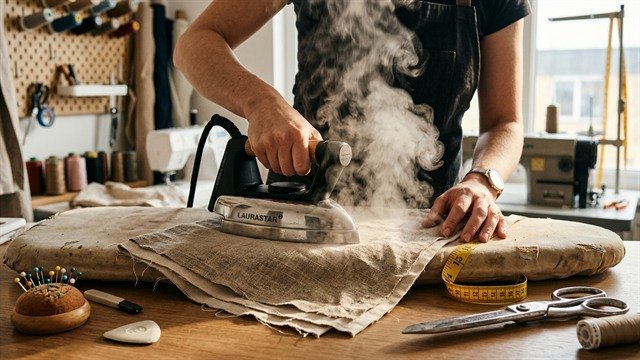
Every experienced craftsman knows the golden rule: never cut fabric immediately after purchase without first carrying out a wet-heat treatment. This process is called decatification.
Ignoring this stage leads to unpleasant surprises: your new favorite dress or trousers may “shrink” and become too small after the first wash. Let's look at why decating is needed and how to properly process different types of fabrics before cutting.
What is decatification and why is it needed?
Almost all textile materials are under tension during production at the factory. The threads are woven under a certain tension, and the fibers may contain residues of technological impregnations and finishing agents.
When the finished product is placed in water or exposed to hot steam, the fibers relax, return to their natural state and shrinking. If you cut an item from untreated fabric, after washing the finished item will inevitably become deformed, the seams will become wavy, and the item will shrink in size by 3–10%.
Decoration rules for different types of fabrics
Each material requires an individual approach. Incorrect processing can irreversibly damage the fabric even before cutting begins.
1. Cotton, linen and blended fabrics
These materials give the most noticeable shrinkage. Soak the fabric in warm (but not hot, about 30–40°C) water for 15–20 minutes, wring it out lightly without twisting (so as not to distort the grain) and lay it flat to dry. Be sure to iron the dried fabric with steam from the wrong side.
2. Wool and wool blends
Wool should absolutely not be soaked in hot water or rubbed vigorously. Wrap the piece in a damp cotton sheet for several hours, then gently dry it in a horizontal position or carefully iron it with a steam generator in the “Wool” mode through a damp iron, moving the iron exclusively along the grain thread.
3. Knitwear (collar, footer, ribana, interlock)
Knitted fabrics are very sensitive to tension. Place the knitwear in warm water with a mild detergent, rinse gently, wring it out through a terry towel and dry strictly in a horizontal position. You cannot hang wet knitwear on a rope - it will stretch out under its own weight. After drying, iron it with steam without stretching the fabric with your hands.
4. Natural silk, viscose and delicate synthetic fabrics
Natural silk and viscose require extreme delicacy. They can be quickly rinsed in cool water with a couple of drops of vinegar added (this will fix the color and brightness), gently wrung out in a towel and ironed slightly damp on the inside on a delicate cycle without using the water spray function (to avoid water spots).
The main mistakes when decatifying
- Ignoring the composition of the fibers:An attempt to treat the fabric with too high a temperature if the composition contains synthetics, which can melt or become deformed from the hot sole of the iron.
- Drying on a rope or hanger: Hanging heavy or knitted sections leads to a strong distortion of the geometry of the fabric even before cutting.
- Cutting wet fabric:Do not cut fabric immediately after ironing. The canvas must cool completely, dry and “rest” on the cutting table for at least several hours.
By devoting just an hour to pre-prepping the fabric, you ensure that your product will retain its ideal size and flawless appearance after many washes.
Follow new useful materials in the SHITTYA TA KRIY category on our portal vykroyka.com.ua!

Apparel Industry Hub in Telegram
Community of garment manufacturers, tailors and designers. Daily fresh workshop vacancies, verified factories database and direct contacts.