Buying fabric is always an exciting stage. Take too little and the costume piece simply won’t fit on the cut. Take it with a huge reserve - the extra meters will gather dust in the closet for years.
How to accurately calculate the fabric consumption for a dress, skirt, trousers or jacket, taking into account the width of the roll, allowances and body shape? We analyze step-by-step formulas and professional tricks for economical cutting.
Main factors affecting fabric consumption
Before you count centimeters, you need to consider four key parameters:
- Roll width: The standard width of tailor's fabrics is narrow (90–110 cm) and wide (140–150 cm, and for knitwear and bed linen - 180–220 cm). The width directly determines how many parts will fit in one row horizontally.
- Direction of pattern and pile: If the fabric has a pronounced check, stripe, coupon print or pile (corduroy, velvet), all patterns of the pattern can be placed strictly in one direction. This increases fabric consumption by an average of 20–30%.
- Shrinkage (decatation): Materials made from natural fibers (cotton, linen, wool, viscose) shrink after WTO. It is always necessary to include a margin of 5–10% to the calculated footage.
- Features of the figure and style: Non-standard height, curvy shapes, the presence of deep folds, flounces, belts, pockets and cuffs require additional footage.
Basic calculation formulas for main types of clothing
1. Dress with a straight or semi-fitting silhouette (without a cut-off waist)
- For wide fabric (140–150 cm): The consumption is equal to Product length + Sleeve length + 15–20 cm for processing the neckline, hems and allowances. If the size is up to 48-50, all the main parts of the front and back easily fit across the width.
- For narrow fabric (90–110 cm):The front and back parts do not fit side by side, so the calculation is carried out in two lengths: (Product length × 2) + Sleeve length + 25 cmfor allowances.
2. Skirt (depending on cut)
- Straight skirt or pencil skirt: With wide fabric, the consumption is Skirt length + 15–20 cm (for the belt, vent and hem). If the hip circumference exceeds the width of the fabric including allowances, two lengths will be required.
- Skirt-sun and half-sun:Calculation for half-sun: (Skirt length + Waist notch radius) × 2 + allowances. Full sun with a standard fabric width usually requires 4 skirt lengths plus a radius.
3. Trousers or dress shorts
- For wide fabric (140–150 cm): The standard consumption is The length of the trousers along the side seam + 20–30 cm (for the stitched waistband, codpiece, burlap pockets, hem and seam allowance). From one yardage, two halves of trousers are cut out at once in a “jack” layout.
- For narrow fabrics or large sizes (OB > 108–112 cm):Requires Two trouser lengths + 20 cm.
Professional tricks for economical cutting
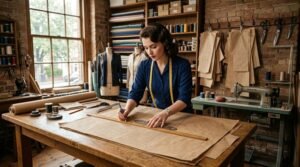
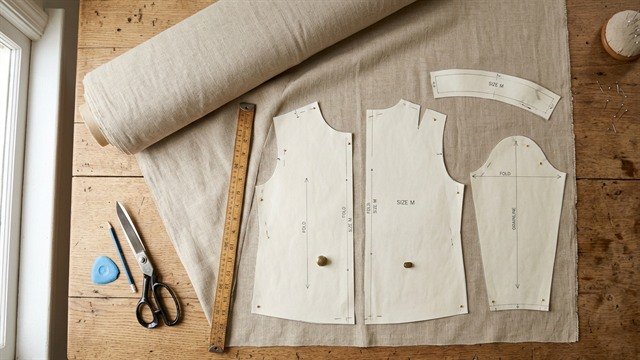
- Mini layout of the layout: Before going to the store, outline the boundaries of the future width of the fabric (for example, 140 cm) on the table or floor and lay out the paper patterns. This is the most reliable way to find out the exact footage down to the centimeter.
- Compliance with the shared thread: It is strictly forbidden to save money by slanting or randomly placing patterns (if this is not provided for in the style) - the item will warp the first time you wear it.
- Taking into account seam allowances: Standard seam allowances (1–1.5 cm) and hem allowances (3–5 cm) take up a noticeable area, especially on products with reliefs and pockets.
Proper calculation of footage will protect you from unnecessary expenses and relieve stress when cutting.
Follow new useful materials in the SHITTYA TA KRIY category on our portal vykroyka.com.ua!

Apparel Industry Hub in Telegram
Community of garment manufacturers, tailors and designers. Daily fresh workshop vacancies, verified factories database and direct contacts.