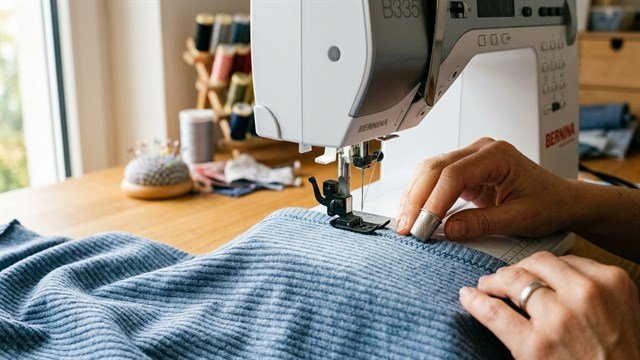
Knitted fabrics are a favorite material for creating comfortable clothing: T-shirts, hoodies, dresses and suits. However, many home craftsmen avoid sewing knitwear for fear of skipped stitches, rippled seams and torn threads if they do not have a professional overlocker or cover stitcher at home.
In fact, you can sew a high-quality and durable product from knitwear using the most ordinary household sewing machine. The main thing is to know a few important rules for preparing and setting up equipment.
1. Choosing the right needle is the key to success
Ordinary universal needles (Universal) are not suitable for knitwear: their sharp tip pushes the fibers apart, but often tears them or leaves gaps in the stitching.
- Use special Stretch or Jersey needles:
- Jersey brand needles have a slightly rounded tip that gently pushes the fabric loops apart without damaging the threads.
- Stretch needles have a special blade shape and a special coating that prevents stitch skipping on highly elastic synthetic fabrics (supplex, oil, thick tricot).
- Select the needle size according to the thickness of the fabric: No. 75/11 is suitable for thin knitwear, and No. 90/14 is suitable for dense fleece.
2. Select the right threads and foot
The quality of the stitching directly depends on the fittings and the pressure of the presser foot on the fabric:
- Quality polyester thread:Use 100% polyester thread (such as Gutermann, Madeira or Durak). They have high elasticity and tensile strength, unlike cotton threads.
- Adjusting the foot pressure:If your sewing machine has an adjustable foot pressure on the fabric, reduce it slightly. This will prevent the knitted fabric from stretching and deforming under the foot while sewing.
- Walking foot (upper feed): A Teflon foot or walking foot (upper feed) will be an excellent help. It feeds both the bottom and top layers of fabric evenly, eliminating their displacement and seating.
3. Selecting elastic seams on a regular machine
The main requirement for a seam on knitwear is that it must stretch along with the fabric, otherwise the thread will simply burst the first time the product is put on. Forget about the usual straight stitch on cut details.
Use the following alternative stitches on your machine:
- Narrow zigzag: Classic option. Set the stitch width to 0.5–1 mm and the stitch length to 2–2.5 mm. This seam looks almost like a straight line, but has the necessary elasticity.
- Full zigzag:Used for processing cuts and stitching parts on moderately elastic fabrics.
- Triple Stretch Stitch (Reinforced Straight Stitch):The machine stitches back and forth to create a strong, very stretchy line. Ideal for sewing shoulder seams and armholes.
- Imitation overlock seam (pseudo-overlock): A special overlock stitch on your machine that simultaneously stitches and overcasts the cut.
4. Little tricks for perfect fabric feeding
If the knitwear is capricious, stretches or gets caught in the needle plate, use proven sewing life hacks:
- Water-soluble interlining or thin tracing paper: Place a strip of paper under the stitching if the fabric falls through the needle plate. After sewing, the paper is easy to carefully remove, and the water-soluble stabilizer is simply washed off with warm water.
- No pulling with your hands:Never pull the fabric with your hands while sewing in an attempt to “help” the machine. The machine itself must feed the fabric, otherwise the seam will go in waves.
- Mandatory WTO (moist heat treatment): Iron finished seams using a steam iron. This will help the stitching to “settle down” and the fabric to return to its original shape after being pierced with a needle.
Sewing knitwear without an overlocker is not a compromise on quality, but a matter of setting up your technique correctly. Experiment with small patches before starting to create a project and your knits will look professional.
Follow new useful materials on our portal vykroyka.com.ua!

Apparel Industry Hub in Telegram
Community of garment manufacturers, tailors and designers. Daily fresh workshop vacancies, verified factories database and direct contacts.