Expanding garment manufacturing operations, acquiring automated spreading machines or laser cutters, and entering export markets require substantial capital injections. Retained factory earnings are often insufficient for aggressive scaling, while high-interest commercial bank loans carry serious cash-flow hazards. Securing non-repayable grants, developmental financing, and private equity investments serves as a powerful catalyst for apparel enterprise growth.
1. State and International Grants for Light Industry
International development organizations (such as USAID, EBRD, and EU industrial support programs) actively inject capital into apparel manufacturing SMEs:
- Non-Repayable Capital: Grant funds are non-refundable provided enterprise covenants are maintained: creating documented jobs, maintaining payroll compliance, and generating domestic tax revenue over an audit window (typically 12 to 36 months).
- Allowable Capital Expenditures: Grants primarily fund industrial capital expenditures: modern CNC cutting complexes, automated seam-sealing machinery, multi-head embroidery equipment, and CAD/ERP engineering licenses.
- Evaluation Benchmarks: Complete financial transparency, formal employee registration, rigorous economic feasibility calculations, and socioeconomic impact.
2. Crafting a Compelling Factory Business Plan for Investors
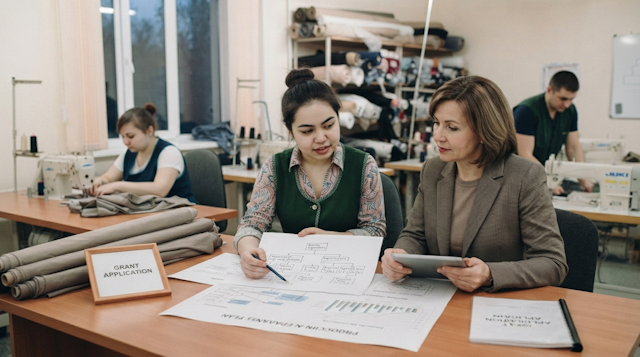
Private equity investors and grant review committees evaluate apparel ventures purely on fiscal discipline and technical viability:
- Market Segment Analysis: Demonstrate verified demand metrics for your target silhouettes (activewear, certified children's collections, or corporate technical apparel).
- Unit Manufacturing Economics: Provide itemized bill-of-materials costing, standard-minute-value (SMV) operation sheets, enterprise break-even benchmarks, and equipment return on investment (ROI).
- Pre-Production Readiness: Investors heavily discount speculative concepts. Supplying finalized technical documentation, calibrated CAD grading, and factory-tested prototypes establishes institutional credibility.
To assure grant evaluators of rapid production rollout without misallocating capital toward protracted prototyping, utilize engineering-grade digital patterns from the Vykroyka.com.ua patterns portal, dramatically curtailing operational risk during new line launches.
3. Alternative Funding: Equipment Leasing and Crowdfunding
Beyond competitive grant tenders, garment manufacturers leverage alternative financing instruments:
- Industrial Equipment Leasing: The premier method for upgrading machinery without exhausting liquidity. Pay a 20–30% initial down payment, deploy machines on the floor immediately, and fund ongoing lease liabilities straight from generated operational margins.
- Crowdfunding & Pre-Order Financing: Ideal for independent apparel brands. Present collection prototypes through social channels or pre-order platforms, collect 100% advance customer payments, and fund workshop runs entirely debt-free.
Securing enterprise financing requires transparent accounting and structured operational governance. Aligning grant funding, equipment leasing, and standardized CAD pattern foundations ensures sustainable, non-dilutive manufacturing growth.
Developing a garment factory business plan for grants or investors?
Access verified digital CAD patterns with calibrated construction specs to de-risk production execution.
EXPLORE PATTERNS →