Many beginning craftswomen put off sewing stylish hoodies, such items as basic pattern for men's T-shirt FMR001 or knitted dresses, due to the lack of an overlock machine. However, you can sew a high-quality item from elastic fabric using a regular household sewing machine. The main thing is to know the special secrets of setting stitches, correct feeding of fabric and selection of needles. In this article we will look at 7 golden rules for sewing knitwear at home, with which your seams will never burst when worn.
Contents of the article
- Rule 1. Choosing the right needles: Jersey, Stretch and Super Stretch
- Rule 2. Threads for knitwear: elasticity and quality
- Rule 3. Elastic stitches on a household sewing machine
- Rule 4. How to avoid “waves” and stretching of fabric
- Rules 5–7. Double needle, stabilization and processing of sections
- Tailor's advice: the secret to the perfect neckline and hem
- Frequently asked questions (FAQ)
Rule 1. Choosing the right needles: Jersey, Stretch and Super Stretch
An ordinary universal needle with a sharp tip cuts through thin threads of knitted fabric, which is why holes and arrows form on the product over time, and the machine begins to skip stitches.
- Jersey needles:Have a rounded tip that gently pushes the threads of knitted fabric apart without damaging them. Ideal for cotton, kulirka, interlock and footer.
- Stretch needles: Designed for highly elastic synthetic materials containing lycra and elastane (supplex, oil, viscose jersey).
- Super Stretch needles: Helpful when sewing dense, heavy elastic fabrics and high-stretch knitwear, eliminating skipped stitches.
Rule 2. Threads for knitwear: elasticity and quality
Old cotton threads are not suitable for sewing knitwear - they do not have elasticity and burst at the first tension of the fabric.
Use quality 100% polyester reinforced threads (for example, No. 120 / Gutermann, Madeira, Dor Tak). To sew highly elastic areas, textured or monofilm elastic thread can be wound on the shuttle bobbin.
Rule 3. Elastic stitches on a household sewing machine
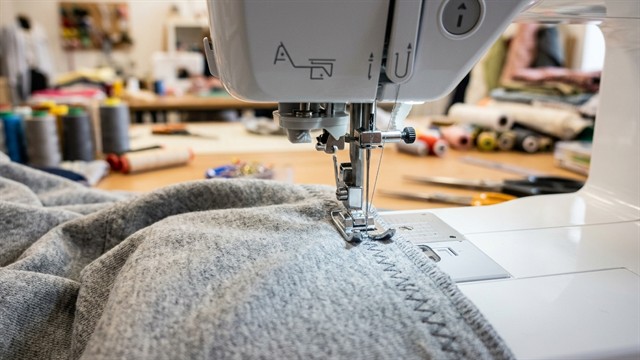
Straight machine stitching does not stretch and will tear when putting the item on. On a regular machine, use alternative stitches:
- Narrow Zigzag:Set the zigzag width to 0.5–1.5 mm and the stitch length to 2.5–3 mm. Externally, the stitch looks almost straight, but has excellent stretchability.
- Knitted “elastic” zigzag (in three pricks): Perfectly hems the waistband and the edges of the product (indispensable if you are working pattern of women's leggings BG002).
- Overlock and imitation stitches: Available in almost every modern machine (they look like honeycombs or parallel loops) - they simultaneously grind and hem the cut.
Rule 4. How to avoid “waves” and stretching of fabric
Under the sewing machine foot, elastic knit fabric often stretches, creating unsightly waves along the seam.
- Loosen the presser foot pressure: If your machine has a presser foot pressure control, lower it to 1 or 2.
- Use a walking foot (top feed):It feeds the fabric from the top and bottom at the same time, preventing the layers from shifting and stretching.
- Place a water-soluble stabilizer or tracing paper:A strip of thin paper under the seam will prevent the fabric from falling through and stretching.
Rules 5–7. Double needle, stabilization and processing of sections
Rule 5. Hemming the bottom with a double needle: A double needle for knitwear (Double Stretch) creates two parallel straight lines on the front side, and an elastic zigzag loop on the back. This is a perfect imitation of the seam of a cover stitching machine.
Rule 6. Stabilization of shoulder seams:Always reinforce shoulder seams and armholes with silicone tape, thin thread-stitched adhesive tape or fabric tape so that they do not stretch under the weight of the product.
Rule 7. Processing open cuts: Since knitwear practically does not fray, open allowances can be cut close to the zigzag stitch (up to 3-4 mm) or processed with zigzag scissors.
Tailor's advice
Before cutting, be sure to decoat the knitted fabric(wash or thoroughly steam with an iron), since natural knitwear shrinks up to 5–10%. Never hang-dry knitted cuts or finished items. And accurate and proven ready-made patterns from our catalog will help you sew the perfect basic hoodie or sweatshirt.
Frequently asked questions (FAQ)
Which foot should I use if I don’t have a special walking foot?
Use a standard walking foot or a Teflon/knit walking foot. Laying a strip of foam paper or masking tape over the fabric will also help.
Why does a double needle make a “roll” (bulge) between the lines?
This happens because the bobbin thread is too tight. Loosen the bobbin thread tension or lightly tighten the upper threads.
Is it possible to sew knitwear with 100% cotton threads?
Strongly not recommended. Cotton threads do not have a reserve of elasticity and quickly break when the knitted fabric is tensioned.
Expertly designed patterns are the key to a perfect fit of any product. To be the first to learn about the intricacies of design, modeling and trends in the sewing world, subscribe to our video channel Pattern - Ready-made patterns.