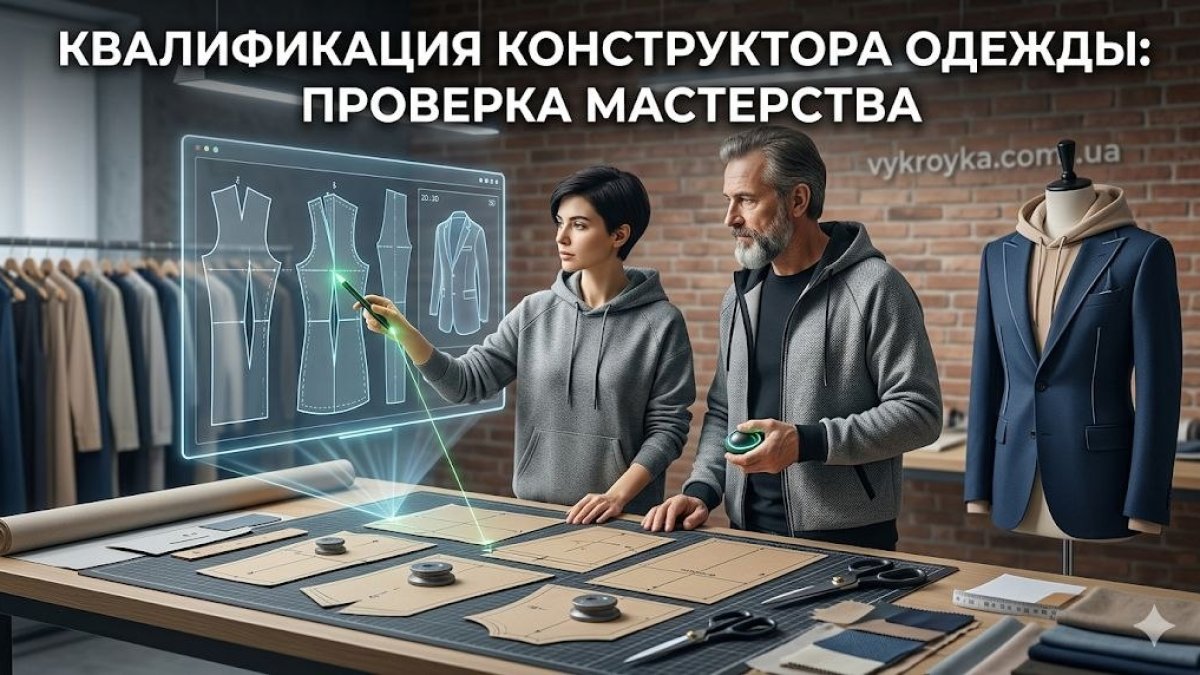
In the era of widespread digitalization, the ability to build precise patterns “by hand” on graph paper and electrical cardboard remains the highest criterion of the skill of a model designer. A designer capable of calculating the ideal balance of a shoulder or waist product without computer programs is indispensable in small and medium-sized sewing industries. In this article, we will analyze in detail practical tests and control questions that will allow you to identify the true qualifications of a specialist in 15 minutes.
Contents of the article
- Unit 1: Checking the accuracy of the drawing and manual construction skills
- Unit 2: Materials science, shrinkage and calculation of the elasticity coefficient
- Unit 3: Structural balance and alignment of control marks
- Unit 4: Practical exam: developing a collar or sleeve pattern in 15 minutes
- Expert advice: what to look for when interviewing a designer
- Frequently asked questions (FAQ)
Block 1: Checking the accuracy of the drawing and manual construction skills
A high-quality hand-made designer is distinguished by his confident hand position and knowledge of the geometry of tailor's patterns. When checking, look for the following key markers:
- Thickness of pencil lines:Drawing lines should be ultra-thin (up to 0.3–0.5 mm) and clear. Blurred lines 1–2 mm thick give a cutting error of up to an entire size.
- Design of connections: The lines of the armhole, sleeve cap and neckline should form smooth curves without sharp drops and angles at the points of convergence of parts.
- Proper application of allowances: A professional clearly delineates the allowances: 0.7 cm for edging and facings, 1 cm for stitching, 2.5–4 cm for hems.
Unit 2: Materials science, shrinkage and elasticity coefficient calculation
A true specialist never builds patterns “in a vacuum”, without knowing the physical and mechanical properties of a particular roll of fabric.
A qualified designer must be able to calculate the percentage of fabric shrinkage after decaling and recalculate the basic grid of the drawing to the knitwear tensile coefficient (Ky and Kx) to avoid sagging of the finished product.
Block 3: Structural Balance and Matching Markers
Structural balance is the ratio of the length of the front and back to the waist, which determines the verticality of the seams when worn.
Ask the candidate to line up the side and shoulder sections of the finished pattern. The control cuts along the waist, hips and armholes must coincide within 1 mm. Distortions or discrepancies in the length of the armhole and the sleeve cap are unacceptable.
Unit 4: Practical exam: designing a collar or sleeve pattern in 15 minutes
The best way to check is to give a small express task on a piece of cardboard:
- Construct a turn-down collar with a one-piece stand-up for a given neck length (for example, 38 cm).
- Construct a two-seam jacket-type sleeve with a given edging height and a fit of 3–4 cm.
- Cut out the cardboard pattern, following the warp thread and making clear cuts.
Advice from a sewing production manager
The main indicator of the professionalism of a manual designer is the speed of spatial thinking. A high-level specialist immediately sees the future product in volume and makes advance allowances for a loose fit. And professional ready-made patterns from our catalog will always help you use proven reference databases.
Frequently asked questions (FAQ)
Why do you need hand-made patterns if you have CAD (Gerber, Lectra, Grafis)?
Manual design is indispensable when creating experimental samples, individual haute couture tailoring and in production where instant adjustment of patterns is required without digital printing on a plotter.
Which cardboard is best to use for working patterns?
Use calibrated electrical cardboard (pressboard) with a density of 0.3–0.5 mm. It does not deform from moisture, holds a clear edge and can withstand hundreds of chalks.
Expertly designed patterns are the key to a perfect fit of any product. To be the first to learn about the intricacies of design, modeling and trends in the sewing world, subscribe to our video channel Pattern - Ready-made patterns.