Once a master sloper tailored to your individual proportions is established, the true creative journey of garment construction begins: pattern manipulation and styling. You no longer need to source individual commercial patterns for every trend spotted on runways or in fashion publications. By mastering core pattern slashing, dart rotation, and fullness distribution methods, you gain the independence to engineer hundreds of unique, bespoke designs. In this practical guide, we examine fundamental pattern manipulation principles, explore real-world garment transformations, and walk through pre-cut geometric alignment checks.
1. What is Garment Pattern Manipulation?
While drafting represents the foundational engineering grid derived from exact body dimensions, pattern manipulation is the creative styling process of reconfiguring a two-dimensional sloper block. Its primary advantage is complete silhouette freedom: introducing gathers, flare, asymmetric cuts, or decorative style lines, all while preserving the baseline fit around the neck, bust, and waistlines.
Every elaborate couture creation is derived from a reliable basic pattern sloper. The entire spectrum of designer aesthetics relies on combining a few timeless slash-and-spread and dart rotation techniques.
2. Core Principles of Pattern Transformation
Pattern engineering utilizes two primary geometric methods:
A. Parallel and Slash-and-Spread Expansion (Gathers and Flare)
- Parallel Expansion: used to distribute fullness uniformly along a pattern segment (creating gathered hemlines, pintucks, or box pleats). The block is slashed into equidistant strips and separated evenly;
- Slash-and-Spread (Radial Flare): employed to add circular flare to skirts (flounce, godet, A-line), flutter sleeves, or cascading lapels. Rays are slashed from the hem inward, preserving a tiny 1 mm hinge at the apex line, and opened fan-style to the desired circumference.
B. Graphical Style Line Transfer (Contouring and Slicing)
Enables structural panel subdivision — creating yokes, princess line contours, empire under-bust cuts, and asymmetrical drapes:
- Fresh style lines are sketched directly onto a working paper copy of the sloper;
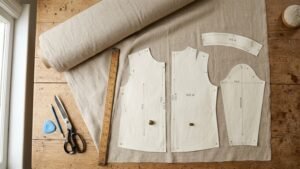
- The master block is cut along the styled lines into individual pattern pieces;
- Any original waist or bust darts intersected by the cut are taped closed, automatically pivoting their volume into the new seamline as natural curvature or gathers.
3. Practical Styling: Wrap Dresses and Puff Sleeves
Case 1: Engineering a Flattering Wrap Dress
Drafted using a full mirrored front bodice block:
- A sweeping diagonal line is plotted from the right shoulder seam down through the bust point across to the left waistline;
- The original bust dart is rotated into waist pleats or neckline gathers along the overlap edge;
- An integrated facing extension or separate binding allowance is drafted along the front edge for clean closure.
Case 2: Drafting a Dramatic Puff Sleeve
Transforming a standard set-in sleeve sloper:
- 4 to 6 vertical guideline rays are drawn from sleeve cap to wrist hem;
- The block is slashed and spread upward from the wrist hinge by 3 to 5 cm between segments, raising the cap height for dramatic shoulder volume;
- For a complete balloon sleeve, parallel spreading is applied across both cap and hem, gathering the bottom into a fitted cuff.
4. The Patternmaker's Pre-Cut Alignment Checklist
Before pinning modified patterns onto fabric, confirm all structural parameters:
- Seam Trueing: walk complementary seams together (front and back side seams, shoulder seams) to verify lengths match within 1 mm and cross transitions smoothly without sharp corner notches;
- Sleeve Cap Ease: ensure sleeve cap circumference exceeds armhole circumference by 1.5 to 3 cm of controlled easing;
- Grainline Integrity: verify the grainline arrow on each cut segment remains precisely parallel to the original center front/back vertical axis.
Never slice into your original master sloper. Always trace a working copy onto craft paper, keeping the original card sloper untouched. When drafting complex gathers, always punch matching balance notches across slash lines to guarantee effortless, accurate alignment during garment assembly.
Sew with Joy Using Precision Patterns!
Browse the Vykroyka catalog for professional digital sewing patterns featuring detailed illustrated construction guides.
Explore Pattern Catalog