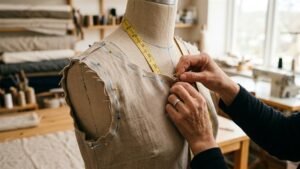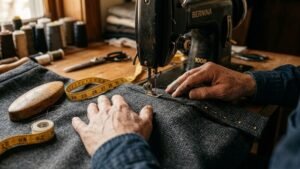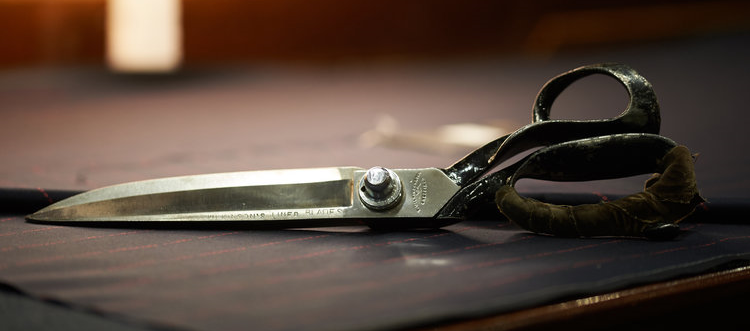
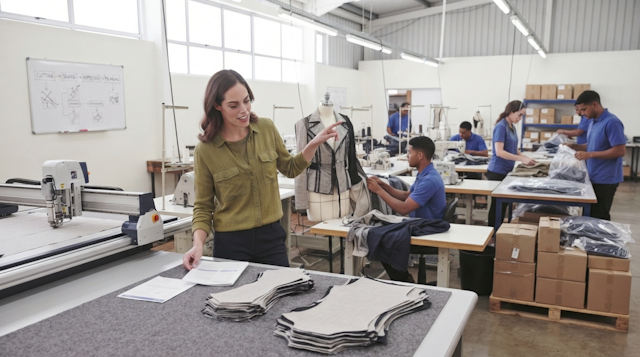
Once machinery is anchored and wired, textiles cleared through incoming testing, and seamstresses positioned at their benches, the apparel entrepreneur confronts the core operational challenge: harmonizing these decoupled stations into an exact, clockwork production line. Inter-stage chaos, semi-finished bundles piling up across worktables, and sewing bottlenecks can instantly decimate anticipated batch profitability. How do you construct an uninterrupted garment flow from the first rotary cut to pristine retail-ready packaging?
- 1. The Cutting Room: The Foundation of Speed and Assembly Accuracy
- 2. Progressive Line Flow vs. Sectional Bundle Methods
- 3. Quality Assurance (QA): In-Process Audits and Final Inspection
- 4. Final Steam Pressing, Labeling, and Retail Packaging
- Chief Technologist’s Advice: Eliminating Line Bottlenecks in Real Time
1. The Cutting Room: The Foundation of Speed and Assembly Accuracy
Cutting room precision directly dictates whether sewing operators breeze through seams or waste valuable minutes trimming misaligned pattern edges:
- Fabric Spreading Tables: Spreading tables must remain perfectly planar and span at least 3–5 meters to ensure tensionless cloth lay without warp-weft distortion.
- Cutting Tools: High-ply lays (10–20+ plies) require vertical straight-knife cutters; small runs and delicate fabrics call for nimble rotary disc cutters. For high-yield operations, computerized automated cutting systems (CAM) set the gold standard.
- Bundle Ticketing and Sequencing: Immediately post-cut, every ply component is sequentially ticketed with shade-lot and ply numbers (using self-adhesive tags) and bundled. This completely prevents shade variations between mismatched fabric rolls during final garment assembly.
To eliminate cutting room downtime, engineering pattern blocks must feature mathematically validated notch alignments and seam allowances. Utilizing professional digital blueprint collections from Vykroyka.com.ua guarantees acute line geometry and eliminates pattern distortion.
2. Progressive Line Flow vs. Sectional Bundle Methods
Your shop-floor layout determines operator productivity and organizational agility:
Sectional (Whole-Garment) Method:
- Principle: A single seamstress or a duo builds the entire garment from first join to final topstitch.
- Pros: Optimal for bespoke tailoring, couture sampling, or small production runs under 50–100 pieces; task variety reduces repetitive strain.
- Cons: Slower volume throughput; requires expensive high-tier versatile craftspeople.
Progressive Bundle Line Method:
- Principle: Garment assembly is deconstructed into discrete operations: operator A closes shoulder seams, operator B presses pockets, operator C sets sleeves, and operator D binds hemlines.
- Pros: Maximum manufacturing speed; superior margin efficiency on commercial volumes (300–500+ units per style); ability to integrate junior operators into simpler operations.
- Cons: Requires meticulous cycle-time balancing by production technologists to prevent line starvation.
3. Quality Assurance (QA): In-Process Audits and Final Inspection
Postponing quality inspection until finished garments reach the shipping dock is financial suicide. A sewing error initiated at step one that goes unchecked until piece forty forces costly seam ripping across the entire batch.
- In-Process Operator Self-Auditing: Each operator inspects the sub-assembly received from the preceding station prior to stitching. Floor supervisors run hourly random checks on stitch pitch, seam margins, and symmetry.
- Final QA Inspection Table: Dedicated inspectors examine garments over back-lit inspection surfaces: measuring critical dimensions against spec sheets, vetting thread trims, and verifying absence of needle oil marks.
4. Final Steam Pressing, Labeling, and Retail Packaging
Final finishing operations create the tactile retail prestige that commands premium pricing:
- In-Process vs. Final Pressing: Seam busting and creasing must occur at each assembly phase rather than only at the end. Final pressing on vacuum tables equipped with steam form-finishers confers structural silhouette stability.
- Thread Cleaning: Utilizing tabletop suction thread trimmers or manual snipping to eliminate loose thread tails.
- Retail Compliance Packaging: Affixing branded hangtags, inserting branded tissue or silica packets, folding around rigid card inserts, and sealing in breathable zip-lock polybags bearing scannable barcode SKU stickers.
Looking to Streamline Cutting and Eliminate Assembly Bottlenecks?
Leverage production-grade digital patterns from Vykroyka.com.ua: calibrated seam allowances and notch guides guarantee swift, seamless line throughput.
EXPLORE PATTERNS →