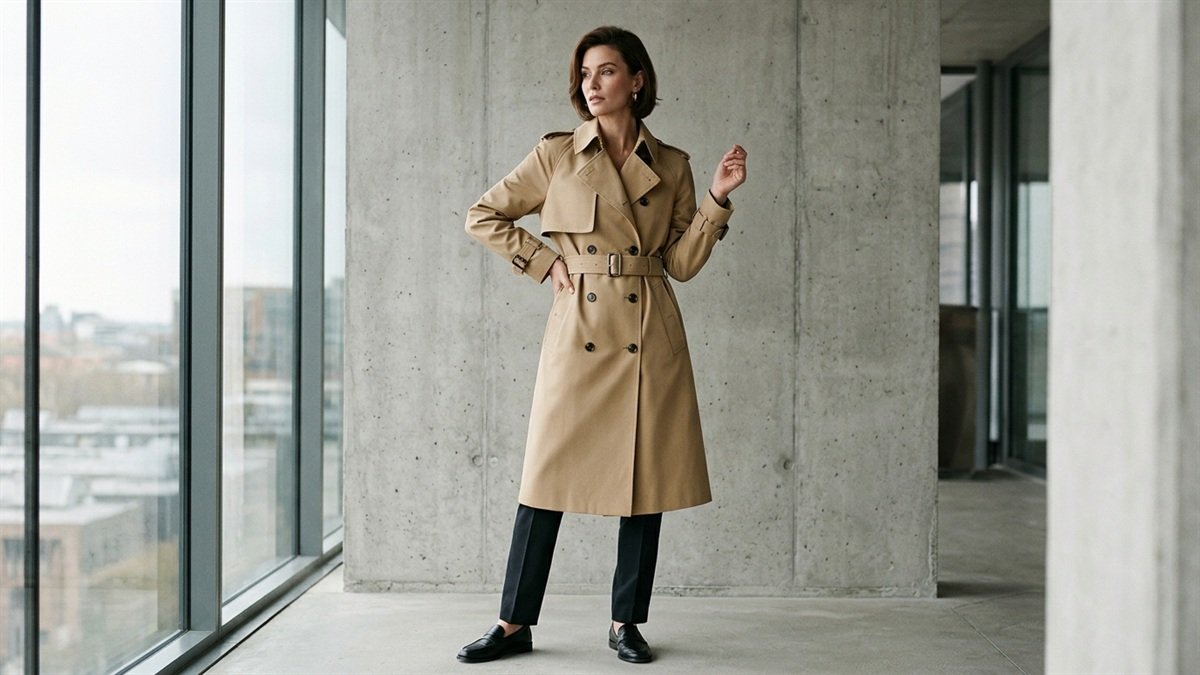
The 2026/2027 season elevates the double-breasted coat to monumental deconstruction: Thomas Burberry classic trench transforms into an expansive architectural cocoon with exaggerated storm flaps, generous raglan sleeves, and a defined D-ring waist belt. In our pattern-making atelier, we engineered and tested full-scale patterns across sizes 42 through 52 using high-density mercerized cotton gabardine weighing 340 to 380 gsm with fluorocarbon water-repellent finishing. In this comprehensive technical guide, we detail the generous ease allowances (+20 cm on chest, +30 cm on waist), the split-stand collar with detachable storm throat latch, the cutting geometry of the asymmetrical gun flap, and disciplined pressing of heavy cotton using a dense oak tailor clapper.
- 1. The 2027 Trench Evolution: From Military Utility to Monumental Couture
- 2. Hyper-Flap Architecture: Asymmetrical Gun Flap and Extended Storm Shield
- 3. Sculptural Raglan Sleeve Modeling: Soft Pitch, Underarm Gusset, and Buckled Straps
- 4. Convertible Collar with Separate Stand and Detachable Storm Throat Latch
- 5. Textile Selection: High-Density Mercerized Cotton Gabardine and Cupro
- 6. Waist Belt Hardware, D-Rings, and Welted Pass-Through Pockets
- 7. Pressing Protocol (VTO) for Heavy Cotton: Taming Dense Gabardine
- 8. Styling Directions 2027: Elongated Maxi Proportions in Dynamic Motion
- 9. Trench Coat Pattern Grading (Sizes 40 to 54): Harmonized Flap Dimensions
The primary defect when crafting an oversized trench coat is mechanically magnifying a vintage 1980s pattern. Doing so creates a heavy, sliding garment that falls backward under the weight of the back yoke, while the sleeves bind uncomfortably over tailored suit jackets or chunky knits. A true 2027 architectural trench coat is engineered around recalculated ergonomic balance: a shifted center of gravity, an optimized raglan slope, an armscye dropped by 4.0 to 5.0 cm with a gusset underarm inset, and an extended maxi sweep (125 to 132 cm back length) that floats dramatically in motion. Below is our design bureau definitive guide to drafting, cutting, and assembling the ultimate couture trench coat.
1. The 2027 Trench Evolution: From Military Utility to Monumental Couture
In the 2026/2027 collections, leading couture houses in Paris and London decisively deconstructed the trench silhouette. It is no longer a fitted utility garment; it is an expressive architectural overcoat celebrating fluid drapery and rhythmic folds as you walk.
When engineering master patterns, we incorporate the following ease allowances into basic half-girth dimensions (for sizes 42 to 52):
- Chest Ease Allowance: +18.0 to +22.0 cm (full girth ease of 36 to 44 cm), accommodating thick knitwear and structured wool blazers underneath;
- Waist Ease Allowance: +28.0 to +34.0 cm (total ease of 56 to 68 cm), permitting supple gathering with a belt without creating harsh diagonal fabric creases;
- Hip Ease Allowance: +16.0 to +20.0 cm, providing a flared trapezoidal sweep during strides;
- Raglan Armhole Drop: lowered by 4.0 to 5.0 cm, paired with an elbow sleeve girth of 46 to 52 cm for unrestricted upper body mobility.
2. Hyper-Flap Architecture: Asymmetrical Gun Flap and Extended Storm Shield
Floating storm flaps are the visual focal point of the modern trench. For 2027, their dimensions are enlarged by 35 to 40 percent relative to heritage archives:
Asymmetrical Front Gun Flap: Positioned on the right front, this flap extends downward to the waistline (28 to 32 cm length) with an acute lower angle. Cut double from self-fabric gabardine, the outer layer is interfaced with ultra-fine knitted fusing to prevent rolling, while the facing remains soft. It anchors with a 25 mm horn button reinforced with an interior stay button.
Deep Back Storm Shield: The back storm flap falls well past the mid-shoulder blade line (34 to 38 cm depth at center back) and features a sculpted wave lower hem. It directs rain away from the body while adding a bold horizontal line that anchors the elongated maxi hem.
3. Sculptural Raglan Sleeve Modeling: Soft Pitch, Underarm Gusset, and Buckled Straps
The 2027 trench raglan eliminates boxy sports aesthetics. We build a three-seam raglan sleeve incorporating a curved darted shoulder seam following the clavicle line:
To guarantee complete freedom of movement within an oversized block, we insert an underarm diamond gusset measuring 14 cm long by 6 cm wide. This prevents the coat hem from hiking upward when reaching for steering wheels or umbrellas.
The sleeve cuff features 2 to 3 deep intake pleats anchored by a 4.5 to 5.0 cm wide cuff strap with leather-covered or solid brass buckles, allowing instantaneous transition into a voluminous balloon silhouette.
4. Convertible Collar with Separate Stand and Detachable Storm Throat Latch
A high-performance trench collar must withstand gusty winds while laying in a crisp lapel roll when unbuttoned:
Separate Collar Stand Construction: The collar stand is drafted at 4.2 to 4.8 cm height with a gentle cervical curve and reinforced with heavy-duty warp-inserted fusible canvas. The collar points are expanded to 9.5 to 11.0 cm width with sharp acute points.
Detachable Throat Latch: Fastened beneath the undercollar with two buttons, this latch can be deployed to lock the collar upright around the neck during inclement weather. When not in use, it stows neatly on interior horn buttons concealed beneath the left lapel.
5. Textile Selection: High-Density Mercerized Cotton Gabardine and Cupro
Sculptural trench coats require densely woven fabrics that hold clean architectural lines without collapsing:
- English and Italian Cotton Gabardine (100 percent cotton or 70/30 cotton-nylon): 340 to 380 gsm, steep 63-degree twill line, and mercerized yarns delivering a refined semi-matte luster;
- Water-Repellent Finishes: Fluorocarbon Teflon or Bionic-Finish Eco coating that forces water to bead and roll off without penetration;
- Sleeve and Yoke Lining: Bemberg cupro twill or yarn-dyed jacquard viscose (95 to 110 gsm) providing effortless glide over chunky knits.
Yardage Requirements: Due to generous 128 cm back length, double storm flaps, and wide hem circumferences, fabric consumption is 3.80 to 4.10 meters for sizes 42 to 46, and 4.20 to 4.45 meters for sizes 48 to 52 (at 145 to 150 cm fabric width). Lining requirement is 2.80 to 3.10 meters. Hardware set: 10 large 25 mm front buttons, 8 medium 20 mm strap buttons, and 4 small 15 mm stay buttons.
6. Waist Belt Hardware, D-Rings, and Welted Pass-Through Pockets
Fine tailoring details substantiate the garment bespoke caliber:
Topstitched Waist Belt: The 5.5 cm wide belt is reinforced with four rows of heavy topstitching at 1.2 cm intervals to eliminate twisting when cinched. Two or three solid brass or nickel D-rings are anchored at the rear flank seams in homage to military field heritage.
Pass-Through Welt Pockets: The front features deep slant welt pockets with 3.5 cm welts and buttoned safety flaps. Cut at a 25-degree diagonal, they offer natural hand-resting ergonomics.
7. Pressing Protocol (VTO) for Heavy Cotton: Taming Dense Gabardine
Heavy gabardine resists standard domestic irons due to highly twisted combed cotton fibers. Achieving sharp, unglazed seams requires a disciplined regimen:
Steam Penetration: Press through a heavy linen or cotton press cloth using dry steam at 150 to 170 degrees Celsius under 3.5 to 4.0 bar pressure.
Immediate Oak Clapper Setting: Instantly upon lifting the steam iron, clamp the seam firmly with a polished dense oak tailor clapper for 10 to 15 seconds. The wood absorbs moisture and seals the thick seam flat without producing unsightly shine on the face fabric. Never press edges without a clapper, or seam impressions will show on the exterior.
8. Styling Directions 2027: Elongated Maxi Proportions in Dynamic Motion
An architectural trench dominates an outfit. For the coming season, our studio recommends two essential wearing attitudes:
Style 1: Unbuttoned Fluidity. Worn wide open with the belt knotted casually at the center back. As you walk, the fronts billow like wings, revealing straight wool trousers, a silk shirt, or fine cashmere knitwear. Pair with pointed boots or masculine leather loafers.
Style 2: Sculpted Hourglass. Buttoned fully to the neck, collar turned up with throat latch closed, and the belt pulled firmly through the buckle. The broad raglan canopy contrasts dramatically with a defined waist.
When assembling shoulder epaulettes, sleeve cuff straps, and belt tabs, always bevel the seam allowances inside the corners step-wise: trim one seam allowance to 3 mm and the adjoining allowance to 5 mm. After turning the points with a wooden point turner, press thoroughly through dry cotton and weight with an oak clapper until fully chilled. This graduated trimming ensures corner points remain as sharp and flat as a razor blade without unsightly bulk beneath perimeter topstitching.
9. Trench Coat Pattern Grading (Sizes 40 to 54): Harmonized Flap Dimensions
Grading oversized trench outerwear requires proportional restraint across exterior flaps:
- Center Back and Sleeve Lengths: +0.5 cm increment per size step, combined with +1.5 cm increments across height clusters (164 to 176 cm);
- Flap Depth Increments: limited to +0.3 cm per size step to prevent oversized flaps from overwhelming sizes 50 through 54;
- Double-Breasted Overlap: fixed at a reliable 9.5 to 10.5 cm to preserve parallel button symmetry across all sizes.
Sew Your Signature Trench Coat with Andrey Ardatiev Studio Patterns
Explore our digital PDF patterns for oversized architectural trench coats in sizes 40 through 54. Each download includes calibrated ease allowances, double-breasted layout diagrams, storm flap construction templates, and full master tailoring instructions.
Explore Trench Coat Patterns
Apparel Industry Hub in Telegram
Community of garment manufacturers, tailors and designers. Daily fresh workshop vacancies, verified factories database and direct contacts.