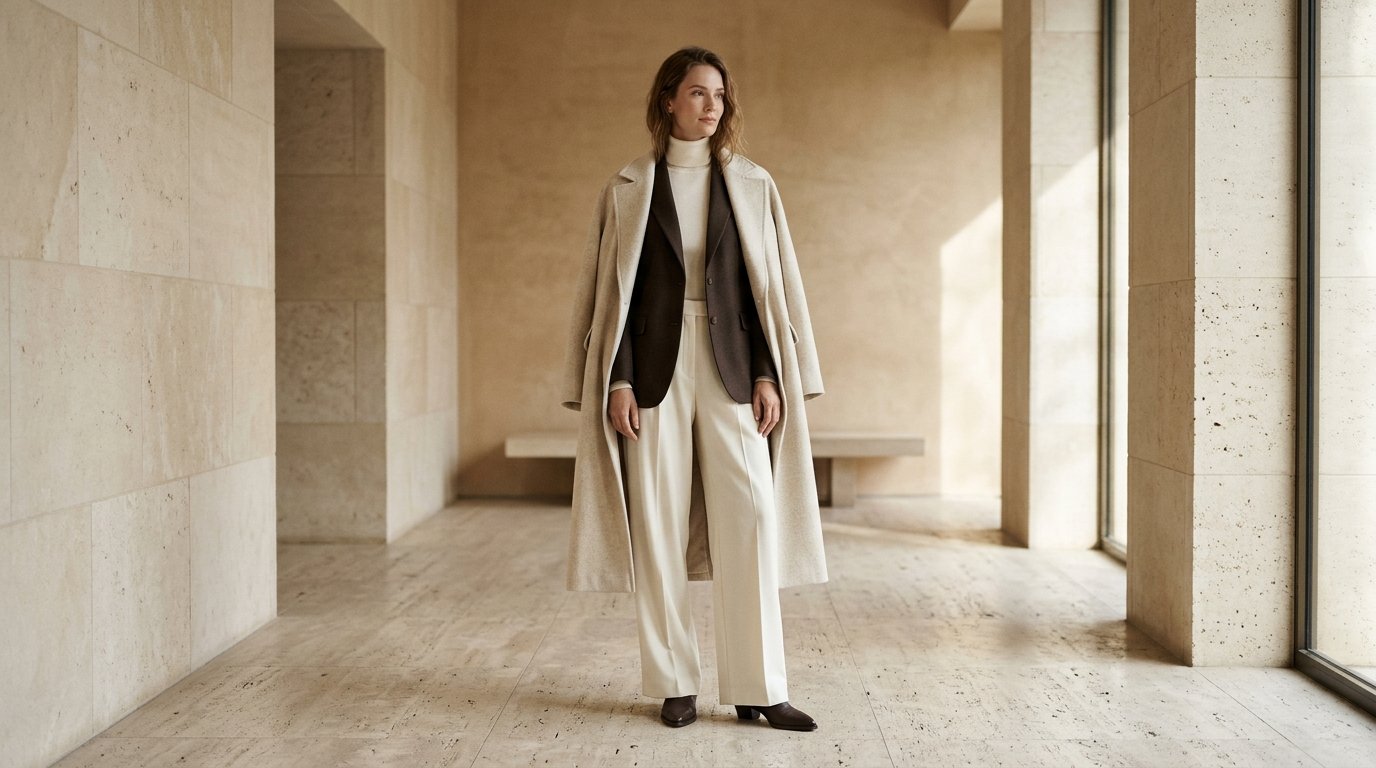
The defining sartorial strategy of winter 2026/2027 marks a decisive shift away from wardrobe clutter in favor of an intellectually engineered capsule grounded in Quiet Luxury principles: replacing excess consumption is an 8-piece foundational matrix yielding over 20 cohesive outfits. In our technical atelier, we mapped layer interaction physics, formulating precise ease allowances for base, mid, and outer garments (L1, L2, L3) that eliminate armhole constriction and bulk. In this engineering manual, we dissect the tonal triad palette formula, the dialogue of four tactile textures, Golden Ratio silhouette geometry, and hem alignment rules for an elongated profile.
- 1. The 2026/2027 Philosophy: Architectural Minimalism and Quiet Luxury
- 2. Color Mapping: The Triad Temperature Formula
- 3. Layering Dynamics: Ease Allowances for L1, L2, and L3
- 4. The 8-Pattern Master Matrix: Over 20 Signature Looks
- 5. Dialogue of Four Textures: Wool, Leather, Silk, and Cashmere
- 6. Proportional Geometry: The Golden Ratio and Hem Alignment
Scrutinizing minimalist collections for 2026/2027 reveals that true refinement requires no logo hardware; it speaks through architectural drafting, pure proportions, and supreme textile pedigree. The core patternmaking challenge in building a winter capsule lies in aligning garments not merely by hue, but across armhole depths, shoulder extensions, and hem heights. Below is our engineering blueprint for curating an enduring winter capsule.
1. The 2026/2027 Philosophy: Architectural Minimalism and Quiet Luxury
Winter 2026/2027 establishes intentional capsule design as the highest form of personal dressing. Quiet luxury represents an engineered wardrobe wherein every component performs a specific structural role while integrating effortlessly into any pairing.
Sculptural unadorned shapes anchor the aesthetic: straight double-breasted maxi coats, structured strong-shouldered blazers, pleated wool palazzo trousers, and plush cashmere separates. These pieces transcend fleeting trend cycles through universal geometric harmony.
2. Color Mapping: The Triad Temperature Formula
Effortless capsule synergy depends on chromatic discipline. We recommend avoiding jarring contrasts in favor of tonal gradations within three color values of shared color temperature:
- Warm Cream-Chocolate: Oatmeal cream + soft butter yellow + deep espresso chocolate;
- Cool Nordic Slate: Ice grey + wet graphite + midnight navy;
- Organic Earth: Moss olive + roasted chestnut + warm sandstone.
Any piece within a given triad coordinates seamlessly with another, creating unbroken vertical columns that lengthen the body.
3. Layering Dynamics: Ease Allowances for L1, L2, and L3
The most frequent error in winter dressing is forcing a narrow-armhole coat over a tailored blazer. The result is binding at the underarm and distorted shoulder crowns. To preserve ease of movement, apply systematic layer gradations:
- Layer L1 (Base — silk top, fine merino turtleneck): Bust ease = 2.0 to 4.0 cm; standard anatomical armhole depth;
- Layer L2 (Mid — structured blazer, cardigan, vest): Bust ease = 6.0 to 8.5 cm; armhole lowered 1.5 to 2.0 cm; shoulder seam extended 1.0 cm for shoulder pads;
- Layer L3 (Outer — maxi coat, trench): Bust ease = 12.0 to 16.0 cm; armhole lowered 3.5 to 4.5 cm; shoulder extended 2.0 cm to accommodate suit shoulders without drag.
4. The 8-Pattern Master Matrix: Over 20 Signature Looks
The core capsule drafted by our pattern studio comprises 8 interchangeable garments:
- Double-breasted maxi wool overcoat in worsted wool or cashmere blend;
- Architectural tailored blazer with sharp set-in sleeve heads;
- High-waisted wide palazzo trousers with deep front pleats;
- Tailored midi skirt in heavy suiting wool;
- Bias-cut dress in fluid wool crepe or velvet;
- Fine-gauge knit turtleneck in pure cashmere;
- Relaxed menswear-cut shirt in silk twill;
- Leather vest or tailored jacket in matte nappa.
Together, these items cover the spectrum from executive meetings to cultural evenings and weekend travel.
5. Dialogue of Four Textures: Wool, Leather, Silk, and Cashmere
Why do monochromatic quiet luxury ensembles captivate the eye? The answer lies in juxtaposing four tactile fabric surfaces:
- Matte Stability: Dense worsted wool or suiting flannel (380 to 450 gsm);
- Supple Sheen: Smooth leather or structured eco-leather;
- Tactile Warmth: Ribbed cashmere, baby alpaca, or boucle knits;
- Liquid Fluidity: Heavy silk crepe-de-chine or viscose twill.
Light refracts differently across each texture, imbuing even an all-cream outfit with rich visual dimension.
Master Tailor's Advice:When drafting a winter capsule, always draft the mid-layer blazer before cutting the coat. Assemble a blazer muslin, place it on a dress form over a base knit, and take your coat balance measurements directly over the suited mannequin: back width, chest breadth across lapels, and armhole drop. Always include a 1.5 to 2.0 cm pleat jump at the coat lining hem to prevent pulling during stride.
6. Proportional Geometry: The Golden Ratio and Hem Alignment
Every capsule look balances across two classical geometric ratios:
The 1/3 to 2/3 Ratio: A cropped tailored top (hip-length blazer or tucked knitwear) balanced against sweeping palazzo trousers that graze the footwear sole, visually allocating two-thirds of the stature to leg length.
The 3/4 to 1/4 Ratio: A statuesque maxi overcoat revealing merely 10 to 15 cm of skirt hem or sleek leather boot shafts, banishing awkward horizontal skin breaks.
Build Your Cohesive Winter Capsule with Professional Patterns
Download our modular collection of digital patterns for coats, blazers, trousers, and dresses with tested ease compatibility across European sizes 34 to 48.
Explore Capsule PatternsJOIN THE CHANNEL
Apparel Industry Hub in Telegram
Community of garment manufacturers, tailors and designers. Daily fresh workshop vacancies, verified factories database and direct contacts.