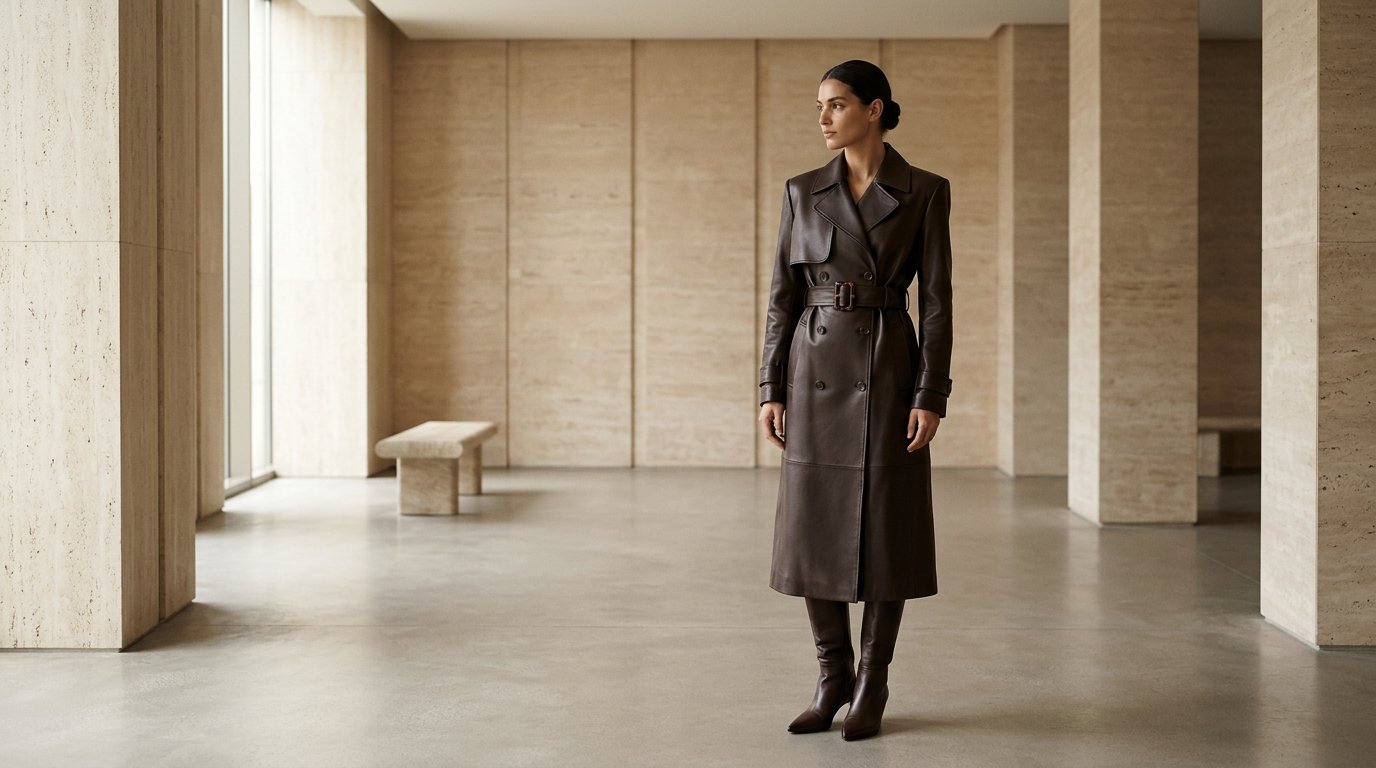
Leather and structured eco-leather throughout the 2026/2027 winter season decisively transcend utilitarian outerwear to emerge as the central pillar of refined urban tailoring: replacing excessive patent shine and biker moto jackets are monumental double-breasted maxi trench coats, pencil skirts with engineered walking slits, and architectural leather blazers in rich espresso and black cherry shades. In our pattern studio, we conducted rigorous prototype trials with buttery lambskin nappa and heavy microfiber leather, calibrating patterns to the irreversible physics of needle penetrations. In this technical manual, we dissect skin topography, non-piercing clip assembly, Teflon presser feet dynamics, low-temperature fusible engineering, and dry seam mallet beating without steam.
- 1. The 2026/2027 Direction: From Biker Utility to Haute Tailoring
- 2. Material Anatomy: Natural Hide Topography vs Microfiber Eco-Leather
- 3. The Irreversible Hole: Specialized Tooling for Faultless Stitching
- 4. Adhesive Engineering and Seam Flattening Without Steam
- 5. Pattern Drafting and Ease Allowances (EU Sizes 36 to 46)
- 6. Styling and Proportions: Balancing Leather with Chunky Knitwear
A thorough review of the 2026/2027 winter runway presentations confirms that tailored leather has become the modern cornerstone of quiet luxury. Working with leather at home or in the atelier often intimidates sewists because needle holes cannot be erased. However, mastering artisan leathercraft techniques allows you to produce impeccably fitted luxury garments. Below is our comprehensive engineering guide to cutting, assembling, and tailoring leatherwear.
1. The 2026/2027 Direction: From Biker Utility to Haute Tailoring
The 2026/2027 cold season redefines leatherwear: overt biker zippers, heavy studs, and ultra-tight glossy finishes have vanished. The dominant design axis embraces pristine architectural lines derived from bespoke overcoat traditions. The hero garment is the double-breasted leather maxi trench coat featuring broad peak lapels, a deep back storm flap, and a wide belt anchored with a leather-wrapped buckle.
The seasonal color palette favors nuanced dark neutrals: rather than stark black, collections celebrate deep espresso chocolate, vintage oxblood, deep forest peat, and wet slate charcoal. The surface finish features a subtle satin sheen that illuminates tailored seams without glare.
2. Material Anatomy: Natural Hide Topography vs Microfiber Eco-Leather
Cutting natural hides requires an understanding of organic topography, as hide thickness and stretch vary across its surface:
- The Butt (Backbone section): The densest, most stable area with minimal elongation. Front panels, center back, upper collar, and waistbands must be laid along this axis;
- The Shoulder and Neck: Durable, though often marked by natural growth creases that add organic character to sleeves and storm flaps;
- The Flank and Belly: Looser grain with maximum stretch. Reserved strictly for non-structural parts such as pocket facings and interior hem underlays.
Contemporary microfiber eco-leather (450 to 600 gsm) eliminates surface irregularities, offering consistent crosswise and lengthwise tensile properties that allow precision single-layer drafting with negligible waste.
3. The Irreversible Hole: Specialized Tooling for Faultless Stitching
The foundational rule of leather tailoring is that every needle penetration is permanent. Standard pins puncture leather irreparably, weakening seam lines. Assembly relies exclusively on spring-loaded craft clips (Wonder Clips) or narrow 4 to 6 mm double-sided transfer tape.
To prevent friction, standard metal presser feet are replaced with non-stick Teflon (PTFE) feet, roller feet, or dual-feed walking foot attachments. Needles must feature a triangular chisel point (Schmetz Leather / LL) in sizes 80 to 100, which slice through leather fibers at a 45-degree angle. Stitch length must be calibrated between 3.5 and 4.5 mm for construction and 5.0 mm for topstitching using bonded polyester thread sizes 30 to 40; closely spaced stitches risk perforating leather like postage stamps.
4. Adhesive Engineering and Seam Flattening Without Steam
Heat and moisture are hazardous to leather. Steam scalds collagen fibers, producing irreversible puckering and shrinkage. All pressing operations must be conducted bone-dry:
Low-Temperature Interfacing: Collars, lapels, and pocket welts are reinforced with specialized leather fusible fleece. Apply with a dry iron set to the wool/silk mark (100 to 115 °C) through a pressing cloth for 6 to 8 seconds without sliding the iron plate.
Latex Seam Taping: Seam allowances cannot be pressed open with steam. Instead, open the allowances, apply a thin coat of elastic latex leather cement, and press them flat against the hide. Once dry, tap the seam gently with a polished wooden leather mallet or press with an oak clapper to produce an ultra-flat finish.
5. Pattern Drafting and Ease Allowances (EU Sizes 36 to 46)
Because leather cannot be shrunk with steam like woolen cloth, all three-dimensional shaping must be achieved through drafting lines: vertical princess seams, yoke breaks, and shaped darts:
- Leather Maxi Trench: Bust ease = 8.0 to 11.0 cm; Waist ease = 6.0 to 8.0 cm; Hip ease = 7.0 to 9.0 cm (to fit comfortably over chunky knitwear);
- Leather Blazer: Bust ease = 6.0 to 7.5 cm; Waist ease = 3.5 to 4.5 cm; Hip ease = 4.5 to 6.0 cm;
- Leather Pencil Skirt: Waist ease = 1.5 to 2.0 cm; Hip ease = 2.5 to 3.5 cm (preventing excessive strain when seated).
Yield requirements for a maxi trench average 4.5 to 5.5 m² of natural leather (4 to 6 lambskins) or 3.20 to 3.60 m of 140 cm wide eco-leather for sizes 36 to 42, and 3.70 to 4.10 m for sizes 44 to 46.
Always stitch a test seam on scrap hide with lining and interfacing before commencing garment assembly. If leather drags even beneath a Teflon foot, apply a tiny drop of pure sewing machine mineral oil along the seamline with a cotton swab or stroke dry tailor chalk over the surface to ensure smooth feeding without skipped stitches.
6. Styling and Proportions: Balancing Leather with Chunky Knitwear
The paramount styling rule for winter 2026/2027 avoids head-to-toe monolithic leather. Outerwear pieces must engage in tactile dialogue with cozy natural textures. Create balance by contrasting slick leather trench coats against heavy ribbed cashmere knits, or pairing leather skirts with structured wool flannel blazers.
Footwear should align tonally with outerwear to form a seamless monochrome column: matte leather boots or chiseled derbies produce an unbroken vertical line that flatters and elongates the frame.
Craft Your Designer Leather Trench or Blazer with Precision Patterns
Download digital patterns engineered for natural and eco-leather tailoring across European sizes 34 to 48 with illustrated tutorials.
Explore Leather Patterns
Apparel Industry Hub in Telegram
Community of garment manufacturers, tailors and designers. Daily fresh workshop vacancies, verified factories database and direct contacts.