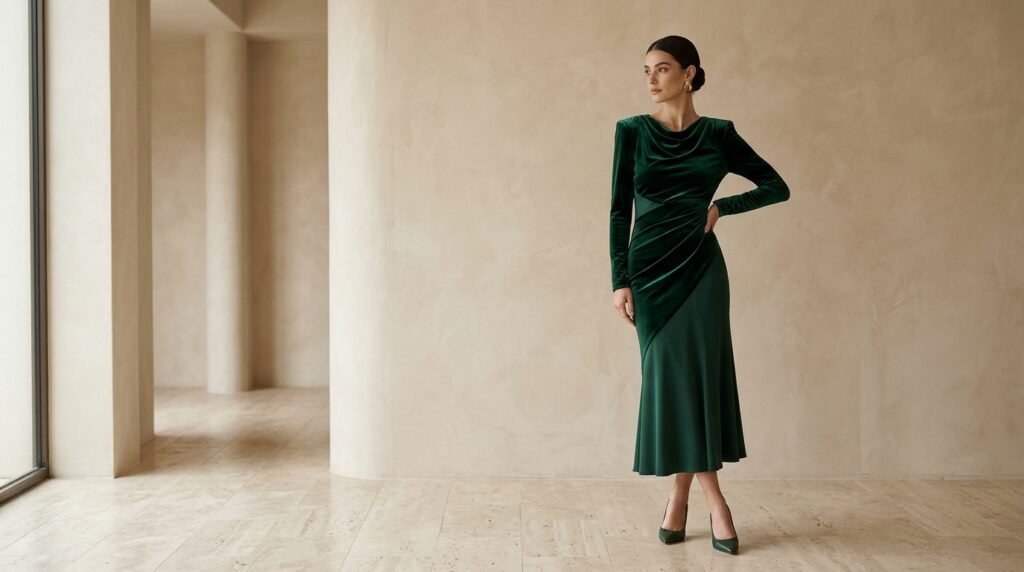
The pivotal trend of the winter 2026/2027 dress category marks a triumphant return of intricate bias-cut couture craftsmanship, transforming substantial cold-weather textiles into fluid sculptural silhouettes: replacing rigid sheath designs are midi and maxi dresses distinguished by draped cowl necklines, asymmetric waist gathering, and concealed internal corset structures. In our patternmaking atelier, we adapted Madeleine Vionnet principles to modern winter fabrications, testing gravity drape on dress forms using heavy silk velvet, double wool crepe, and fluid viscose satin. In this technical manual, we dissect 45-degree grain physics, elongation hanging allowances, puckering-free seam construction, and waist stay installation for an immaculate contour.
- 1. The 2026/2027 Silhouette: Couture Fluidity Over Rigid Sheaths
- 2. Bias Mechanics: 45-Degree Grain, Gravitational Drop, and Mannequin Hanging
- 3. Fabric Foundations: Silk Velvet, Double Wool Crepe, Heavy Satin, and Twill
- 4. Internal Engineering: Waist Stay Ribbon, Neckline Support, and Balance
- 5. Assembly Technique and Ease Allowances (EU Sizes 36 to 46)
- 6. Styling and Proportions: Layering with Outerwear and High Boots
Studying runway presentations for the 2026/2027 cycle makes it clear that the dress has reclaimed its prestige as the pinnacle of sartorial engineering. The chief challenge for the patternmaker working with winter bias cut is taming natural fabric drift while guaranteeing neckline and hem stability. Below is our engineering guide to cutting, stabilizing, and pressing winter designer dresses.
1. The 2026/2027 Silhouette: Couture Fluidity Over Rigid Sheaths
Winter 2026/2027 moves decisively away from stiff straight sheath dresses in favor of organic, breathing garments. The defining cut is a midi or maxi dress drafted strictly at a 45-degree angle to the warp. The diagonal grain grants natural mechanical elasticity, hugging anatomical contours without requiring harsh darts or heavy princess seams.
Sculptural draping forms the design nucleus: asymmetric folds that originate at the shoulder and glide diagonally toward the opposite hip, or cascading cowl necklines that frame the collarbones. During movement, the dress acts like a kinetic sculpture, altering light reflection across rich velvet and crepe textures with every stride.
2. Bias Mechanics: 45-Degree Grain, Gravitational Drop, and Mannequin Hanging
Cutting on the bias demands strict geometry. Pattern pieces must be cut in a single layer flat on non-slip surfaces like felt or pattern kraft paper. Cutting on the fabric fold is strictly prohibited, as it causes grain distortion and irreparable spiraling side seams.
Gravitational elongation is the dominant physical factor. Under its own weight, the garment narrows horizontally and stretches vertically. Assembled dresses MUST hang freely on a tailor dress form for 24 to 48 hours to allow fibers to settle. Length drop in heavy wool crepe reaches 4.5 to 8.0 cm. Leveling the hem with a chalk marker from the floor is done only after complete relaxation.
3. Fabric Foundations: Silk Velvet, Double Wool Crepe, Heavy Satin, and Twill
Sculpting bias volumes in winter requires dense drape weighing 260 to 420 gsm:
- Silk-base velvet: exhibits extraordinary chromatic depth. Cut strictly with the pile running upward for matte saturation or downward for high sheen;
- Double wool crepe: highly resilient with a pebble grain, holding soft draped folds without creasing;
- Heavy crepe-back satin: the matte reverse provides traction against undergarments while the liquid satin face creates dramatic evening reflections.
4. Internal Engineering: Waist Stay Ribbon, Neckline Support, and Balance
A heavy bias gown tends to pull downward with gravity, distorting necklines. To maintain structural integrity, an internal waist stay is essential:
Internal Waist Stay: A 2.5 to 3.0 cm grosgrain ribbon is anchored along the interior anatomical waistline and fastened with hooks independently of the main zipper. It absorbs 100% of the skirt weight, keeping the upper bodice relaxed and distortion-free.
Staystitching: Necklines and armholes are stabilized with lightweight bias stay tape to eliminate stretching during assembly and wear.
5. Assembly Technique and Ease Allowances (EU Sizes 36 to 46)
Ease allowances for bias cutting differ fundamentally from straight-grain garments:
- Bust ease: 2.0 to 3.5 cm;
- Waist ease: 1.0 to 2.0 cm;
- Hip ease: 3.0 to 5.0 cm (to allow the diagonal weave to glide freely without clinging).
Fabric consumption on 140 cm width ranges from 2.80 to 3.60 m due to the expansive 45-degree layout. Longitudinal seams are stitched with a narrow stretch zigzag (0.5 mm width, 2.4 mm length) while maintaining gentle manual tension to prevent seam waviness.
Never press velvet on a flat ironing board, as direct pressure crushes the delicate pile. Always steam velvet face-down onto a needle velvet board or a thick terry towel. Use dry steam at 130–140 °C with minimal iron contact. For bias hems, finish with a hand-rolled baby hem using silk thread with a 3 mm allowance.
6. Styling and Proportions: Layering with Outerwear and High Boots
The modern winter dress reaches mid-calf (8 to 10 cm above the ankle), intentionally overlapping the shaft of tall leather boots to create an unbroken vertical plane. Bare leg breaks are eliminated to preserve winter warmth and silhouette continuity.
When styling with outerwear, embrace textural contrasts: pair liquid velvet or soft crepe with architectural double-breasted wool coats or sharp oversized blazers. This juxtaposition of delicate draping and masculine tailoring defines contemporary quiet luxury.
 Free
Women's dress pattern
View Pattern → Free
Women's dress pattern
View Pattern → Free
Women's dress pattern
View Pattern →Create Your Designer Winter Dress with Professional Patterns
Download precision bias-cut dress patterns with balanced anatomical proportions across European sizes 34 to 48 with illustrated tutorials.
Explore Dress Patterns
Apparel Industry Hub in Telegram
Community of garment manufacturers, tailors and designers. Daily fresh workshop vacancies, verified factories database and direct contacts.