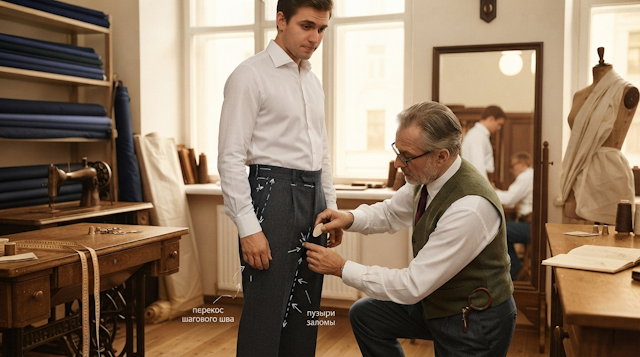
Achieving a bespoke, flawless trouser fit is widely regarded as the ultimate litmus test for any master tailor. While minor construction variances in bodice garments can often be concealed, trousers mercilessly reveal every drafting flaw: stubborn drag lines gathering beneath the seat, inseams twisting around the shins during movement, and waistbands pitching forward into the abdomen. At vykroyka.com.ua, we examine the anatomical diagnostics of trouser fitting defects and how to systematically eliminate them at the initial muslin stage.
1. Crotch Curve Diagnostics: Seat Wrinkles and Front Drag Lines
The crotch curve represents the geometric cornerstone of trouser drafting. Its depth, inclination angle, and fork extension dictate both aesthetic drape and dynamic stride mobility.
Horizontal or Diagonal Wrinkles Beneath the Gluteal Fold ("Smile Wrinkles")
Cause: The back crotch extension (fork) is drafted too short or too narrow. The fabric lacks adequate seat depth, pulling tightly across the buttocks and collapsing into unsightly drag ripples below the seat.
How to fix: On the muslin fitting, release seam allowance along the center back crotch seam, scooping out the seat curve by 1–1.5 cm and extending the horizontal fork length outward to restore ease.
Excess Fabric Bubbling or Drag Lines Across the Front Fly
Cause: An excessively long or deeply scooped front crotch curve, or excessive front fork width drafted for a flat pelvic profile.
How to fix: Pin out surplus fabric in a vertical or curved tuck beside the fly base, shaving away unnecessary depth along the front crotch seamline on the working pattern.
2. Leg Inseam Twisting: Why Does the Inseam Spiral Inward?
A properly balanced trouser leg must hang dead plumb: the press crease bisects the leg precisely, with side seams and inseams dropping vertically without spiraling.
Cause: Deviation from the true lengthwise grain during cutting, or an unbalanced width distribution between the front and back leg panels (e.g., uneven tension during seam joining).
How to fix: Verify that the grainline runs strictly parallel to the press crease along the entire length of the pattern piece. If seams twist, release the inseam and rebalance: the back leg panel should be cut 1.5–2 cm wider than the front across the knee and hem to accommodate the calf curve and maintain plumb seam hang.
3. Waistband Pitch Defects: Slipping Down at the Back or Digging in at the Front
Cause: Incompatible waistband pitch relative to natural pelvic posture. Human anatomy features a pronounced lumbar curve and gluteal depth; therefore, the center back waistline must sit considerably higher than the front.
How to fix: If trousers slide downward when seated, elevate the center back rise by 1.5–2.5 cm, smoothly blending the seamline down toward the side seam. Ensure back waist darts are deepened to anchor the waistband snugly against the small of the back.
Prior to stitching any leg seams, perform thorough iron shaping (VTO): stretch the upper third of the back leg inseam using heat and steam, while shrinking (easing in) the area directly beneath the gluteal fold. This shapes the flat cloth into a 3D anatomical silhouette before assembly, preventing seat drag lines entirely!
Flawless trouser fitting stems from precision geometric drafting and keen anatomical observation. Explore comprehensive fitting guides, patternmaking masterclasses, and pre-balanced sewing patterns on the homepage of vykroyka.com.ua.
Sew Tailored Trousers With Flawless Fit!
The Vykroyka pattern collection features professional digital patterns for classic, wide-leg, and tapered trousers engineered with balanced stride geometry.
VIEW PATTERNS →