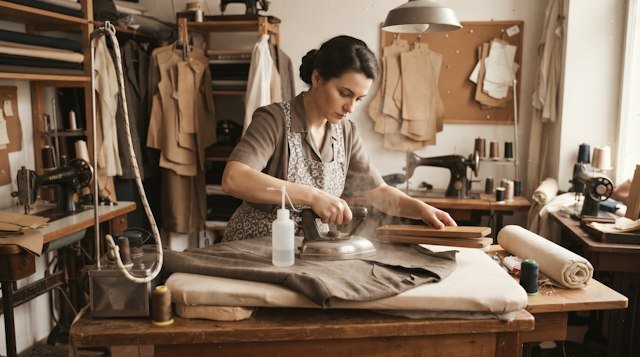
Novice garment makers frequently assume that pressing is merely a finishing touch reserved for the final moments of assembly — to smooth out wrinkles before trying on the finished outfit. However, seasoned bespoke tailors operate by an indisputable golden maxim: garment quality and silhouette fit are 50% determined by rigorous in-process steam pressing and ironwork (ВТО). Flawless pressing elevates homemade garments into luxury couture pieces with razor-flat seamlines, molded curvature, and impeccable structural drape. On the tailoring portal vykroyka.com.ua, we explore the essential pressing vocabulary, bespoke pressing bucks, and temperature control across diverse textiles.
- 1. Pressing Terminology: Pressing Flat, Pressing Open, and Shrinking
- 2. Tailor's Toolkit: Clappers, Pressing Hams, and Sleeve Boards
- 3. Temperature Dynamics: Woolens, Silks, and Stretch Knits
- 4. Preventing Fabric Glaze (Shine Marks) and Seam Imprints
- Tailor's Tip: Rapid Heat Dissipation with Hardwood Clappers
1. Pressing Terminology: Pressing Flat, Pressing Open, and Shrinking
Precision tailoring manuals utilize distinct terminology for fundamentally different ironwork procedures:
- Pressing Flat (Setting the Stitch): flattening the seam line immediately after machine stitching to embed thread into fabric fibers before opening the seam;
- Pressing Open: parting seam allowances in opposite directions using the tip of the iron;
- Pressing to One Side: directing both seam allowances simultaneously toward the back or center panel;
- Fulling / Shrinking (Сутюживание): contracting fabric fullness through targeted steam application (e.g. shrinking sleeve cap ease or rounding dart tips, as explored in our guide on dart manipulation and pattern modeling);
- Stretching (Оттяжка): deliberately elongating a fabric edge under steam to contour around body topography (e.g. stretching trouser back inseams to prevent trouser fitting defects and seat draglines).
2. Tailor's Toolkit: Clappers, Pressing Hams, and Sleeve Boards
A standard domestic flat ironing board cannot mold three-dimensional anatomical silhouettes. Essential bespoke tools include:
- Steam Generator Iron: delivering high-pressure dry steam without dripping condensation;
- Hardwood Tailor's Clapper: crafted from unfinished hardwood (beech, oak, or ash). Immediately upon lifting the steaming iron, press the clapper firmly over the seam. The wood absorbs heat and moisture in seconds, locking the seam permanently razor-flat without surface shine;
- Tailor's Ham: an ergonomically contoured, sawdust-packed pressing buck essential for molding curved bust darts, princess seams, and hip silhouettes;
- Sleeve Board: a narrow elevated arm allowing seamless pressing of cuffs, sleeves, and pant legs without creasing the underlayer.
3. Temperature Dynamics: Woolens, Silks, and Stretch Knits
Every textile structure commands distinct moisture and heat thresholds:
- Woolens and Coating Fabrics:
- Settings: medium-high temperature with generous steam;
- Technique: wool fibers become remarkably pliable under damp heat. Shape and shrink sleeve head ease up to 1.5 cm with circular iron motions beneath a damp pressing cloth.
- Pure Silk, Rayon, and Chiffon:
- Settings: delicate low heat, strictly WITHOUT steam;
- Technique: stray water droplets create irreversible water spots on delicate silks. Press dry through a fine batiste press cloth without excessive downward force.
- Stretch Knits and Jerseys:
- Settings: moderate heat with light steam;
- Technique: never slide the iron back and forth along seamlines — stretch knits immediately ripple and distort. Work strictly by lowering and raising the iron straight down. If seam puckering occurs during stitching, review our troubleshooting guide: why sewing machines pucker fabric.
4. Preventing Fabric Glaze (Shine Marks) and Seam Imprints
Surface glaze and seam edge impressions telegraph amateur execution. Eliminate them completely:
- Slip strips of brown kraft paper or cardstock underneath seam allowances before pressing open;
- Always press dark woolens through a preshrunk unbleached cotton pressing cloth;
- If shine marks occur on wool, hover the iron over the area dispensing steam, and gently lift the nap with a natural bristle clothes brush.
Never stitch a crossing seam until the preceding seam has been meticulously pressed open and set with a wooden clapper! Once crossed by another seam, trapped seam allowance thickness can never be corrected. For optimal results, build garments upon verified drafting blocks — explore our guide on how to draft a basic pattern sloper from scratch.
Explore more expert sewing secrets, textile tutorials, and multi-size digital patterns on vykroyka.com.ua.
Sew Garments of Flawless Couture Quality!
Browse the Vykroyka pattern catalog for professionally drafted digital PDF patterns accompanied by detailed step-by-step pressing and construction tutorials.
Explore Pattern Catalog