Selecting the right sewing needle is 80% of success when sewing any product. Missed stitches, thread loops, pulls on silk and holes along the seams on knitwear are most often caused by using the wrong type or number of needle. In this article we will analyze in detail the international classification of needles from Universal to Super Stretch, decipher the markings and learn how to select the ideal point for any type of fabric.
Contents of the article
- Anatomy of a sewing needle: why every millimeter is important
- Needle marking: numbering systems (70/10, 90/14) and color bands
- Classification of tip types: from Universal to Super Stretch
- Summary table of needle selection by fabric types and numbers
- Specialty needles: Microtex, Jeans, Leather and twin needles
- Tailor's advice: how often to change the needle and check it for defects
- Frequently asked questions (FAQ)
Anatomy of a sewing needle: why every millimeter matters
The sewing needle of a household machine has a complex geometry, where each part performs its own technological function:
- Flask: The upper thickened part with a flat cut (flat) at the back, which is inserted into the needle holder.
- Shaft and long groove:The groove carries the upper thread when the needle is immersed in the fabric, which protects it from chafing.
- Notch (notch above the eye):The area where the nose of the shuttle catches the lap loop of the upper thread. Stretch needles differ from regular needles in the shape of their notch.
- Point (tip):The shape of the tip (sharp, rounded, ball-shaped or cutting edge) determines how the needle passes through materials.
Needle marking: numbering systems (70/10, 90/14) and color bands
Numbers and letters are always stamped on the needle flask. The numbers indicate the thickness of the rod in two systems:
- Metric system (Nm):The thickness of the rod in hundredths of a millimeter (for example, No. 80 = 0.8 mm).
- Inch system (US): Designations from 8 to 19 (for example, No. 12 corresponds to 80 metric).
On the packaging it looks like 80/12or 90/14. The lower the number, the thinner the needle.
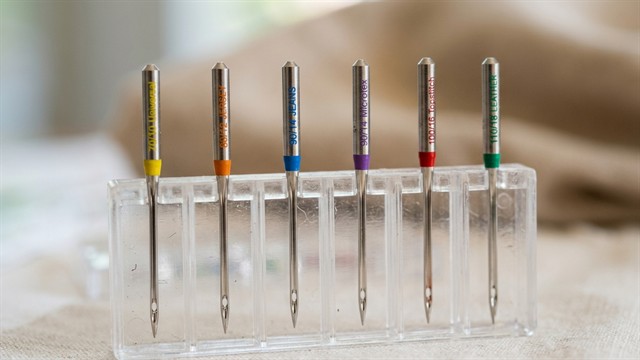
Leading manufacturers (Schmetz, Organ) use a double color designation on the flask: the top color indicates the type of needle (for example, orange - Jersey, yellow - Stretch), and the bottom color indicates its size (blue - 70, purple - 80, red - 90).
Classification of tip types: from Universal to Super Stretch
Point design divides needles into several key groups:
- Universal (H):Has a slightly rounded tip. Universal needle for most woven materials (cotton, linen, wool, shirting fabrics).
- Jersey (H-S):Spherical or medium rounded point. Spreads the fabric threads apart without punching them. Ideal for classic knits, jerseys and knits.
- Stretch (H-S):Rounded point combined with a special cut notch above the eye. Prevents stitch skipping on highly elastic fabrics (supplex, oil, thin knitwear with elastane).
- Super Stretch (HAx1 SP):Features a wider eyelet, larger groove and a special coating. Indispensable when sewing thick sports fabrics, highly elastic knitwear and when working on overlock/cover stitching machines.
Summary table of needle selection by fabric types and numbers
| Fabric Type/Material | Recommended needle type | Needle number (Nm/US) |
|---|---|---|
| Chiffon, organza, cambric, silk | Microtex (H-M) | 60/8 – 70/10 |
| Cotton, shirt fabrics, suit wool | Universal (H) | 70/10 – 90/14 |
| Jeans, canvas, canvas, twill | Jeans (H-J) | 90/14 – 110/18 |
| Classic weave fabric, 2-thread footer | Jersey (H-SUK) | 70/10 – 80/12 |
| Supplex, linen knitwear, latex, thermal underwear | Stretch (H-S) / Super Stretch | 65/9 – 75/11 |
| Natural and artificial leather, suede | Leather (H-LR) | 80/12 – 100/16 |
Special Needles: Microtex, Jeans, Leather and Twin Needles
- Microtex (H-M): Very sharp, fine point. Pierces the densest or ultra-thin materials (microfiber, silk, raincoat fabric, taffeta) without jamming or deforming the threads.
- Jeans (H-J):Reinforced shaft and sharp shape. Will not bend or break when passing through thick cross seams on denim and workwear.
- Leather (H-LR):The point has a right-handed cutting edge. The needle does not pierce, but literally cuts the skin at an angle of 45 degrees, forming a beautiful decorative inclined stitch.
- Twin Needle:Attached to one flask. Allows you to simulate a cover seam using a regular shuttle stroke of a sewing machine.
Tailor's advice
A sewing needle is a consumable item, not a permanent item. The service life of a household needle is 8–10 hours of active sewing. After this time, the tip becomes dull and becomes covered with microburrs, invisible to the eye, but destroying the fibers of the fabric. Always change the needle before each new project! And proven ready-made patterns from our catalog will help you sew products with a perfect fit.
Frequently asked questions (FAQ)
Why does a sewing machine skip stitches on knitwear?
The main reason is to use a Universal needle instead of a Stretch or Super Stretch. The utility needle has the wrong notch angle above the eye, which prevents the hook from catching the thread loop when stretching the material.
Can leather needles be used on artificial leather or eco-leather?
No, you cannot use Leather needles on artificial leather! The cutting edge will tear the film coating of the eco-leather, and the seam will quickly unravel. For eco-leather and suede, use Microtex or Universal needles.
What is the difference between Organ and Schmetz needles?
Both brands are world leaders in the production of high quality needles. They are interchangeable and suitable for most household sewing machines (Janome, Brother, Singer, Bernina, Pfaff) with a 130/705 H household needle system.
Expertly designed patterns are the key to a perfect fit of any product. To be the first to learn about the intricacies of design, modeling and trends in the sewing world, subscribe to our video channel Pattern - Ready-made patterns.