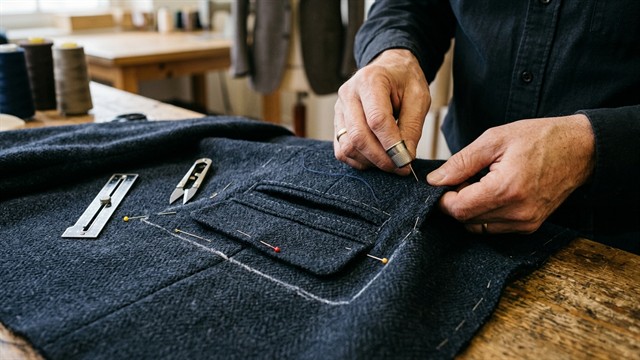
A framed welt pocket with a flap is one of the most important and revealing units in the art of sewing. It is the quality of this element that determines the class and premium look of a jacket or coat. In this step-by-step master class, we will examine in detail the knot processing technology, which guarantees smooth frames, clear corners and no creases on the main part.
Contents of the article
- Required tools and preparation of parts
- Step 1: Marking and duplicating the pocket entrance
- Step 2: Preparation and stitching of the valve and facings
- Step 3: Cutting the entrance, turning and securing the corners
- Tailor's advice: secrets of impeccable corners and WTO
- Frequently asked questions (FAQ)
Necessary tools and preparation of parts
To make a welt pocket you will need: two facings from the main fabric, a flap with a sub-flap, two pieces of pocket lining (valances), fabric-backed dublerin, tailor's pins, chalk or a washable marker, and sharp tailor's scissors with thin tips.
- Valve: Glued with thin dublerin to maintain shape.
- Earths:Duplicated with strips of adhesive material along the entire length.
- Main detail: In the cut areas, it must be reinforced with a doblein sheet from the wrong side.
Step 1: Marking and duplicating the pocket entrance
On the front side of the main part, apply precise markings of the frame: the center line of the entrance to the pocket and two parallel lines (the width of the frame is usually 1.5 cm - 0.75 cm up and down from the center). Draw vertical lines to limit the length of the pocket.
On the wrong side of the shelf, iron a strip of doublerin (dolevik), going beyond the borders of the frame by 1.5–2 cm on all sides.
Step 2: Preparation and stitching of the valve and facings
Place the valve and sub-valve parts right sides together, stitch along the side and bottom edges, cut off the allowances in the corners, turn them inside out and sweep out the piping. Iron the valve.
- Seaming the facings: Smooth the facings in half lengthwise. Attach them with folds to the center marking line and stitch strictly from one transverse boundary line to the other.
- Stitching the flap: Place the finished flap over the top facing (or under it, depending on the technology) and stitch stitch to stitch.
- Checking parallelism: On the wrong side, two parallel lines must end exactly at the same level.
Step 3: Cutting the entrance, turning and securing the corners
Cut the main part along the center between the lines, not reaching the ends of the frame by 1–1.5 cm. Next, make inclined cuts strictly to the last stitches of the lines (at an angle to the corners), not reaching the thread by 1 mm.
Tuck the facings and lining to the wrong side. Straighten the frames to the same width, secure the triangle corners on the wrong side with a double stitch on the machine, stretching the shelf.
Tailor's advice
The main secret of a perfect welt pocket isthe precision of cutting the corners. If you don’t cut half a millimeter, wrinkles and creases will form on the front side in the corners of the pocket, and if you cut it, the fabric will fall off. Professional ready-made patterns with elaborate markings from our catalog will help you make a pocket without errors and accurately calculate the proportions.
Frequently asked questions (FAQ)
What is the standard frame width used on coats and jackets?
For classic suit jackets, the finished width of each facing is 0.5–0.7 cm (total frame 1–1.4 cm). On a thick wool coat, the frame is made 0.7–1 cm wide (up to 2 cm in total).
What to cut pocket burlap from?
One piece of burlap is cut from the main fabric (so that the lining is not visible when opened), and the second is cut from sliding viscose lining fabric to reduce the thickness of the knot.
What to do if the fabric on the corner still falls off?
Glue a small piece of thin dublerin from the inside out, tuck in the loose threads and re-fasten the corner with a fine stitch butt to the split.
Expertly designed patterns are the key to a perfect fit of any product. To be the first to learn about the intricacies of design, modeling and trends in the sewing world, subscribe to our video channel Pattern - Ready-made patterns.