Why does one tailored garment fit like a second skin, accentuating natural body contours with effortless ease, while another—constructed to identical raw measurements—gapes, binds across the chest, or hangs like an unflattering sack? The answer lies not in sartorial luck, but in exacting technical science: patternmaking anthropometry and calibrated wearing ease allowances. At the sewing portal vykroyka.com.ua, we examine the engineering principles that convert static body measurements into wearable volume, movement, and silhouette elegance.
- 1. Anthropometry: Why Standard Size Charts Fail Without Calibration
- 2. Understanding Wearing Ease vs. Design Ease
- 3. Dynamic Ease Allocation Across Drafting Zones
- 4. Silhouette Ease Allowance Reference Table
- 5. Pre-Cut Quality Checklist
- 6. Head Patternmaker's Balance Secrets
- 7. Conclusion and Practical Takeaways
1. Anthropometry: Why Standard Size Charts Fail Without Calibration
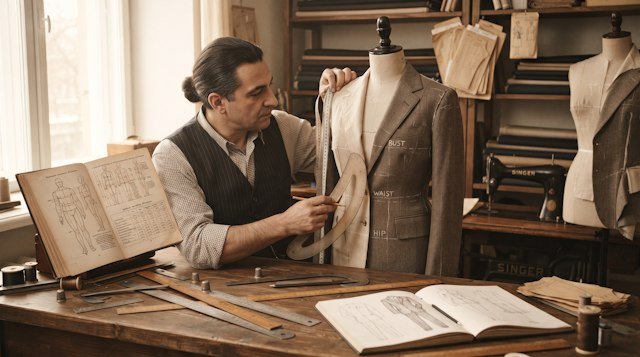
Taking measurements forms the cornerstone of pattern drafting. However, recording bust circumference (Bust) or waist circumference (Waist) is merely the starting point. Professional pattern engineers must analyze 3D anatomical posture:
- Spinal Posture: Erect, forward-head, or kyphotic postures necessitate distinct balance splits between front bodice length and back bodice length. Ignoring posture causes garments to hike up at the back or form diagonal stress folds. Read our guide on adjusting patterns for full bust and narrow shoulders.
- Musculoskeletal Distribution: Two individuals with identical 92 cm bust circumferences can differ by 3–5 cm in back width versus front chest width due to athletic muscularity.
- Shoulder Slope: Square or sloping shoulders require dedicated adjustments to shoulder seam angles and sleeve cap heights.
2. Understanding Wearing Ease vs. Design Ease
Cutting fabric directly to exact skin measurements produces a compression bandage in which breathing is restricted. Ease allowance is the planned difference between garment interior circumference and physical body girth. It fulfills three critical roles: breathing room, movement dynamics, and silhouette styling.
- Wearing Ease (Ergonomic / Functional): Mandated by human respiration and movement. Breathing expands the ribcage by 1.5–3 cm, while arm extension stretches back flesh. Without wearing ease (0.5–1.5 cm minimum for close-fitting garments), seams tear on first movement.
- Design Ease (Aesthetic / Silhouette): Defines fashion volume. Design ease transforms a baseline block into a bodycon sheath, an executive blazer, or an oversized cocoon coat.
3. Dynamic Ease Allocation Across Drafting Zones
Total chest ease (Ease_bust) is never split evenly around the circumference! Biomechanical principles govern where volume is needed:
- Back Width Zone: Receives 25% to 35% of total chest ease to support arm forward reach, typing, and driving.
- Armhole / Side Zone: Claims the majority—50% to 60% of ease. Generous armhole width prevents binding under the axilla and avoids pulling the hem upward during arm lifts.
- Front Chest Zone: Receives merely 10% to 20% of ease, keeping the neckline and decollete neatly contoured without sagging.
4. Silhouette Ease Allowance Reference Table
| Silhouette Classification | Dress / Blouse (Ease_bust) | Jacket / Blazer (Ease_bust) | Overcoat (Ease_bust) |
|---|---|---|---|
| Skin Tight / Corsetry | 0 – 1.5 cm | — | — |
| Fitted (Slim Fit) | 2.0 – 3.5 cm | 4.0 – 5.5 cm | 6.0 – 7.5 cm |
| Semi-Fitted (Regular Fit) | 4.0 – 5.5 cm | 6.0 – 7.5 cm | 8.0 – 10.0 cm |
| Straight Classic | 6.0 – 8.0 cm | 8.0 – 10.0 cm | 10.0 – 13.0 cm |
| Oversized Volume | 10.0 – 18.0+ cm | 12.0 – 20.0+ cm | 14.0 – 25.0+ cm |
Thicker fabrics require larger ease allowances! When designing outerwear, always add 2–5 cm of additional ease to account for interlinings, canvas, padding, and warm sweater layers worn beneath.
5. Pre-Cut Quality Checklist
- Benchmark against a favorite garment: Lay a beloved closet staple flat and measure pit-to-pit chest width. Compare directly with your pattern draft.
- Factor in fabric mechanical stretch: High-stretch Lycra and knits demand zero or negative ease (-2 to -6 cm). Read our guide "Sewing Lycra and High-Stretch Knits".
- Verify hip sitting ease: Hip ease on trousers must allow comfortable seated posture. For fixing crotch wrinkles, consult "Trouser Fitting Defects and How to Correct Them".
6. Head Patternmaker's Balance Secrets
- Draft robust baseline blocks: Advanced modeling cannot fix a distorted sloper. Learn our methods in "How to Draft a Basic Bodice Block".
- Integrate steam molding (Ironing): Sculpting bust and shoulder contours requires ironwork alongside darts. See "Pressing in Sewing: Secrets of Professional Ironing".
- Proportional grading: When scaling size charts, maintain ease ratios across sizes. Study "Pattern Grading by Sizes".
Flawless Fit Without Guesswork
Every digital sewing pattern in the Vykroyka library is drafted with rigorous anthropometric standards and calibrated wearing ease. Pick your style and sew with complete confidence from first fitting!
Browse Pattern Catalog →7. Conclusion and Practical Takeaways
Anthropometry and calculated ease allowances bridge human physiology with high-fashion tailoring. Consciously engineering ease ensures garments are not merely visually captivating on dress forms, but effortless in real everyday movement. Discover more masterclasses and production patterns at vykroyka.com.ua.