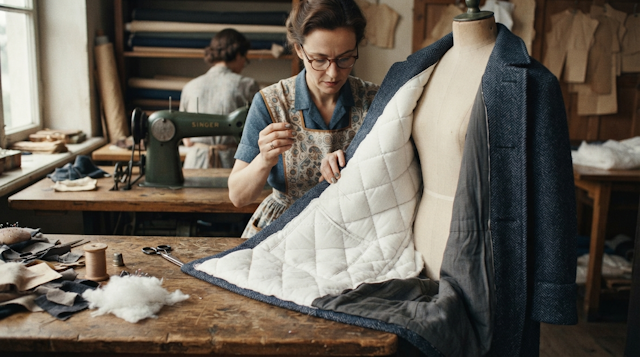
Constructing a tailored coat, down jacket, or insulated parka by hand represents the pinnacle of bespoke tailoring craftsmanship. The most pervasive concern when working with thermal insulation is producing an overly cumbersome, billowing garment that fails to block wind or loses its structural loft after cleaning. Modern synthetic insulations (Alpolux, Thinsulate, Hollofil) provide extraordinary warmth-to-weight ratios, yet they demand rigorous adherence to specific engineering workflows. At vykroyka.com.ua, we explore professional quilting secrets, layering techniques, and outerwear assembly protocols designed to eliminate the dreaded "sail effect."
1. Anatomy of an Insulation Package: What Makes a Warm Garment?
High-end outerwear is constructed not from an isolated shell and raw batt, but as an engineered multi-ply garment package. A traditional bespoke configuration includes four critical components:
- Shell Fabric: Heavyweight coating wool, technical water-repellent nylon, or supple faux leather;
- Windproof Membrane or Interlining: Blocks convective wind chill and halts fiber migration toward the exterior;
- Thermal Batt: Alpolux (infused with fine Merino wool), Thinsulate, or micro-cluster down ranging from 100 to 250 g/m²;
- Smooth Lining: Glazed cupro, viscose twill, or silky acetate ensuring seamless glide over knitwear and tailored suits.
2. Core Rules for Working with Modern Insulation Materials
A. Stabilizing Insulation (Quilting and Perimeter Anchoring)
Never construct shell and insulation layers independently with the intention of joining them at final assembly; shifting will occur, causing severe distortion across seams.
Precision Cutting Protocol: Place cut shell panels (fronts, back, sleeves) face up over the insulation batt, pin along outer edges, and rough-cut the batt with a 5–10 mm margin.
Secure the insulation immediately: sew a basting staystitch 2–3 mm inside the seam allowance boundary. This converts the two plies into a unified composite component that handles effortlessly during construction.
B. Eliminating Bulk and the "Sail Effect"
Grading Seam Allowances: Voluminous insulation batt generates excessive seam thickness. To maintain crisp collars, flat lapels, and smooth pocket welts, trim away the insulation batt directly inside seam allowances. Shear the batt back to within 1–2 mm of the stitchline, allowing only the shell and lining fabrics to occupy the final seam fold.
Thermal Protection: Synthetic microfibers melt under direct iron heat. Never allow the iron soleplate to directly contact exposed synthetic batting. Always press through a heavy wool or drill press cloth using gentle steam to protect fiber loft.
3. Lining Construction and Ease in Insulated Garments
To prevent the interior lining from pulling or distorting an insulated coat:
- Incorporate a vertical 1–1.5 cm length ease allowance into both front and back lining patterns;
- Draft an inverted box pleat (action pleat) down the center back lining seam. Because the insulation package consumes considerable internal volume, the lining requires surplus ease to accommodate dynamic shoulder motion without tearing.
When quilting shell fabric to insulation, always stitch parallel passes strictly in the same unidirectional flow (e.g., top to bottom) or radiating outward from the center. Reversing directions in alternating rows produces progressive diagonal drag ripples in the face fabric that cannot be pressed out.
Mastering outerwear insulation guarantees luxurious warmth, featherlight comfort, and crisp tailoring lines. Explore precision outerwear sewing patterns and technical masterclasses on the homepage of vykroyka.com.ua.
Sew Tailored Coats and Jackets with Precision Patterns!
The Vykroyka catalog features professional digital outerwear patterns pre-engineered with accurate insulation ease.
VIEW PATTERNS →