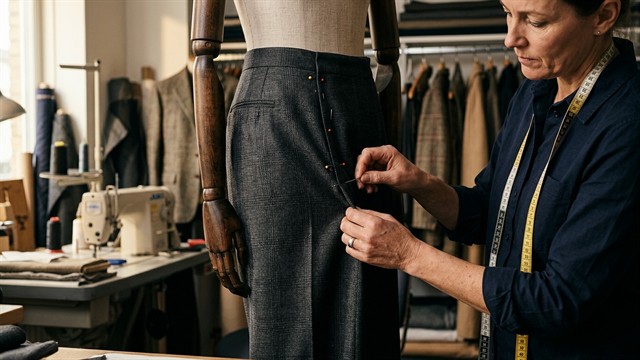
Adjusting trousers to your individual figure is one of the most important stages in the tailoring process. Even an ideal pattern, built according to standard measurements, can cause creases or tension due to the tilt of the pelvis, the shape of the buttocks or the structure of the hips. Knowledge of the main structural components and correction rules makes it possible to easily eliminate any fit defects at the fitting stage.
Contents of the article
- Typical defects in the fit of trousers and the reasons for their occurrence
- Correction of the bow line and middle cuts
- Correction for convex buttocks or flat buttocks
- How to remove folds under the buttocks and tension in the step
- Tailor advice: the important role of correct WTO before fitting
- Frequently asked questions (FAQ)
Typical defects in the fit of trousers and the reasons for their occurrence
A high-quality fit of trousers is determined by the absence of unnecessary folds, horizontal and vertical creases, as well as freedom of movement. Most problems arise at the junction of the middle and step seams.
- Slanted folds from the crotch to the buttocks:Indicate insufficient depth or width of the seat.
- Horizontal folds at the back under the belt:The reason is the excessive height of the rear middle section or peculiarities of posture (kinked figure).
- Front creases in the groin area (letter V):Arise due to insufficient length of the anterior middle cut or excess step width.
Correction of bow line and middle cuts
The bow line (front middle cut) and the rear cut form the so-called arc cut of the seat. Trying to correct the fit using only the side seams is a common mistake, which distorts the direction of the crease and throws off the balance of the trousers.
When tightening in the groin, it is necessaryto deepen and smoother the curve of the anterior middle cut. If the trousers “cut” in the back, the rear cut is released in the wedge area or its slope is increased.
Correction for bulging buttocks or flat buttocks
The shape of the buttocks directly affects the angle and length of the back seam:
- For convex buttocks:The rear middle section is lengthened at the top (raise the waist from the back) and the wedge section is pulled outward, adding width along the hip line.
- For flat buttocks:The rear middle cut is made more vertical, reducing the width of the wedge and lowering the waistline along the back.
How to remove folds under the buttocks and tension in the step
Horizontal folds under the gluteal crease indicate that the back wedge is too wide or lacks the correct shaping wet heat treatment (WHT). Reducing the width of the rear step cut at the top solves this problem without losing volume at the hips.
Tailor's advice
Never begin tailoring trousers withoutthorough wet-heat treatment (WHT) of the back halves. Pulling back the step cut and tapping the area under the buttocks creates the necessary shape even before sewing down the parts. For a quick and accurate fit, use proven ready-made patterns from our catalog with a professionally built balance.
Frequently asked questions (FAQ)
Is it possible to adjust the fit of trousers if the fabric has already been cut?
Yes, that is why when cutting new models it is recommended to leave increased allowances (2.5–3 cm) along the middle and crotch seams for possible correction during fitting.
Why do the creases on trousers go to the side when walking?
This occurs due to the displacement of the warp thread during cutting or due to incorrect joining of the step and side cuts during basting.
How to adjust a trouser pattern to fit a protruding belly?
Increase the height and curve of the front middle cut at the top, and also transfer some of the waist volume into the front pleats or tucks.
Expertly designed patterns are the key to a perfect fit of any product. To be the first to learn about the intricacies of design, modeling and trends in the sewing world, subscribe to our video channel Pattern - Ready-made patterns.
Portal Textil en Telegram
Comunidad de fabricantes textiles, modistas y diseñadores. Vacantes diarias en talleres, fábricas verificadas y contactos directos.