Every craftswoman has encountered a situation when the sewing machine suddenly starts looping at the bottom, skipping stitches, or breaking the top thread right in the middle of work. In 90% of cases, the reason lies not in a breakdown of the mechanism, but in minor settings, incorrect needle selection or threading. In this article, we have compiled a complete fault map that will help you quickly find the cause of the failure and fix it in a few minutes.
Contents of the article
- Diagnostics: 3 main symptoms and their causes
- Why does the sewing machine loop (loops from below or from above)
- Why does the machine skip stitches on knitwear and thin fabrics
- Why does the upper or lower thread break
- Summary table of faults and quick solutions
- Tailor's advice: the golden rule of customization before each project
- Frequently asked questions (FAQ)
Diagnosis: 3 main symptoms and their causes
Before turning the tension regulators or calling a repairman, it is important to correctly identify the “symptom” of the problem. Most stitching defects fall into three categories:
- Looping thread: “Beards” and loose loops are formed on the wrong side or right side of the fabric.
- Skip stitches: The stitching is uneven and individual needle punctures are missed.
- Thread breakage: The thread constantly frays and breaks in the shuttle knot or at the eye of the needle.
Why does the sewing machine loop (loops on the bottom or top)
The main law of the sewing machine: if loops form at the bottom of the fabric, the problem is in the top threading, and vice versa.
- Loops on the wrong side (bottom):The upper thread did not get between the tension dial plates. Rethread the upper thread, be sure toraise the foot(in this position the plates unclench).
- Loops on the front side (top):Loose bobbin thread tension or blockage in the shuttle case under the spring.
- Dust accumulation: Thread cuttings and dust between the tension plates prevent them from pinching the thread.
Why does the machine skip stitches on knits and thin fabrics?
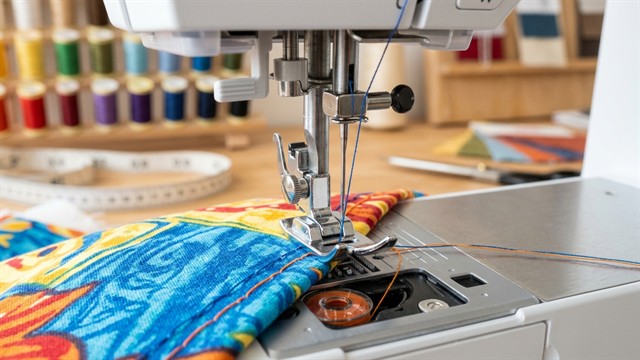
Skipping a stitch occurs when the nose of the shuttle does not have time to capture the overlap loop created by the needle as it rises.
- Wrong needle type: Attempting to sew knit or stretch fabric with a standard Universal needle. Use strictly Stretch or Jersey needles with a round tip.
- Blunt or bent needle: Even a bend in the needle that is invisible to the eye changes the trajectory of movement and leads to skips.
- Thread and needle mismatch: Thread that is too thick for a thin needle will block the formation of a loop.
- The needle is not installed all the way: Or the saw is turned in the wrong direction.
Why does the upper or lower thread break?
Constant thread breakage is the most annoying thing, but its causes are easy to eliminate:
- Tighten:The upper thread is too tight for the selected fabric.
- Burrs on the needle plate or hook:If the needle previously hit the plate, the resulting burr will fray the thread.
- Thread quality: Old cotton threads (Soviet style) or cheap reinforced threads with knots and uneven thickness.
- Incorrect bobbin threading: The bobbin is inserted the wrong way, and the thread unwinds against the shuttle.
Summary table of faults and quick solutions
| Problem | Possible reason | Remedy |
|---|---|---|
| “Beard” made from threads from below | The upper thread is threaded with the presser foot down | Raise the presser foot and completely rethread the upper thread. |
| Passes on knitwear | A universal needle is used | Install the Stretch / Super Stretch needle of the desired number |
| Frequent upper thread breakage | The needle is inserted not as far as it will go / needle thread | Replace the needle, check the installation with the long groove back/to the left |
| Pulling fabric into an accordion | Too much tension/dull needle | Loosen the tension, insert a new sharp needle (Microtex) |
| Loud knocking noise when sewing | Lack of lubrication / shuttle clogged | Clean the shuttle compartment from dust and lubricate it with machine oil. |
Tailor's advice
Make it a rule: 1 new project = 1 new needle. Needles are consumables, with a service life of 8–10 hours of active sewing. Always test the stitching on a scrap of the exact fabric you plan to sew from. And to make practicing the perfect stitch quick and enjoyable, use proven ready-made patterns with exact allowances from our catalog.
Frequently asked questions (FAQ)
How often should the shuttle compartment be lubricated and cleaned?
It is recommended to clean the shuttle compartment from dust and lint after each large product (especially when working with footer, fleece or coat fabrics). Lubricate with 1-2 drops of specialized oil - once every 1-2 months.
What number of threads and needles should I sew basic fabrics?
For most suit and dress fabrics, threads No. 40 (120) and needles No. 75–90 are suitable. For thin fabrics (chiffon, silk) - needles No. 60–70 and thin threads No. 150–180.
What to do if adjusting the tension with the wheel does not help?
Remove the top thread completely, clean the regulator with floss or a folded piece of fabric, then rethread the machine strictly according to the instructions, checking the thread movement with the presser foot raised and lowered.
Expertly designed patterns are the key to a perfect fit of any product. To be the first to learn about the intricacies of design, modeling and trends in the sewing world, subscribe to our video channel Pattern - Ready-made patterns.

Portal Textil en Telegram
Comunidad de fabricantes textiles, modistas y diseñadores. Vacantes diarias en talleres, fábricas verificadas y contactos directos.