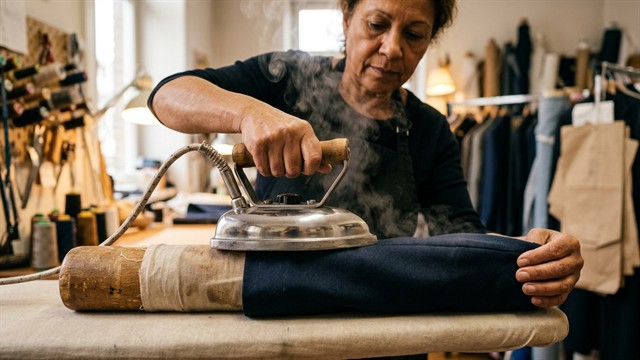
Wet heat treatment (WHT) is a fundamental stage in the creation of clothing, determining the spatial shape and fit balance of the finished product. Without proper tightening and pulling, even the most precise patterns will not provide a couture fit. In this article, we will look in detail at professional trouser leg WTO patterns, sleeve cap and shoulder knot shaping, as well as techniques for removing slack and working with pairs.
Contents of the article
- The essence of the WTO: the physics of the process, pleading and procrastination
- Full diagram of the WTO of classic trousers
- Shaping the shoulder girdle, sleeve cap and armhole
- Technology for ironing out slack and seating on convex
- Sewing equipment: pads, pillows and ironing irons
- Tailor's advice: correct temperature conditions and steam stagnation
- Frequently asked questions (FAQ)
The essence of the WTO: the physics of the process, pouting and procrastination
Wet-heat treatment is based on the property of fabric fibers to change their shape under the influence of heat and moisture, followed by fixation upon cooling and drying.
- Titting: Reducing the area of individual sections of a part to create a convexity in an adjacent section (reducing the length of the fabric while increasing its thickness).
- Pulling:Increasing the linear dimensions of a part in certain areas to obtain a concave shape or a tight fit of anatomical curves.
Complete diagram of the WTO classic trousers
WTO of trousers is carried out after stitching the darts and folds before sewing the crotch and side seams.
- Formation of the calf area: Fold the back half of the trousers inside out, combining the step and side cuts from the bottom to the knee. Tie up the slack in the calf muscle and pull out the step cut in the middle.
- Pull up the seat cut (bow seam):Pull the top of the seat cut on the back half of the trousers to create volume in the buttocks and provide comfort when sitting.
- Ironing the creases: Align the crotch and side seams along the entire length. Iron the arrows on the front and back halves from the hip line to the bottom strictly along the grain thread.
Molding of the shoulder girdle, sleeve cap and armhole
To create a three-dimensional shape of the shoulder area, special ironing pads are used.
- Tightening the sleeve cap: Two parallel lines are laid along the sleeve cap with weak tension. The threads are pulled together to the size of the armhole, and the resulting slack is ironed with the nose of the iron through a damp iron without ironing the creases.
- Shaping the armhole and shoulder: The armhole of the back is tightened in the area of the shoulder blades to prevent bristling, and the shoulder section is pulled back for a perfect fit to the shoulder joint.
Technology for ironing out slack and seating on convex areas
When removing slack (for example, at the ends of darts or on the bulge of the chest), the iron is moved from the periphery in a circular motion to the center of the slack.
Excess fabric is gently pressed under the influence of steam, turning into a smooth, voluminous surface without folds or pinches.
Sewing equipment: pads, pillows and ironing irons
High-quality WTO is impossible without special tailoring equipment:
| Tool / Shoe | Purpose | Features of application |
|---|---|---|
| Tailor's Ham | Molding of chest darts, roundels, hip darts | Egg-shaped, covered in cotton and wool |
| Seam Roll | Pressing seams on sleeves and trousers | Prevents seam allowances from printing onto the front side |
| Block “Iron” (Tard) | Cooling and fixing creases, folds and seams | Made from hard wood (beech, oak) |
| Ironing machine | Protecting fabric from lass (shine) and opals | White calico, see-through cotton or linen |
Tailor's advice
The main secret of clear creases and flat seams is using a wooden fixing iron. Immediately after steam is applied, press the hot joint with a flat wooden block for 5-10 seconds. The wood will instantly absorb moisture and fix its shape. And proven ready-made patterns from our catalog will help you sew products with an ideal structural balance.
Frequently asked questions (FAQ)
How to get rid of lass (shiny iron marks) on fabric?
You can remove the resulting lashes by steaming by weight through a cloth soaked in a weak solution of vinegar (1 tablespoon per glass of water), or using a soft brush.
Can synthetic fabrics be ironed?
Synthetics (polyester, nylon) are difficult to iron and stretch, since their fibers are thermoplastic. Work at minimal temperatures and rely primarily on precise cuts and design darts.
What is the difference between pressing and pressing seams?
Ironing is the process of spreading seam allowances in different directions and fixing them. Ironing - placing both seam allowances on one side.
Expertly designed patterns are the key to a perfect fit of any product. To be the first to learn about the intricacies of design, modeling and trends in the sewing world, subscribe to our video channel Pattern - Ready-made patterns.