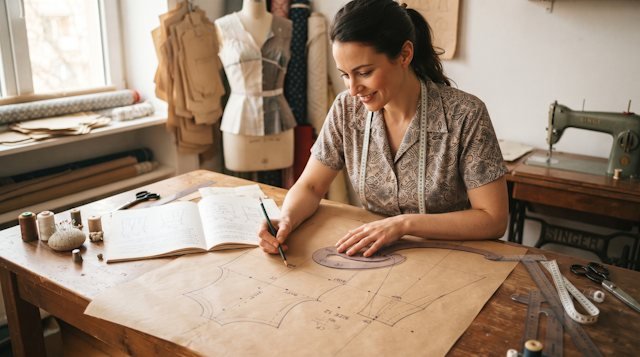
Every flawlessly fitted and elegant garment begins not with luxurious fabric, but with a meticulously drafted basic pattern sloper (block). A sloper serves as your personal architectural blueprint — a flat two-dimensional template engineered to reflect your individual posture, body contours, and natural proportions with millimeter precision. With a tested sloper block in your toolkit, you can effortlessly manipulate and draft hundreds of custom garments, from sleek pencil skirts and tailored shirts to evening dresses and structured coats. In this master guide, we break down essential measuring principles, draft setups, and toile fitting essentials.
1. Preparation: Drafting Tools and Flawless Measurements
Precision pattern drafting demands specialized tools:
- Measuring Tape: a fresh fiberglass tape that has not stretched out over time;
- Drafting Paper: metric gridded paper (millimeter grid), heavy Swedish tracing paper, or 80 gsm craft paper roll;
- Rulers and French Curves: long clear acrylic or metal grading ruler (80–100 cm), L-square (90° tailor's square), styling design curve, and armhole curve rulers;
- Marking: fine 0.5 mm mechanical pencil (HB/2H) and non-abrasive eraser.
Golden Rules of Body Measurements:
- Waist Reference Ribbon: tie an elastic cord around the natural waist level horizontally to ground level — this serves as the foundational zero-datum line for all vertical balance heights;
- Natural Posture: measure over seamless foundation garments in your everyday relaxed posture, without holding your breath or pulling your stomach in;
- Core Girths: Bust Circumference (across bust apex points), Waist Circumference, and Full Hip Circumference (accounting for abdomen prominence);
- Vertical Balance Lengths: Back Waist Length (Nape to Waist) and Front Waist Length (Shoulder Neck Point over apex to waist);
- Widths: Across Back (between armscye crease lines) and Across Front Chest;
- Bust Height: distance from the side neck point straight down to the bust apex.
2. Step-by-Step Drafting: Skirt, Bodice, and Trouser Blocks
Select your foundational drafting project:
A. Straight Skirt Block
The optimal starting point for novice patternmakers to understand dart intake distribution:
- Framing Grid: draw a 90° right angle. Plot total skirt length vertically, and half hip circumference plus wearing ease (Hip Ease = 1–2 cm) horizontally;
- Hip Level: drop 18–20 cm down from the waistline to establish the hip landmark line;
- Dart Distribution: calculate waist-to-hip difference. Allocate 50% into the side seam contour, 30% into the back dart, and 20% into the front dart for clean contouring.
B. Basic Bodice Block
A multi-dimensional block that shapes chest contours and armhole curves:
- Baseline Grid: built upon half bust girth plus design ease (Bust Ease = 3–5 cm for semi-fitted silhouette), allocating width across back, armhole width, and front chest;
- Bust Dart Intake: mathematically determined by cup size difference between high bust and full bust. The dart apex aims toward the bust point, ending 1.5–2 cm short of apex for smooth contouring without conical peaks;
- Armscye and Shoulder: draw a smooth elliptical curve connecting back and front shoulder slopes, checking front and back pitch balance.
C. Basic Trouser Block
Consists of front and back leg panels. Drafted from crotch depth (rise), knee height, hip girth, and ankle opening width. Proper shaping of the front fly curve and back seat seam curve ensures complete sitting and walking comfort without drag lines.
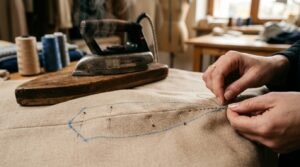
3. Mockup Toile: Why First Fitting Cannot Be Skipped
Two-dimensional paper drafts behave differently when draped over anatomical curves. Seasoned designers and ateliers always sew a toile (muslin mockup) prior to cutting precious final fabric:
- Cut from Inexpensive Muslin: trace the draft onto medium-weight unbleached cotton calico with 1.5 cm seam allowances;
- Baste Seams: machine-stitch darts and structural seams with a wide basting stitch (4 mm) without backtacking;
- Live Fitting: try on the toile with seams facing outward. Verify waistline levelness and shoulder balance. Pinch out excess fabric or release tight spots with dressmaker pins directly on the body;
- Transfer Adjustments: mark pin adjustments with a colored pencil, unpick the muslin, and mirror all corrections onto your master paper pattern.
Always preserve your verified basic slopers onto heavy tagboard or plastic pattern film without seam allowances or style lines. This master sloper serves as your permanent foundation for limitless creative styling: slash-and-spread techniques, dart manipulation into princess seams, yoke additions, and gathers.
Sew with Joy Using Precision Patterns!
Browse the Vykroyka catalog for professional digital sewing patterns featuring detailed illustrated construction guides.
Explore Pattern Catalog