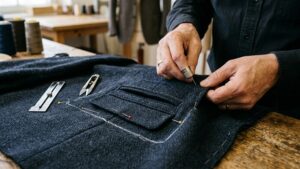
In the 3rd part of the video course on creating a bomber jacket, we assemble the base of the product with a comfortable anatomical cut of the raglan sleeves. You will learn how to accurately align raglan lines along the front and back, perform decorative stitching on raglan seams using a flat-stitch or straight-stitch machine, and connect the side sections of the jacket and sleeves with a single continuous seam.
Contents of part 3 of the video lesson
- 1. Features of the raglan cut: freedom of movement and fit over the shoulders
- 2. Aligning control marks and stitching raglan lines on a 4-thread overlock
- 3. Decorative topstitching of raglan seams for the width of the foot (0.5–0.7 cm)
- 4. Stitching the side sections of the front/back and sleeve seams with a single seam
- Designer's advice: how not to stretch the inclined sections of raglan when assembling
- Frequently asked questions (FAQ)
1. Advantages of raglan sleeves
The raglan cut does not have a hard shoulder point, so the bomber fits perfectly on any shoulder width and allows you to wear a voluminous hoodie or sweater underneath.
2. Sewing raglan
The front part of the sleeve is stitched to the front flange, the back part to the back. When stitching on an overlocker, the cuts are not stretched, the differential is adjusted to a neutral or slightly seated position (1.05–1.1).
3. Finishing stitches
Raglan seam allowances are pressed onto the sleeve or body and topstitched with a thick stitching thread (#30 or #40).
4. Single side seam
The side seams and sleeve seams are pinned in the armpit area, aligning the overlock seams “into a lock”, and sewn down in one pass.
Advice to the master
When matching seams in the armpit, direct the seam allowances in opposite directions (one forward, one back) - this will ensure zero thickness and a perfect intersection of the seams. And you can download patterns for a bomber jacket with raglan sleeves in the catalog ready-made patterns.
Frequently asked questions (FAQ)
Do I need to duplicate raglan sections?
Only if the knitwear is very loose and stretches strongly along the bias cut (the adhesive edge is laid along the allowance).
What stitch length should I use to topstitch the footer?
The optimal stitch length for decorative stitching of dense footer is 3.5–4.0 mm.
Expertly designed patterns are the key to a perfect fit of any product.
For other designs of warm shoulder clothing, see the section patterns of sweatshirts, hoodies and sweaters.
To be the first to learn about the intricacies of design, modeling and trends in the sewing world, subscribe to our video channel Pattern - Ready-made patterns.